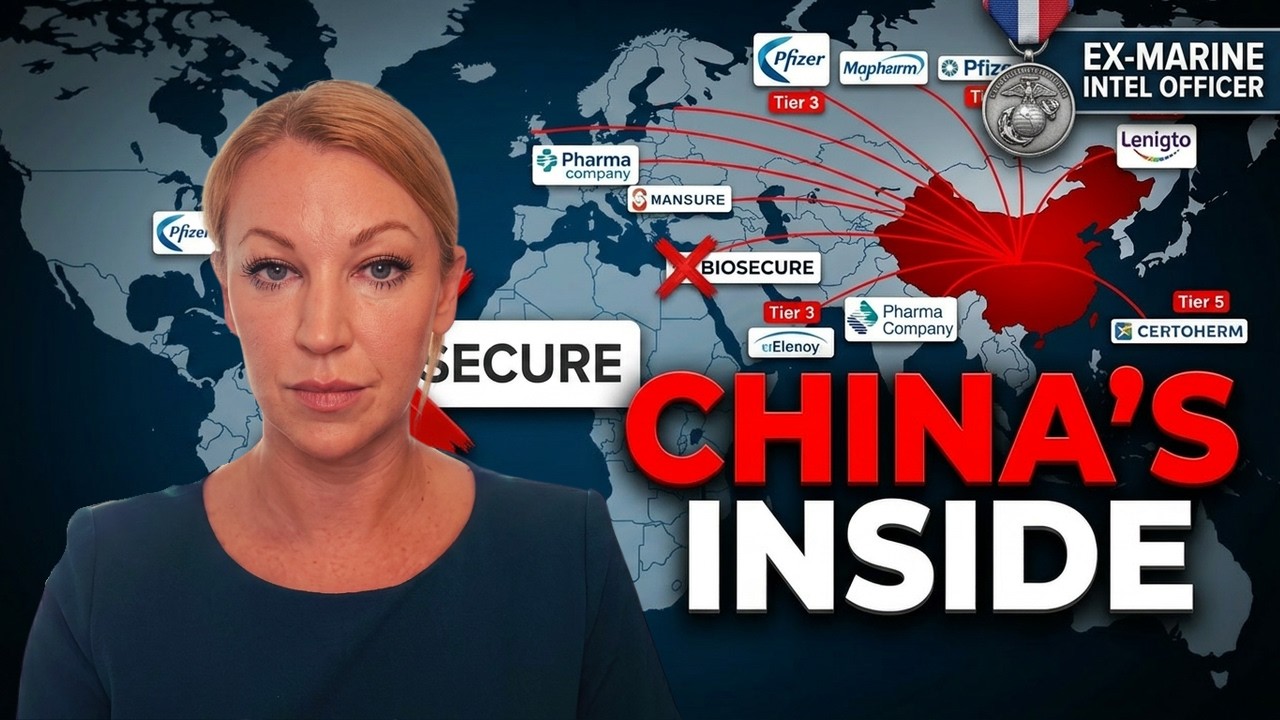
Theresa Campobasso, Ex-Marine Intel Officer, on Why BIOSECURE Won’t Protect Pharma From China
What you’ll learn
- Why the real China risk hides in tiers three to five of the supply chain, not the company you vet
- Why standard third-party due diligence stops too early, and what to do instead
- How AI and modern data make sub-tier supply-chain mapping solvable today
- What the Uyghur Forced Labor Prevention Act demands of your sourcing
- Why the BIOSECURE Act alone won't protect pharma: the commercial-channel gap
The BIOSECURE Act was written to keep Chinese biotech out of the U.S. pharmaceutical supply chain. In the first episode of Open Door Salon’s series on China and the life sciences, Theresa Campobasso, senior vice president at Aardwolf Global Solutions and a former U.S. Marine Corps intelligence officer, explains why the law leaves a door wide open, and where the real risk actually lives.
Most companies run a third-party check on a new partner, clear it, and move on. That, Campobasso argues, is exactly where the risk begins. Obfuscated state ownership, Chinese government and military presence, and hidden foreign ownership, control, and influence tend to sit in tiers three through five of the supply chain, below where almost anyone looks. Mapping only the first tier leaves the rest invisible.
She and host Lori Ellis trace the full picture: intellectual-property and patent theft, forced-labor exposure under the Uyghur Forced Labor Prevention Act and the “trust but verify” discipline it demands, and the BIOSECURE Act‘s commercial-channel gap. The law binds federal contractors and a short list of named companies, but a private pharmaceutical company can still license molecules, co-develop IP, and run discovery on Chinese AI platforms untouched by it. They also read the geopolitics: how the war in Iran and the closure of the Strait of Hormuz are handing China an opening on energy security.
The close is the hopeful one. Mapping a supply chain down to the raw material is possible today in a way it was not five years ago: big-data tools plus generative and agentic AI can surface hidden connections across vast datasets at a scale and speed no human team could. The problem is solvable, and the question is answerable.
For the investment-side counterpart to the BIOSECURE procurement rules, see What Is the COINS Act?, the outbound investment law a House bill would extend to U.S. capital and licensing deals with Chinese biotech.
It really leaves the door open for a private... pharmaceutical company... that doesn't have federal contracts... none of that right now is touched by BIOSECURE.
Key takeaways
- The risk isn't the company you vet, it's the suppliers beneath it. First-tier diligence looks clean; tiers three to five are where hidden state and military ownership live.
- Standard third-party checks stop too early. A box-checked vendor questionnaire never maps the sub-tier network where the real exposure sits.
- Sub-tier mapping is solvable now. AI and modern data sets surface hidden connections at a speed no human could five years ago.
- COVID reframed supply chain as national security, not a procurement or cost-optimization exercise.
- 'China is the only source' is usually an assumption, not a finding. Test it before you accept the risk.
- UFLPA puts the burden on you. You must verify provenance; trusting a supplier's word can mean seized goods, fines, and reputational damage.
- The Strait of Hormuz closure is an opening for China, trading energy-security help for economic and political leverage.
- BIOSECURE only covers federal contractors. A pharma with no federal contracts can still license from any Chinese biotech, co-develop IP, or use a Chinese AI platform, none of it touched by the law.
Key Questions, Answered
Where does the US-China relationship stand for the life sciences?
I've heard it described as everything from economic competitors to frenemies... there are kind of three big areas... genomic sequencing... synthetic biology, and then API or pharmaceutical precursor manufacturing.
The competitive and security dynamics concentrate in three biotech arenas: genomic sequencing, synthetic biology, and API/precursor manufacturing.
What are the biggest risks for life sciences working with China?
there are patterns and trends around things like intellectual property theft or some challenges around hidden or obfuscated state ownership in private companies that is fairly common in China.
The open, collaborative culture of emerging science collides with documented IP-theft patterns and hidden state ownership.
Why isn't standard third-party due diligence enough?
We do a great job around assessing the risk environment for the third party itself, but oftentimes we stop there because we're so excited to do this research... we're not mapping our subtier supplier network.
Most diligence stops at the first-tier company; the real exposure sits deeper in the chain.
Where does the hidden risk actually live in the supply chain?
tiers three to five are where you're going to find obfuscated state ownership or Chinese government presence, Chinese military technology presence, and maybe some hidden... foreign ownership, control, and influence.
The first-tier vendor can look clean while tiers three to five hide state and military ties (FOCI).
Can a company actually map its sub-tier supply chain today?
it is possible to do this today in a way that was not possible even five years ago... you can take these huge data sets and... pull out these hidden trends. You can identify these connections at a scale and at a volume and at a speed that a human being previously wouldn't be able to do.
AI plus modern, redundant data sets make sub-tier mapping solvable now, not five years ago.
How did COVID change how we think about supply chains?
before that point in time supply chain was typically seen as really just an acquisition or procurement or an optimization exercise. It wasn't really seen as a security equity... people can clearly see why supply chain is a national security issue.
COVID flipped supply chain from a cost-and-procurement exercise into a recognized national-security issue.
What does the Uyghur Forced Labor Prevention Act mean for sourcing?
it's prohibited right now in the United States to do business with a company that uses forced labor from the Xinjiang region of China... You have to understand that provenance... You need to trust but verify.
UFLPA bans Xinjiang forced-labor inputs and puts the burden on you to verify provenance, or face seizures, fines, and reputational damage.
Is China really the only source?
I would test that assumption... Is that true that this Chinese organization is the only source for this material? It's the only source for this type of research... there's been a proliferation of innovation to get away from some of those bottlenecks.
'China is the only source' is usually an unverified assumption worth challenging before you accept the risk.
How is the Iran war and the Strait of Hormuz benefiting China?
China has been able to jump into a void around energy security that has been created by the closure of the straight of Hormuz... and the war in Iran... They're generating a lot of not just social capital, but economic leverage.
With the Hormuz closure, China is filling the energy-security void and trading help for leverage with regional partners.
Why won't the BIOSECURE Act fully protect pharma from China?
the biosecure act is talking about... federal organizations definitely may not do this, but it... really leaves the door open for a private... pharmaceutical company... that doesn't have federal contracts... and none of that right now is touched by biosecure.
BIOSECURE restricts only federal contractors. The commercial channel stays open, which is why the Act alone won't protect pharma.
Resources
- BIOSECURE Act (enacted) Section 851 of the FY2026 NDAA (S.1071, 119th Cong.); restricts federal contractors only
- Uyghur Forced Labor Prevention Act (UFLPA) bars goods made with forced labor from the Xinjiang region; US Customs and Border Protection enforcement
- The three competitive arenas genomic sequencing, synthetic biology, and API / pharmaceutical-precursor manufacturing
Need the life-sciences signal but short on time?
Get the free quarterly briefing: every guest from the quarter, in one sitting. What decides whether a therapy reaches a patient, gets funded, and can be trusted.