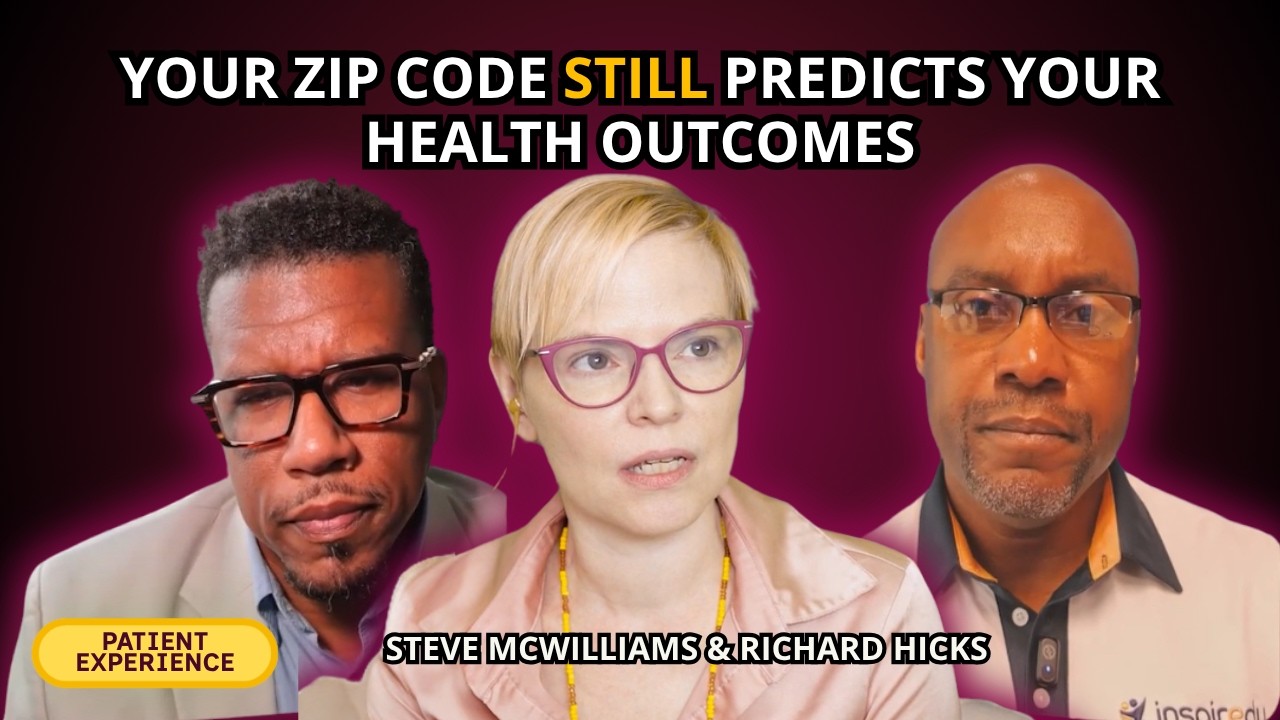
“AI Won’t Cut Corners” | A Hospital CIO and Community Advocate on the Digital Divide | McWilliams & Hicks
What you’ll learn
- Why trust, not bandwidth, is the first thing a patient withholds
- What a technology desert is, and why closing a rural pharmacy makes it a health problem
- How hospitals are handling consent for ambient AI in the exam room, and what is still unsettled
- Why ransomware is now being tracked against patient deaths, not just downtime
- Why the silver tsunami will not be solved by AI, and what it will be solved by
Georgia’s hospitals are adopting digital tools about as fast as a regulated industry can. Patients still say they cannot get to their doctor. This episode is about the space between those two facts, and neither guest puts the blame on the technology.
Steven McWilliams is VP and CIO at the Georgia Hospital Association, an organization whose job, in his words, is to “advocate, educate, and communicate with the goal of shaping a healthier Georgia.” He also sits on the Georgia HIMSS board. His remit runs from cybersecurity to the operational reality that a hospital can be full and still be losing money.
Richard Hicks is CEO of Inspiredu, a nonprofit providing equitable access to technology, training, and broadband education in underserved communities. He worked in technology for years before moving to the nonprofit world in 2007, driven by a family mission of service. He frames the work around kitchen table items, the things a family actually talks about over dinner, rather than nice-to-haves.
Trust comes before technology
Asked where the disconnect sits, McWilliams does not start with infrastructure. “Over the years, there have been challenges around people trusting the system,” he says, and he keeps returning to that word. Technology plays a role, but “it’s not so much of a clinical issue, it’s a humanity issue.”
The order matters to him. “Part of a healthy relationship is some level of transparency,” he says. “And you can’t be transparent if you don’t trust the person.” A patient who does not trust the system withholds, and a system working from withheld information delivers worse care, which justifies the withholding.
Privacy is where the loop tightens. “If I share something with you and you can’t protect that secret,” he asks, “how am I going to trust you?” And where a person lives still shapes what they get. He cites a framing he has heard from others: “your zip code, where you live, that could dictate your future.” In health care that is a prediction about outcomes, and it costs most for patients who cannot navigate the system by knowing someone inside it.
Technology deserts, and why connectivity is not a nice to have
Hicks works the other end of the same problem. “We have technology deserts in the state of Georgia, and we’re trying to see how we can bridge those gaps,” he says. Infrastructure money is moving at both the state and federal level, but money laid in the ground does not teach anyone to use what it carries.
He rejects the framing of broadband as a convenience. “It is kind of like breathing,” he says. His example is not telehealth but pharmacy: branches keep closing in rural communities, and a patient who cannot get online cannot order the medication a closing branch used to dispense. A household without connectivity simply absorbs that loss.
Both guests land on shared responsibility rather than a single culprit. “Everyone has to have a stake in it,” Hicks says. “It’s almost like buying stock in a company.” McWilliams turns the same point into a warning: “One of the misnomers is that one particular group is going to solve the whole problem.” The pattern holds anywhere a system expects patients to complete a journey it never designed for them.
Consent is the unsettled question in clinical AI
The most common clinical use of AI right now is not diagnosis. McWilliams identifies it as “artificial intelligence that we’re seeing more recently is around ambient listening” in the exam room, and the questions it raises are procedural rather than technical. Is the visit recorded or only transcribed? What happens to the audio afterward?
He walks through the practical version. “Can we put a just a little sign on the wall and just assume” consent has been given by walking in, or does the clinician have to ask on the record? Then the harder one: “How many times do you need to get consent? Once you capture it, do you need to get consent at the next use case.” He calls consent capture “a hot topic” rather than a solved problem.
The safeguard he insists on is the one easiest to quietly drop. “We need to keep the human in the loop,” he says. The physician still has to confirm “that what was captured, what has been documented is accurate.” That is the failure mode that sinks large institutional AI projects: the tool works, and the process around it was never built.
Check the bag before you drive off
Hicks teaches the patient-side version of the same discipline. When an order comes through a drive-thru window, “you going to go in and check the bag to make sure you got everything.” AI output deserves the same reflex. “Double check your homework, double check your information,” he tells the people his organization trains.
He is careful not to teach fear instead. The point is to be “mindful of the information that you received,” in the way a patient reads the side effects on a medication and then still takes it. Risk gets named and put in proportion, never used to talk someone out of a resource they need.
The savings nobody is measuring
McWilliams makes the sharpest point of the conversation, and it is a question rather than a claim. The case for ambient documentation is that clinicians spend less time typing and go home earlier. He accepts the logic and then asks whether anyone has checked. “Are physicians and our medical professionals, are they spending less time because of these tools being put in place? I think we assume it, but are we measuring for that?”
That gap between promise and lived result runs through the patient experience too. He describes portals that require navigating several systems to find one result, and forms that ask the same questions repeatedly. “It’s a little bit of a conflict of trying to reconcile what is being said versus what’s being lived.”
Ransomware is now a patient-safety problem
On cybersecurity, McWilliams is direct about how far the stakes have moved. “We are now seeing hospitals that have had ransomware attacks close,” he says. “I’ve seen a metric recently that’s now tracking ransomware events to patient deaths. This is unprecedented times.”
The response he describes is unglamorous and mostly rehearsal. He has helped run tabletop exercises around the state so organizations practice before a crisis, on the same logic as a fire drill, and hospitals are working through the cross-sector cyber performance goals published for critical infrastructure. He is honest about the ceiling on all of it: “You can do everything right and still something bad happens.”
The ransom question is where leadership gets tested. His preference is to make paying unnecessary rather than to moralize about it, because incentives drive volume. If hospitals can be given options “so that they do not have to pay, then that disincentivizes the effort from the bad actor.” The same economics govern how attackers pick targets across life sciences, where the newest science draws attention rather than the weakest defenses.
What a breach feels like from the other side
Hicks handles the aftermath in the community. What he sees is not outrage but anxiety, and a confidence level that drops each time. He describes the problem as keeping “people to stay confident when the system can sometimes show let downs.”
His counterintuitive point is that notification helps. “Not knowing is horrible,” he says. A letter confirming that data was exposed is unwelcome, but it proves someone is working the problem, and silence proves nothing. What is at stake justifies the discomfort: “Their medical information is sacred to them. They want to be able to make sure that no one else has that.” The discipline he draws from it is to name real risk without inflating it, and above all to “not oversell and under deliver.”
Consistency over confetti
Asked what would close the gap fastest, Hicks does not name a technology. “We got to maintain some consistency and not put no barriers up,” he says. Communities have watched initiatives arrive and leave. Return after two years and “expect people to still pop confetti and be ready to take what you’re offering, that’s not going to be the case.” By then “they’re going to look at you as a snake oil salesman.”
McWilliams reaches the same conclusion from the hospital side. “We have to communicate beyond the clinic,” he says, because “this is a matter of relationships” rather than transactions. His picture of what good looks like is unremarkable and still far off: get seen “in a timely manner and get accurate results,” and have the referral already hold everything the next provider needs. “We can get to be from reactive to proactive. We can get to value-based care versus fee-for-service.”
Behind all of it sits the demographic wave he calls the silver tsunami. More people are aging into the bracket that consumes the most care, and the workforce to serve them does not exist. “We’re hoping that AI is going to come bail us out. But I’m going to tell you right now, I don’t believe AI is a shortcut.” What it will do is speed up work that already functions. “It’s not going to allow us to not do the things that are required in order for us to deliver the care that people deserve.”
His warning is about the temptation rather than the tools: that we “over rely and under commit and cut corners because the technology hype is there.” His standard for the whole system comes from a line he adapted out of education. There they said enter to learn, depart to serve. In health care, “you come in to heal and depart to be well.”
It's not so much of a clinical issue, it's a humanity issue.
Key takeaways
- Trust is upstream of every other fix. Steven McWilliams argues a patient will not be transparent with a system they do not trust, and a system working from withheld information delivers worse care.
- Broadband is infrastructure, not convenience. Richard Hicks calls connectivity a necessity on the order of breathing, because rural pharmacy closures make online ordering the only route to a prescription.
- Infrastructure money does not teach anyone to use it. State and federal projects are laying capacity into technology deserts, but education has to travel with it or the capacity sits unused.
- Ambient listening is the live AI use case, and consent is unresolved. Whether a sign on the wall counts, and whether consent renews at each new use of a recording, are open questions.
- Nobody is measuring the time savings AI was bought for. McWilliams accepts the logic that documentation tools reduce clinician hours, then asks whether anyone has checked.
- Ransomware has crossed into patient safety. Hospitals hit by attacks are closing, and McWilliams cites a metric now tracking ransomware events against patient deaths.
- Notification is a trust builder, not just a legal duty. Hicks finds that a breach letter lands badly but silence lands worse, because patients treat their medical information as sacred.
- Consistency beats campaigns. A program that arrives, leaves, and returns two years later reads to a community as a sales pitch rather than a service.
- AI augments, it does not cut corners. The workforce gap behind the aging population is real, and McWilliams rejects the idea that generative tools let anyone skip the work.
Key Questions, Answered
Why don't patients trust digital health systems?
Over the years, there have been challenges around people trusting the system... whether it's just fear that the system is going to do what it says it's going to do, or just fear that the reality of life, you may not want to hear it.
Steven McWilliams puts trust ahead of technology as the reason patients disengage, and traces it to fear on two sides.
What is a technology desert?
But we have technology deserts in the state of Georgia, and we're trying to see how we can bridge those gaps... What has to happen is we've got to educate the folks more on how to get to these resources, especially when the resources may not be in their community.
Richard Hicks describes areas where connectivity and the services that depend on it are simply absent, and where education has to arrive alongside infrastructure.
Whose responsibility is it to close the digital divide in health care?
I think everyone has to have a stake in it. It's almost like buying stock in a company, so that you can see it flourish.
Hicks rejects a single owner for the problem and frames participation as shared investment across community, hospitals, and industry.
Is the digital divide a technology failure?
it's not so much of a clinical issue, it's a humanity issue. We are needing to interact with one another from a human perspective... part of a healthy relationship is some level of transparency. And you can't be transparent if you don't trust the person.
McWilliams locates the failure in the relationship rather than the tooling, and makes transparency conditional on trust.
How does a patient's zip code affect their health outcomes?
your zip code, where you live, that could dictate your future. And so, imagine how that impacts your health care outcomes. Imagine how that impacts your experience interacting with the health care system.
Geography predicts more than access in McWilliams's framing. It predicts the quality of the entire encounter with the system.
Can one organization solve the health care access problem alone?
one of the misnomers is that one particular group is going to solve the whole problem. It's not going to just be this over here or that group over there in a silo. It's going to take us coming together.
McWilliams names the assumption that a single actor closes the gap, and argues partnership is the only structure that moves it.
How should patients check what an AI tool tells them?
double check your homework, double check your information... you going to go in and check the bag to make sure you got everything.
Hicks teaches AI validation with a drive-thru analogy: confirm the output before you act on it.
How many times does a patient need to consent to AI recording a visit?
how many times do you need to get consent? Once you capture it, do you need to get consent at the next use case of that recording or transcription?
McWilliams lays out the unresolved mechanics of consent for ambient listening, including whether it renews at each downstream use.
Is AI actually saving clinicians time?
Are physicians and our medical professionals, are they spending less time because of these tools being put in place? I think we assume it, but are we measuring for that?
The case for ambient documentation rests on reclaimed clinician hours. McWilliams accepts the logic and questions whether the result is being measured.
Should patients want to be notified about a data breach?
you don't want to sit there and have your information just put out there and they're not notifying you that they've had a breach... Their medical information is sacred to them.
Not knowing is the worse outcome, Hicks argues. Disclosure protects trust better than silence, because patients treat medical data as sacred.
Are ransomware attacks on hospitals affecting patient outcomes?
we are now seeing hospitals that have had ransomware attacks close. I've seen a metric recently that's now tracking ransomware events to patient deaths. This is unprecedented times.
McWilliams marks the point where hospital cybersecurity stopped being an IT concern and became a patient-safety one.
What actually builds trust in an underserved community?
we got to maintain some consistency and not put no barriers up. We got to treat it in a way like it's a just a normal thing that people should have.
Hicks puts consistency above programming. Initiatives that arrive and disappear teach a community not to engage with the next one.
Will AI solve the health care workforce shortage?
I don't believe AI is a shortcut. Some people talk as if the generative AI tools that we see today is going to allow us to cut corners and do skip the process. I just don't believe that's what that's going to do.
With an aging population and no workforce to match it, McWilliams rejects AI as a way out and casts it as augmentation only.
Resources
- Georgia Hospital Association Steven McWilliams's organization, advocating and educating on behalf of Georgia's hospitals.
- Inspiredu Richard Hicks's nonprofit, providing technology access, training, and broadband education in underserved Atlanta communities.
- Georgia HIMSS The state chapter of the Healthcare Information and Management Systems Society, where McWilliams sits on the board.
- CISA Cross-Sector Cybersecurity Performance Goals The cross-sector baseline practices for critical infrastructure that McWilliams refers to as the cyber performance goals.
- Steven McWilliams on LinkedIn VP and CIO, Georgia Hospital Association.
- Richard Hicks on LinkedIn CEO, Inspiredu.
Need the life-sciences signal but short on time?
Get the free quarterly briefing: every guest from the quarter, in one sitting. What decides whether a therapy reaches a patient, gets funded, and can be trusted.