
Should Startups Put AI in Their Pitch Deck? A CEO Says No
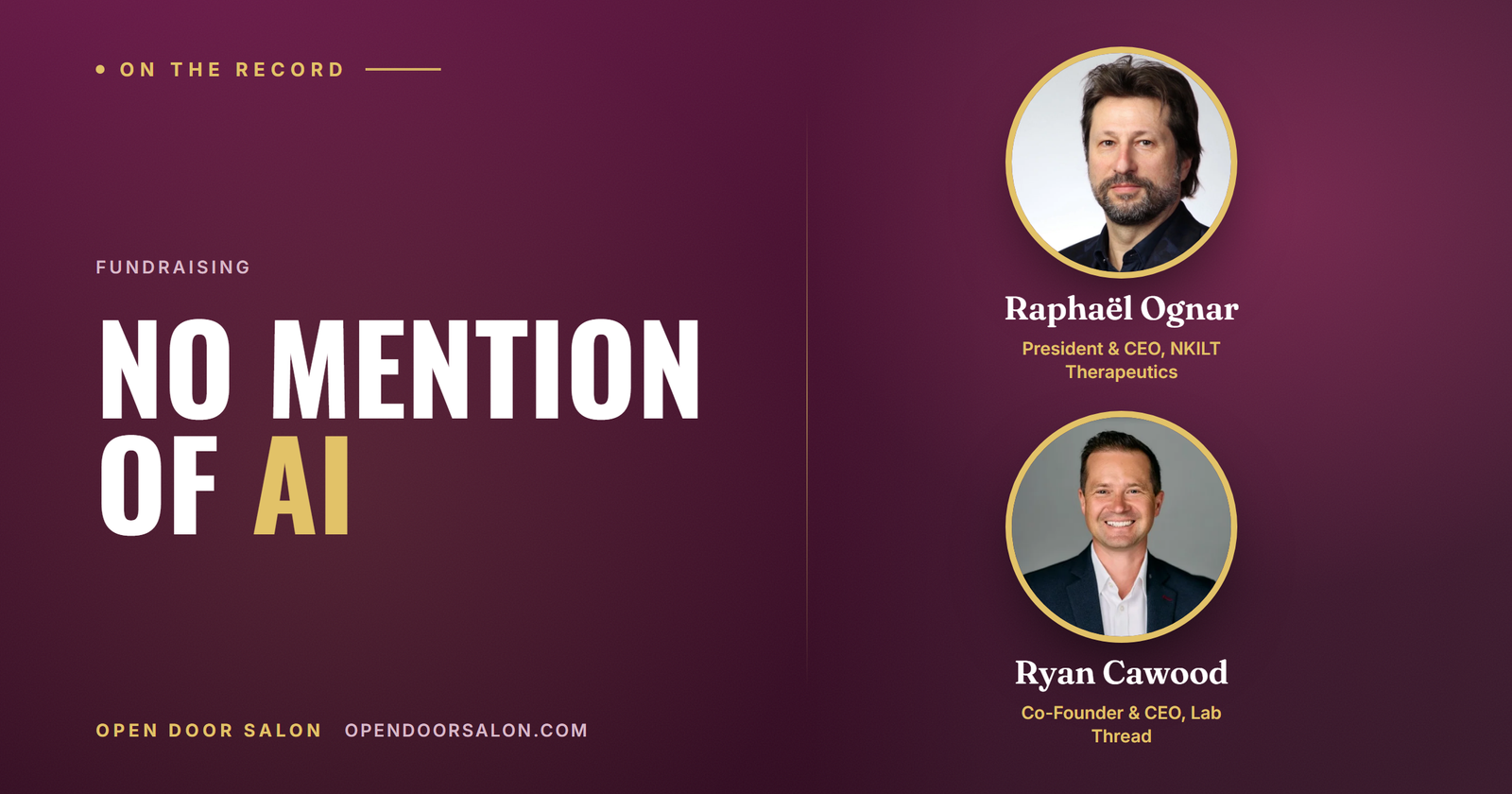
Raphaël Ognar is raising money for a biotech in a market where investors expect to see AI in the deck, and his deck does not mention it once. He is President, CEO, Co-Founder and Chairman of NKILT Therapeutics, the company uses AI in its workflow, and people keep telling him to say so.
my pitch deck for example doesn't have one mention of AI and everybody's telling me you need to put AI in your pitch deck
He is aware this costs him something. He describes the position as old-fashioned and possibly naive, and holds it anyway, which makes the reasoning worth understanding whether or not you would make the same call.
Why leave it out if you actually use it?
Because in his view the claim does not survive contact with anyone who asks a second question.
when you want to use AI you don't need to claim it
His argument is that a company genuinely using AI well shows it in how the work gets done, and a company that is not shows it the moment anyone asks a second question. Putting the acronym on a slide signals membership rather than capability, and it invites exactly the diligence question you would rather answer with a result.
Underneath that sits his broader read of the moment, which is that a great deal of what is being built is designed around extraction rather than outcome. A founder who believes the enthusiasm is partly a bubble has a straightforward reason not to price his own company into it, an argument we look at in why AI is so expensive to run, and who pays for it.
What is the alternative test?
Ognar replaces the question entirely. Instead of asking whether the company uses AI, he asks what adopting it changes.
His framing is to go back to the basics of building a business: what is the goal, how do we achieve it, and is there a way to do it better, faster and more effectively. AI is a candidate answer to that question rather than an answer in itself. He is convinced it can help, and equally convinced it should be used for what it is needed for, not for everything.
Does the same logic apply to a product?
Ryan Cawood, Co-Founder and CEO of Lab Thread, arrives at the same place from the builder's side, and his version has a sharper edge.
I'm very anti- AI for the sake of AI
His illustration is one every reader has now experienced. Software has started rewriting his email whether or not he asked it to, and he points out that the behavior would be intolerable from a person.
it would be the most annoying colleague on the planet that wants to rewrite every single one of your emails
The distinction he draws is availability versus imposition. He used to ask a colleague to proofread an email when he was unsure of one; he did not want a colleague standing over his shoulder rewriting all of them. His test for his own product follows from that.
where does it actually add meaningful value to you on a day-to-day basis
Where does AI genuinely earn its place?
Cawood is specific rather than abstract, and the example is deliberately mundane.
nobody likes writing protocols. Everybody's always hated it. It's a really boring task.
Generating a protocol is a task nobody enjoys, that has a well-defined structure, and where the human reviews and adjusts rather than accepting blindly. That is the shape of a good application: a real chore, a checkable output, and a person still in the loop. It is the same standard that decides where the review layer belongs when the stakes are regulatory, which we cover in who is liable for AI mistakes in drug development.
His prediction is that the market moves this way on its own. The current phase, where AI is inserted into everything because it can be, gives way to one where it appears when it is needed. That has a side benefit he credits to Ognar: software that is not silently processing every email you write is also not spending energy on work nobody asked for.
What should a founder actually do with this?
The practical translation is not "leave AI out of your deck." It is that the acronym is not the asset. If AI materially changes what a company can do, that shows up as a capability, a cost structure or a timeline, and those are the things a deck should carry. If it does not change any of those, the slide is decoration and a good investor treats it as such.
Ognar is testing that view with his own fundraise. He may be wrong about the market. He is not confused about the tradeoff, and he is prepared to be judged on the result instead of the claim. The habit of asking for the result rather than the claim is the same one that makes AI usable in the lab at all, which is the subject of how to prompt AI for scientific research.
The convener's read
Two founders who build with AI, in a market that rewards saying so, have both declined to lead with it. That is not skepticism about the technology. It is a bet that the signal is about to invert, and that in a year or two the companies making the loudest AI claims will be the ones asked hardest to prove them. Whether that bet is right is a genuinely open question, and it is the most testable thing either of them said.
The full conversation is on the episode page, along with more from Ryan Cawood and Raphaël Ognar. If your organization wants to reach the people making these calls, partner with Open Door Salon.
Methodology: every quotation above is drawn verbatim from the recorded, on-the-record conversation between Ryan Cawood, Raphaël Ognar and host Lori Ellis on Open Door Salon, and was checked against the episode transcript before publication.