
How Many Pitches Do VCs Review Before Investing?
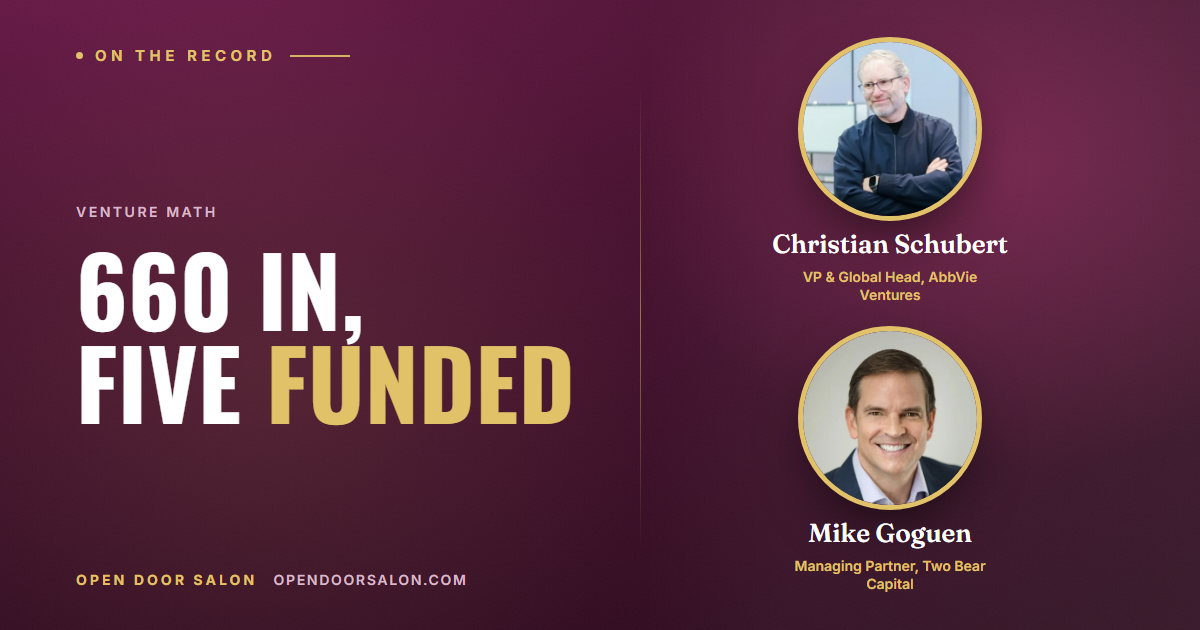
A corporate venture fund in biotech can review about 660 investable opportunities in a year and make five new investments. That is the number Christian Schubert, VP and global head of AbbVie Ventures, gave on Open Door Salon. The wider funnel is larger still: his organization looks at thousands of opportunities across every stage, from early idea through acquisition. About 660 is the subset where his team believes an investment case can be made at all. Five is what survived. For a founder, where the rest fall apart matters more than the headline ratio. Most are decided quickly, for reasons that have nothing to do with how the pitch was delivered.
How many opportunities does a venture fund actually review?
Schubert put the top of the funnel in the thousands and the investable band at about 660 a year, a figure he said fluctuates. AbbVie Ventures works across immunology, oncology and neuroscience, with growth areas in respiratory disease, neuropsychiatry, pain and migraine, so the 660 are already filtered for strategic fit before anyone assesses the science. A founder outside those areas can get a fast pass on fit alone, and the fastest passes in this system are usually the least informative ones.
Which pitches get decided almost immediately?
Both ends of the distribution resolve fast, and Schubert was direct that neither end is where investors earn their returns. The obvious winners announce themselves.
The top 1%, the one or one out of a 100, two out of 100, they’re really easy to spot.
Those companies show aligned science, a druggable target, something testable in the clinic, product-market fit and freedom to operate. The obvious passes are just as visible.
Most people can spot the 80, 85, sometimes 90% that are clearly not investable, right? The gaps are just too big to bridge.
Between them sits a small band that consumes most of a fund’s working time, and that band is where five investments came from.
Where does the real diligence actually happen?
Schubert located the work precisely, and it is neither the top of the distribution nor the bottom.
It’s the 5% to 10% where you’re intrigued enough. They show enough promise to warrant some deeper work.
By our arithmetic, 5% to 10% of 660 is roughly 33 to 66 companies a year that earn genuine investigation. Five of those became investments. For a founder, this is the number that describes the actual odds. The companies competing for a check are the 33 to 66 that got past the first sort, and the weeks of diligence that follow settle the difference between them.
What does deeper work involve?
The phrase covers a specific and unglamorous process.
You actually have to roll up the sleeves, really get in there for a few weeks or sometimes months, and derive the differentiated insights that then lend themselves to an investment thesis.
An investment thesis is something the fund has to construct, and the construction can fail even when the company is good. A promising company whose differentiated insight never quite resolves is a company the fund cannot write a thesis for, and no amount of founder polish closes that gap. This is also why a fund can spend months on a company and still pass without anything going wrong in the relationship.
Does the first meeting decide it?
Mike Goguen, founder and managing partner of Two Bear Capital and previously a general partner at Sequoia Capital for 20 years, answered this one against the grain of what founders usually hope.
It’s hard for me to think of scenarios where we became more and more intrigued over time. There has to be an initial positive reaction.
He is describing a floor. Interest can grow from a positive start, and in his experience it rarely appears from nothing. That puts weight on the first conversation without making it the decision, which is a useful correction to the common founder assumption that persistence alone converts an unenthusiastic investor.
What should a founder take from these numbers?
Three things follow. First, a pass inside the first sort is a category decision and carries almost no signal about the company. Second, the companies genuinely in contention are a much smaller set than the funnel suggests, so being in the middle band is already an achievement worth understanding. Third, the work that decides the outcome happens after the meeting, in diligence a founder mostly cannot see, which is why the questions a fund asks during that period are worth answering fully. Goguen and Schubert both come back to the same underlying point elsewhere in the conversation, which is that what investors look for in a founder weighs more heavily than most pitch coaching assumes.
Why does the ratio look worse than it is?
The ratio of 660 reviewed to five funded sounds brutal. The process behind it is more orderly. Most of the 660 were never in contention on strategic grounds. Of those that were, a large majority carried gaps too wide for capital to close. The genuine contest ran between a few dozen companies, and it was settled by whether a fund could build a thesis it believed in. Founders who understand which stage rejected them can act on it. Founders who read every no as a verdict on the science cannot. What a company does once a check lands is the next question, and the same two investors take it up in whether an early-stage biotech should raise less money.
Getting that first meeting is its own problem: two investors on whether warm introductions still matter in venture capital, and what counts as a connection when a founder has none.
The full conversation with both investors is on the Open Door Salon episode page, drawn from the recorded, on-the-record discussion; quotes are lightly edited for clarity, and the full episode is the record. If your organization wants to reach the operators and investors who have these conversations, partner with Open Door Salon.