
Does a Medical Device Made in China Pose a Cyber Risk?
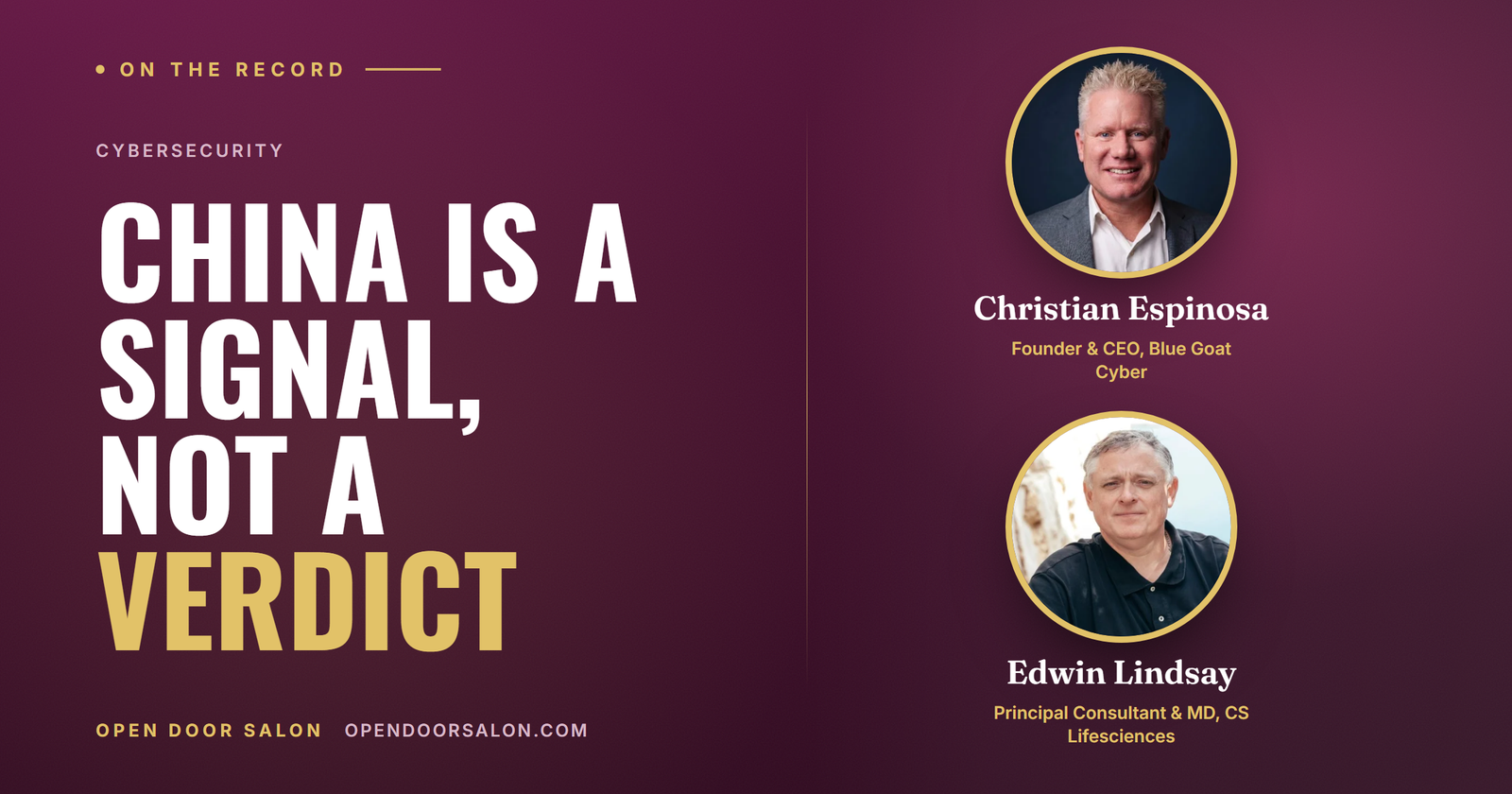
A medical device made in China is not automatically riskier than one made in America, because country of origin is a signal, not a control. What protects a patient is the firmware analysis, the software bill of materials, and the supply-chain scrutiny applied to the device, and those can be missing from an American product just as easily as a Chinese one. On Open Door Salon, Christian Espinosa, founder and CEO of the medical-device cybersecurity firm Blue Goat Cyber, made the case for judging devices by their controls rather than their flag.
Is a Chinese medical device inherently less secure?
Espinosa pushed back on the reflex. Where a device is built tells you something worth noting, but it is not a substitute for testing the device itself.
"The country of origin where a device comes from might be a signal, but it's not a control. Even if a device is manufactured in America, that doesn't mean it's more secure than from China."
His conclusion is deliberately provocative: a Chinese device that has been through detailed firmware analysis and penetration testing is more trustworthy than an American device nobody examined. The scrutiny is what earns the trust, not the address on the label.
But didn't a Chinese device already have a backdoor?
Yes, and Espinosa referenced it directly. The Contec CMS8000, a patient monitor, was found to contain a hidden backdoor that reached out to a hard-coded address, a case U.S. authorities documented in a 2025 advisory.
"Some of the back doors we found with the Contec CMS8000, that was a back door that went to China."
His point is not that the risk is imaginary, but that the answer is controls, not a blanket ban. The FDA already requires firmware analysis, a software bill of materials, and supply-chain analysis for devices that meet its definition of a cyber device, which are the mechanisms that catch exactly this kind of thing regardless of where a device is made. Falling short on any of them is what produces an FDA cybersecurity deficiency letter.
Where does the real supply-chain risk hide?
The harder problem sits below the top-tier supplier, in the subcontractors almost nobody audits for cybersecurity. Edwin Lindsay, principal consultant and managing director at CS Lifesciences, said supplier questionnaires routinely miss it.
"A lot of the supplier audits, they very rarely touch on cyber security. They talk about backup and recovery of your IT systems."
Companies check a supplier's quality and regulatory controls but not how that supplier secures the firmware and software going into the device, or how a compromise there could be introduced during manufacturing and activated once the product is in the field. The gap is not the country, it is the depth of the look.
What raises a cyber expert's suspicion?
Espinosa described a live example. A Chinese prospect had a device that communicated over 4G and had modified the firmware on the 4G chip and the antenna. When he asked why, the answers were vague.
"When somebody modifies the firmware on the device, the chip that does the communication, I'm wondering, is something going here and over here?"
That is why his team traces every third-party component in the software bill of materials back to its origin, and analyzes any piece of code whose source they cannot determine, a discipline that matters just as much for code written quickly with AI assistance as for code arriving from a supplier. A modification with no clear reason is a flag to investigate, not a reason to panic, and the investigation is the control.
What is the takeaway for a device maker?
Do the diligence you would want done on your own device, on every device, wherever it comes from. Run the firmware analysis, build and verify the software bill of materials, and push the scrutiny down into the subcontractor layer where the real gaps hide. Country of origin can inform where you look harder, but the controls are what actually protect the patient. This was one strand of a wider Open Door Salon conversation with Espinosa and Lindsay on the forces that make or break a medtech launch, drawn from the recorded, on-the-record discussion. Companies sharpening their own supply-chain diligence can work with Open Door Salon to reach the leaders making these decisions. The same asymmetry shows up one tier up, in why small biotechs are a bigger cyber target than big pharma.