
FDA, Payers & Hackers: The Three Forces That Make or Break a Launch
What you’ll learn
- Why FDA cybersecurity deficiency letters are surging, and what a 37-page list does to your timeline
- The 180-day response clock, and what happens to the 20% who miss it
- Why vibe coding fails FDA scrutiny for a regulated device
- The real cybersecurity question: patient safety, not data protection
- When reimbursement strategy has to enter product design (not after clearance)
Most medtech founders picture their launch as a single finish line: clear the FDA, and the rest follows. Christian Espinosa and Edwin Lindsay have watched enough launches break to know it does not work that way. A device can fail at the FDA, at the payer, or at the firewall, and increasingly it fails at more than one at once.
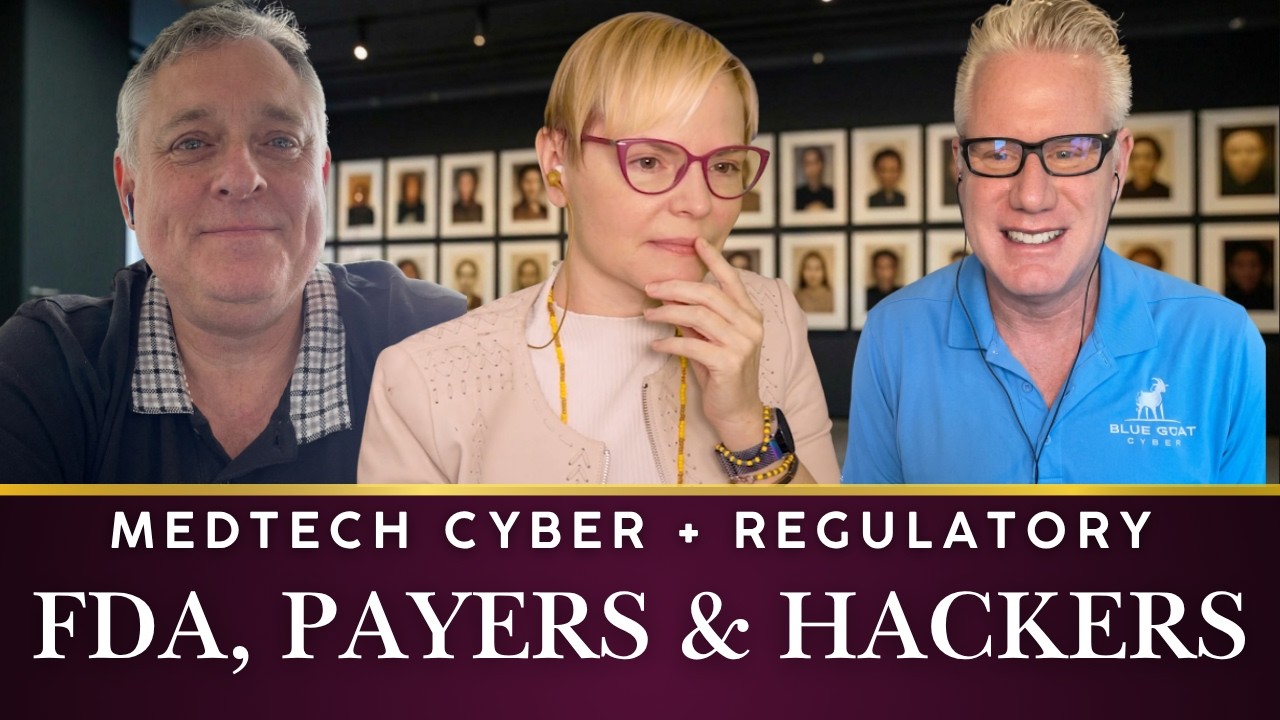
This Open Door Salon conversation, a continuation of a discussion host Lori Ellis started with them at MedTech World, brings together two people who see the failure points from different angles. Christian Espinosa is the founder and CEO of Blue Goat Cyber, a medical-device cybersecurity firm that has supported more than 250 FDA submissions. Edwin Lindsay is principal consultant and managing director at CS Lifesciences, a regulatory and quality consultancy that guides devices from concept through clearance and market launch. The episode is made possible by MedTech World.
The cybersecurity deficiency letters are exploding
The most immediate signal is the volume of FDA cybersecurity deficiencies. In the past two weeks alone, Espinosa said, Blue Goat had roughly ten discovery meetings with prospects that had received cybersecurity deficiencies from the FDA. Some of those lists run 37 pages. Manufacturers rarely grasp the scale of work required to close them, which usually means re-engaging the software team, a long delay, and a lot of unplanned cost.
The clock makes it worse. The FDA gives 180 days to respond. Espinosa estimates about 80 percent of companies fix things inside that window; the other 20 percent have to file an entirely new submission. And as Lindsay pointed out, cybersecurity is often the tip of the iceberg: if the fix means redesigning the device, the verification and validation testing has to be redone too.
Why vibe coding has no place in a regulated device
Espinosa drew a hard line on vibe coding, the practice of generating software through AI prompts. It is fine for proving a concept, he said, but it pulls in unnecessary libraries that each carry vulnerabilities, and the FDA does not recognize it as a proven methodology. The governing standard, IEC 62304, does not reference it. He put the stakes plainly: he once asked an innovator using vibe code for an implantable whether he would trust that device in his own grandmother if her life depended on it. The answer was no.
For investors trying to tell a safe bet from a dangerous one, Espinosa offered a simple diagnostic: ask which software-development standards the team follows. No answer is the red flag.
Patient safety, not data protection
The framing both men returned to is that medical-device cybersecurity is a patient-safety discipline, not an IT one. Many investors still think the risk is data protection, Lindsay said, but it is really about patient safety. If someone can hack the device, the question is not what data they can steal, it is what harm they can cause a patient. He described a live risk assessment on an in-vitro diagnostic: delay a result past 24 hours for a septic patient, or alter it, and the patient can die. When a founder leads with HIPAA and stored records, he treats it as a sign they are solving the wrong problem.
China is a signal, not a verdict
On China, Espinosa resisted the easy answer. Country of origin is a signal, he said, not a control. A device built in America is not automatically more secure than one built in China; the same firmware analysis, software bill of materials, and supply-chain scrutiny apply either way. A Chinese device that passed detailed firmware analysis and penetration testing, he argued, is more trustworthy than an American one nobody examined. The harder problem is the subcontractor layer most companies never audit for cyber controls, and cases like a Chinese prospect that had quietly modified the firmware on its device’s 4G chip with no convincing reason.
FDA readiness in 2026 means proof, not checkboxes
Asked what FDA readiness actually looks like now, Espinosa said the mindset shift is that cybersecurity is quality. It used to sit adjacent to the quality management system; now it is part of it. The second shift is evidence. The FDA and the healthcare delivery organizations buying the device no longer accept a checked box; they ask for the artifacts that prove the process was followed. And any device with a way to connect to it, whether Bluetooth, NFC, or a USB port, is a cyber device, however much a manufacturer wants to argue otherwise.
Reimbursement that starts after clearance is already too late
The third force is the payer. Both men urged founders to bring reimbursement strategy into product design as early as possible. Companies routinely run expensive clinical studies that satisfy the FDA but not the payer, Lindsay said, and getting a reimbursement code can take longer than getting the product cleared. The most expensive mistake he has seen: a company that assumed its device would fit an existing code, got its clearance, then spent five or six years unable to sell at scale while it chased reimbursement, surviving door to door in the private market. A new level of scrappy, as Ellis put it.
Why the work is personal
Both men came to healthcare through the patient side. Espinosa, an Iron Man triathlete, was diagnosed with six blood clots by a Doppler ultrasound and founded Blue Goat Cyber after realizing his life had depended on a medical device working correctly. Lindsay’s grandson had emergency surgery for a pinched aorta at six days old, pulling him toward helping startups bring pediatric devices to market. The throughline of the conversation is that in medtech, the launch and the patient are the same problem seen from opposite ends.
It's not about stealing the data. It's what harm can I cause a patient.
Key takeaways
- Cyber deficiencies are exploding. Blue Goat had about ten discovery meetings in two weeks with companies holding FDA cybersecurity deficiency lists, some 37 pages long.
- The clock is 180 days. Roughly 80% of companies fix deficiencies in time; the other 20% have to file an entirely new submission.
- Vibe coding is a red flag. Fine for a prototype, but the FDA does not recognize it and IEC 62304 does not reference it.
- Ask about standards. If a team cannot name the software-development standards it follows, that is the investor red flag.
- It is patient safety, not data. The cyber risk is patient harm, such as a delayed or altered diagnostic result, not stolen records.
- China is a signal, not a verdict. A device that passed firmware analysis and pen testing beats an American one nobody examined.
- Cybersecurity is now quality. It is part of the QMS, and the FDA wants artifacts that prove your process, not checked boxes.
- Reimbursement starts at design. A code can take longer than clearance; assuming an existing one cost a company five to six years of scaled revenue.
Key Questions, Answered
Why are FDA cybersecurity deficiency letters increasing?
Literally in the past two weeks, we've had probably ten discovery meetings with prospects that have received deficiencies from the FDA in terms of cybersecurity... some of them are like 37 pages of deficiencies
Christian Espinosa says the FDA has sharply raised its cybersecurity bar, and deficiency lists can run 37 pages.
How long does an FDA cybersecurity deficiency delay a submission?
the FDA gives you 180 days by default to respond... 80% can submit within the 180 days and get things fixed. The other 20% have to do an entirely new submission
The response window is 180 days; about a fifth of companies miss it and must re-submit from scratch.
Can you use vibe coding for medical device software?
vibe coding is fine to come up with a minimum viable product or prove your idea, but it introduces a lot of vulnerabilities... I don't believe the FDA accepts vibe coding as a proven methodology
Espinosa: fine for a prototype, not for a regulated device; IEC 62304 does not reference it.
What should investors ask to spot a cybersecurity red flag?
I would ask which standards you follow for software development and have you contracted or brought in house software developers that follow those standards. They don't have an answer for the standards and you know that's a red flag right there
Ask which software-development standards the team follows; no answer is the red flag.
Is medical device cybersecurity about data protection or patient safety?
Many investors still think cybersecurity in terms of medical devices is about data protection... it's really about patient safety... it's not about stealing the data. It's what harm can I cause a patient
Edwin Lindsay: the real risk is patient harm, not stolen data.
Does a medical device made in China pose a bigger cybersecurity risk?
the country of origin where a device comes from might be a signal, but it's not a control... if a Chinese device went through super detailed firmware analysis and pen testing, I would trust that more than an American device that nobody even looked at
Espinosa: origin is a signal, not a control; the controls matter more than the country.
What does FDA readiness actually mean in 2026?
cybersecurity is part of your quality management system. In the past it used to be adjacent to it. Now it's part of it. Cybersecurity equals quality because without the quality in cybersecurity a patient can be harmed
Cybersecurity is now part of the quality management system; cyber equals quality.
Is a device with only a USB port still a cyber device?
if your device has any kind of software and any means to connect to it... any means at all, then it is a cyber device
Any way to connect, whether Bluetooth, NFC, or USB, makes it a cyber device under FDA scrutiny.
When should reimbursement strategy enter product design?
as early as they can... companies make a mistake that they run expensive clinical studies to satisfy the FDA, but it doesn't satisfy the payer
As early as possible; studies that satisfy the FDA often fail to satisfy the payer.
What is the most expensive reimbursement mistake a startup can make?
they presumed that it would fit into a already existing code... it took them nearly... five or six years to get... the reimbursement
Assuming an existing code will cover you; one company lost five to six years of scaled revenue.
Resources
- Section 524B of the FD&C Act: Ensuring Cybersecurity of Devices (FDA) The FDA's premarket cybersecurity authority (effective March 29, 2023), requiring a software bill of materials, a vulnerability-monitoring plan, and reasonable assurance of device security.
- IEC 62304: Medical device software life-cycle processes The international standard for medical device software development that Espinosa cites as the recognized methodology, and that vibe coding does not satisfy.
- FDA guidance: Cybersecurity in Medical Devices (premarket submissions) The FDA guidance underpinning the deficiency letters, covering quality-system considerations and the content of premarket submissions.
- CISA advisory: Contec CMS8000 patient-monitor backdoor (2025) The advisory on the hidden backdoor Espinosa references: a patient monitor transmitting data to a hard-coded IP address traced to China (CVE-2025-0626).


Need the life-sciences signal but short on time?
Get the free quarterly briefing: every guest from the quarter, in one sitting. What decides whether a therapy reaches a patient, gets funded, and can be trusted.