
What FDA Reviewer Turnover Costs Drug Developers
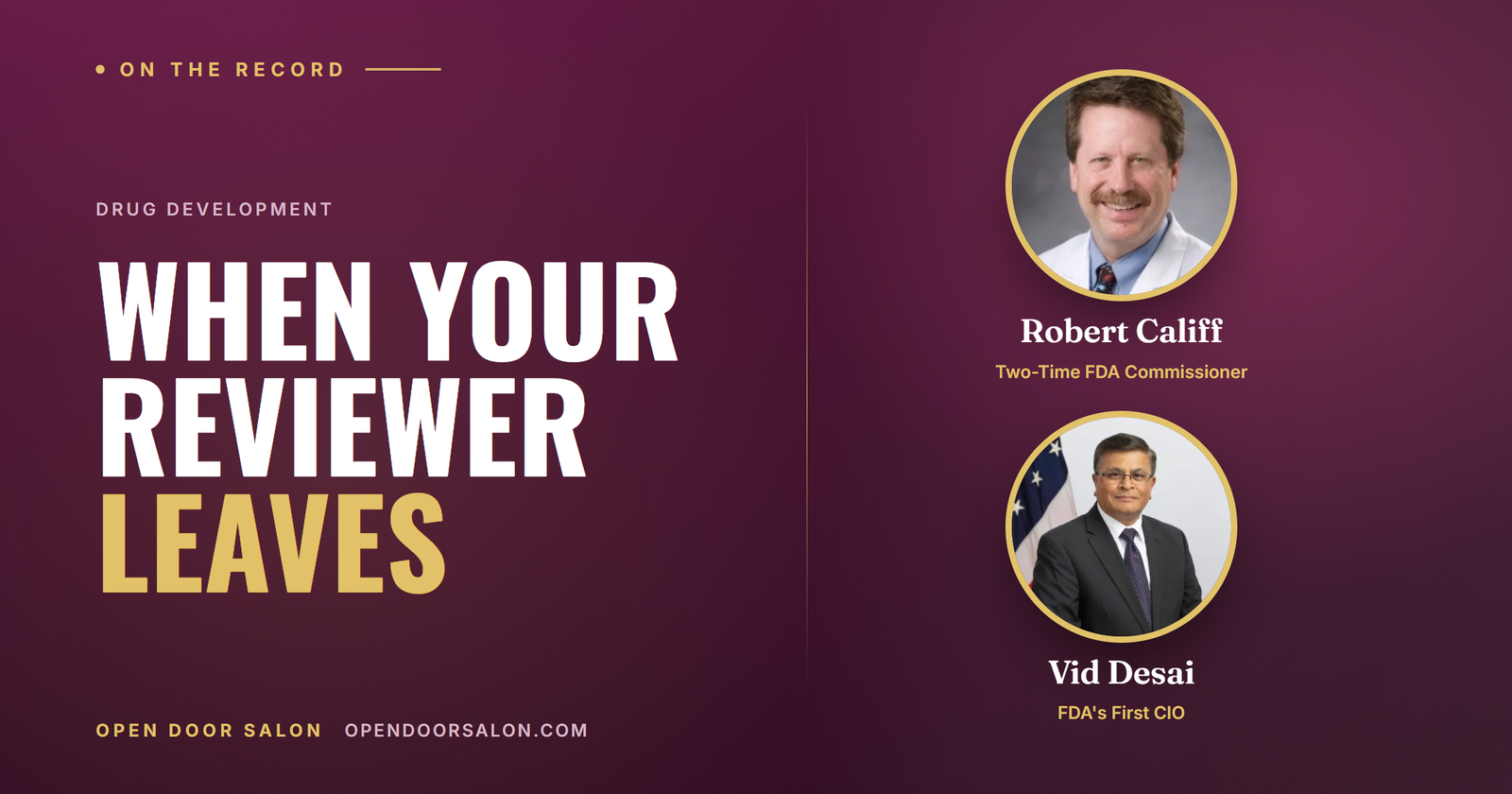
The cost of FDA reviewer turnover lands on sponsors years before a marketing application is ever filed. Most consequential FDA interaction happens in the meetings where reviewers and sponsors work out what evidence will count, and those understandings are carried by people rather than by documents. When the people leave, the understandings leave with them. Robert Califf, the only person to have served twice as FDA Commissioner, and Vid Desai, the agency's first Chief Information Officer, described the mechanism on Open Door Salon. Both left the agency in 2025.
Why does FDA staff turnover reach drug developers at all?
Because the agency's most valuable work is advisory and happens early. Califf made the point in the form of a question sponsors should find uncomfortable.
if the people at FDA have no experience and they don't understand how the system works, how can you bank on what they say five years later when you have to bring all this to the forefront to put your application in?
That is the practical exposure. A development program is built on guidance received in year one and defended in year six. If the person who gave the guidance is gone and no institutional memory of the exchange survives, the sponsor carries the risk of a reopened question at the most expensive possible moment.
How bad is the turnover?
Host Lori Ellis opened with the arithmetic: six different CBER directors, six different CDER directors, and an acting commissioner. Califf did not soften his assessment of it.
I think this is calamitous for the United States and for the FDA
Desai's framing was operational rather than rhetorical, and in some ways more troubling, because it describes something that cannot be reversed by rehiring.
the institutional knowledge is obviously pretty much gone
He also noted the churn extends into the acting roles themselves, so there is no stable layer sitting underneath the visible leadership changes. The pattern has only continued since the recording, with continued director-level turnover leaving drugmakers guessing on the agency’s direction.
How long does it take a new FDA reviewer to become effective?
Desai came to the agency from private industry and is specific about the ramp.
It took me six months before I found my feet at the FDA
He describes those first months as genuinely difficult, to the point of questioning whether to stay. Six months is the ramp for a senior technology executive learning the institutional rulebook. Multiply that across thousands of positions turning over at once and the arithmetic gets bleak quickly, because an administration has roughly two and a half to three years to accomplish anything before the cycle turns again. Desai's conclusion was that this is not enough time to do anything significant or major.
What does inexperience change about review decisions?
Califf offered an analogy, then corrected it mid-answer, and the correction is the more useful version.
I don't see the commissioner as a referee. I see the civil servants as referees. I see the commissioner is more like the coach.
The civil servants apply rules written by Congress to individual products. The commissioner sets policy and argues the calls. What worries Califf is a field full of referees who have not yet learned the rulebook, because inexperienced referees do not make random errors. They make predictable ones: over-caution in unfamiliar territory, inconsistent application of precedent, and difficulty distinguishing a genuinely novel question from one the agency settled a decade ago.
What should sponsors do differently?
Neither guest offered a tidy mitigation, and it would be dishonest to manufacture one. What follows from their description is mostly a documentation discipline. If the guidance you are relying on lives in a person's memory of a meeting, it is fragile. Written minutes, confirmed in correspondence, referencing the specific question and the specific answer, are worth considerably more in a high-turnover agency than in a stable one. The same logic Califf applied to the agency's own record-keeping applies to yours: he pointed to a recent reversal justified partly on the grounds that no administrative record existed for the original decision. Where there is no record, there is nothing to argue with.
The second implication is about timing expectations. Califf expects demand for meetings to rise rather than fall, noting that in the last two user fee negotiations industry's biggest ask was not faster timelines but more meetings, and the agency did not have the staff to hold them. A thinner, less experienced agency does not resolve that. It intensifies it.
The wider question this sits inside
The reputational version of this question, whether the FDA is still the global reference regulator, is one we took up separately in is the FDA still the gold standard. This post is about the narrower and more immediate commercial exposure: what turnover costs the people building products right now. The two compound. An agency losing external trust and internal memory at the same time is a harder counterparty than either problem alone, a dynamic also visible in the three forces that make or break a medtech launch.
Watch the full conversation with Robert Califf and Vid Desai on the episode page. If you want to reach the decision-makers in that room, start here.
Drawn from the recorded, on-the-record conversation with Robert Califf and Vid Desai on Open Door Salon. Figures and program details verified against primary sources where cited.
Related: a cybersecurity deficiency letter can add its own 180-day clock.