
How Is Intellectual Property Stolen in China? Three Routes
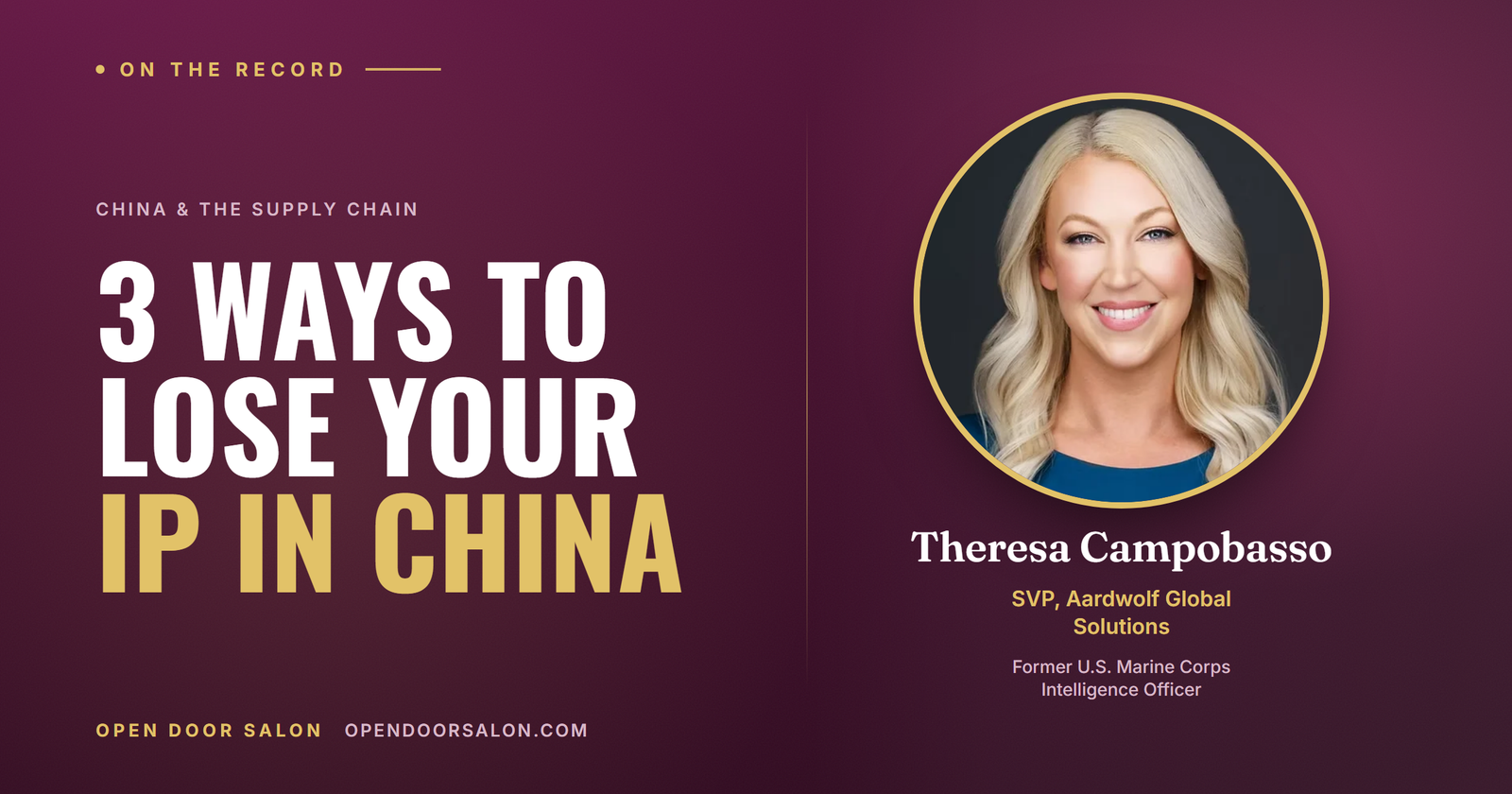
For US life-sciences companies partnering in China, intellectual property is the asset most at risk, and it rarely leaves the way people imagine. In a recent Open Door Salon conversation, Theresa Campobasso, a former US Marine Corps intelligence officer and Senior Vice President at Aardwolf Global, laid out the main routes IP actually takes out the door, only one of which looks like a hack.
Route one: direct access through a partnership
The first route is the simplest, and the easiest to wave away as just doing business. The exposure is created the moment IP is shared with a partner, because from that point protection depends entirely on the partner, and on everyone behind them.
"The first is just a cyber compromise, or just accessing the information. If you're doing business with a company and you're partnering and you expect that your IP is going to be protected, but you're sharing it with this partner or with this investment target."
It is not theft in the dramatic sense. It is access granted by the deal itself, then used in ways the originating company never intended.
Route two: patent acceleration
The second route is the one Campobasso says people underestimate, because it uses the legal system rather than circumventing it.
"The Chinese patent process is much more rapidly executed in China than it is in the United States. Sometimes the IP theft will take the form of patent theft. We've seen Chinese companies accelerate the patent process in their own country and get that IP to the market more quickly, and have a patent where the US company who originated the IP is unable to secure it."
For unpatented research, speed is the vulnerability. Whoever files first owns it, and a faster process on the other side can leave the original inventor locked out of its own work.
Route three: insider threat
The third route is the human layer, and Campobasso is clear that it can be deliberate or entirely accidental.
"We see a lot of insider threat, either through digital compromise, through phishing attempts, witting or unwitting. A lot of insider threat, solicitation, phishing, or in person."
That breadth is the point. An organization can have strong contracts and clean cyber hygiene and still lose ground through a single solicited employee or a convincing phishing campaign.
Why the comparison to stolen art lands
Asked to make it concrete, Campobasso reaches for an analogy outside the lab.
"It's very similar to what we see around digital IP theft with art, stealing artists' designs and selling it elsewhere without any royalties or credit to the artist. It's really the exact same."
The mechanism is familiar; only the scale changes. Instead of a design, it is a molecule or a platform, and instead of a lost royalty, it is a lost market and a lost competitive position. That same competitive pressure is now visible at the national level, where China’s research spending has passed that of the US.
The risk is a blind spot, not their weakness
It would be easy to read all of this as a story about Chinese incapacity. Campobasso is careful to reject that framing. Much of the activity she describes runs alongside genuine, original innovation, which is exactly why the risk is so easy to miss: the partner is often real, productive, and attractive.
The throughline is that protecting IP is not only a cybersecurity problem. It is a question of knowing exactly who is on the other side of a partnership, and who is behind them, before the deal is signed rather than after a patent appears.
What to do about it
What a company actually loses
The consequences are not abstract. When IP moves through any of these routes, the originating company can lose the one thing that justified the research in the first place: a defensible head start. A faster competitor with the same molecule, or a patent filed first in another jurisdiction, does not just dent a single product line. It can erode the value of an entire platform, the basis for a funding round, and the strategic case for the partnership that leaked it. The damage is rarely visible at the moment of the deal, which is precisely what makes it dangerous.
Why this is a blind spot, not a story about weakness
It would be easy to read all of this as a claim that Chinese firms cannot innovate on their own. Campobasso is careful to reject that framing, and it is an important distinction. Much of the activity she describes runs alongside real, original science, which is exactly why the risk is so easy to miss: the partner is often genuinely capable, productive, and commercially attractive. The danger is not that a company is dealing with an obvious bad actor. It is that a legitimate, impressive partner can also be a conduit, and standard diligence is not built to tell the difference.
The practical move follows from the diagnosis. If the exposure is created by partners and the layers behind them, the defense is to map those layers, identify state funding or government ties that standard diligence misses, and treat IP protection as a question asked at the deal table, not a clause buried in a contract. For companies working through that exposure, that is the conversation Open Door Salon exists to host. You can work with us here.
This piece is drawn from the recorded, on-the-record conversation with Theresa Campobasso on Open Door Salon. The bills referenced are proposed US legislation; consult current congressional coverage for their status.