
Warning Signs a Biotech Is Running Out of Money, Explained
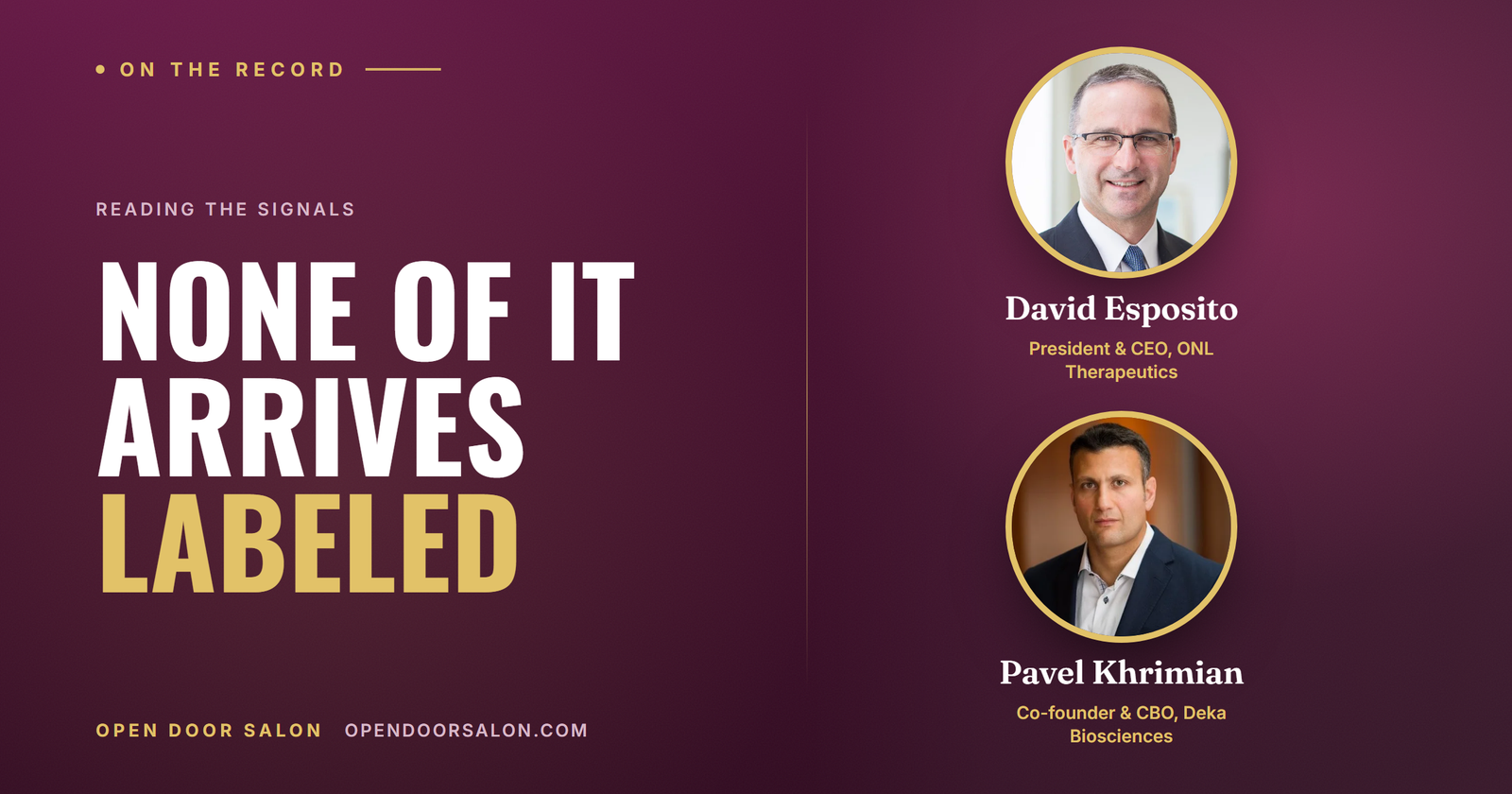
The signals that a biotech is running out of money usually appear well before the cash does. They arrive as ordinary operating problems: a manufacturing delay, a term sheet that moves, a program that is performing but is no longer the priority. None of them announce themselves as decisive. On Open Door Salon, David Esposito, President and CEO of ONL Therapeutics, and Pavel Khrimian, Co-founder and Chief Business Officer of Deka Biosciences, described the same pattern from opposite ends of a career. Esposito has taken companies to exit and taken companies into bankruptcy. Khrimian spent most of 2026 winding down the company he co-founded. Both say the information was available early, and that the discipline is reading it before it becomes a crisis.
How often do warning signs actually appear?
Constantly, which is exactly what makes them hard to read. Esposito puts the rate at every couple of days, and treats that as the normal operating condition of an early-stage company rather than a sign of trouble.
"There's kind of a gut punch or a new data point every couple of days, whether it's a manufacturing, a regulatory hurdle, a clinical site issue."
Because the volume is constant, the signal is never that a problem exists. It is whether the problem changes the plan the company raised money against. A manufacturing delay the team can prepare around while the gate is closed is survivable. The same delay in a company with one program and no backup may not be.
What does a data point have to change to matter?
The base case. Esposito frames the whole exercise around the plan a company presented to investors, and the discipline of testing each new fact against it.
"you've got to start confidently with a base case and then interpret these data points."
He gives a financing example that will be familiar to anyone who has closed a round. A term sheet was supposed to be a hundred million. It dropped to eighty. Then it oversubscribed to a hundred and twenty five. Each move was new information about a plan the company was still executing against. His own diagnosis of the companies he lost is not that the team missed the facts. It is that they read them too slowly.
"in my experience of taking a few over the cliff, we probably didn't have enough dexterity to interpret those data points quickly."
What is the most common mistake in reading these signals?
Not misinterpreting them. Declining to look at them. Khrimian is direct that the failure he has watched is a failure of attention rather than analysis.
"what I have seen done not so successfully is when some data points are ignored"
His argument is that the relevant set is much wider than a company's own development plan, and that it has grown. A small biotech now has to track what pharma partners are signaling, what investors are saying, and a policy environment nobody inside the company can influence.
"the ecosystem has become so vast, so large that you have to pay attention to all the data points"
Why does the funding window close so fast?
Because the market that would fund a pivot is not always open when a company needs it. Esposito separates the things a team controls from the thing it does not, and timing is the one that ends companies.
"sometimes the timing on markets to fund the pivot for a company gets pretty tight. And that can set up a real cash crunch for teams."
This is why the alternative pools matter before they are urgent. Capital that does not depend on a conventional equity round, whether that is non-dilutive grant funding or the family offices now deploying directly into biotech, is easier to approach with twelve months of runway than with two.
What does the science itself do to a company's options?
It narrows them, usually without anyone deciding to narrow them. Esposito describes prioritization compounding across rounds until a company has one program left and no parallel path.
"after a couple rounds of capital and the science is playing out, you eventually realize you've prioritized yourself into maybe one big swim lane."
The company is then waiting on a readout that is effectively binary, and the decision is largely made for it. He calls this the easy case, because it is clear. The harder situations are the ones where the data is neither good nor bad, the market may or may not open, and a kill decision is a judgment call rather than a conclusion.
Where do these signals show up first inside a company?
In the team, before they show up in the bank account. Esposito connects unresolved friction directly to burn.
"The team's not unified. You can get a few egos going one way or the other before you know it, you're arguing enough till you run out of money."
Khrimian's version is about what a leadership team owes the people below it. When alignment breaks between the executive layer and the people executing the milestones, the cost is not morale. It is capital, spent on friction on the way to a value inflection point that then arrives late.
What should a company do once it sees the signals?
Decide whether it is pivoting or closing, and do it with the numbers rather than the mood. Khrimian reduces that call to three questions about hypothesis, cash and time, applied in order. Esposito's addition is that optimism is a required piece of equipment and also the thing most likely to delay the call, because belief is what got the team over every previous obstacle.
"sometimes you get that belief of overcoming too far over your skis. And before you know it, you're looking over the abyss"
Sponsors and partners evaluating this sector face the same reading problem from the outside. Working with Open Door Salon puts a brand in front of the operators making these calls.
Drawn from the recorded, on-the-record conversation with David Esposito and Pavel Khrimian on Open Door Salon. Quotes are verbatim from the episode transcript.
This episode was made possible by Lab Thread.

Nobody went into science for the admin. Lab Thread is the integrated lab management platform that scientists actually enjoy; Built to fit the way you work, from first idea to final report. Everything connected. Nothing lost. Never in your way.
Visit labthread.com to learn more, or book a demo