
When a Biotech Shuts Down, What Happens to Its Patients?
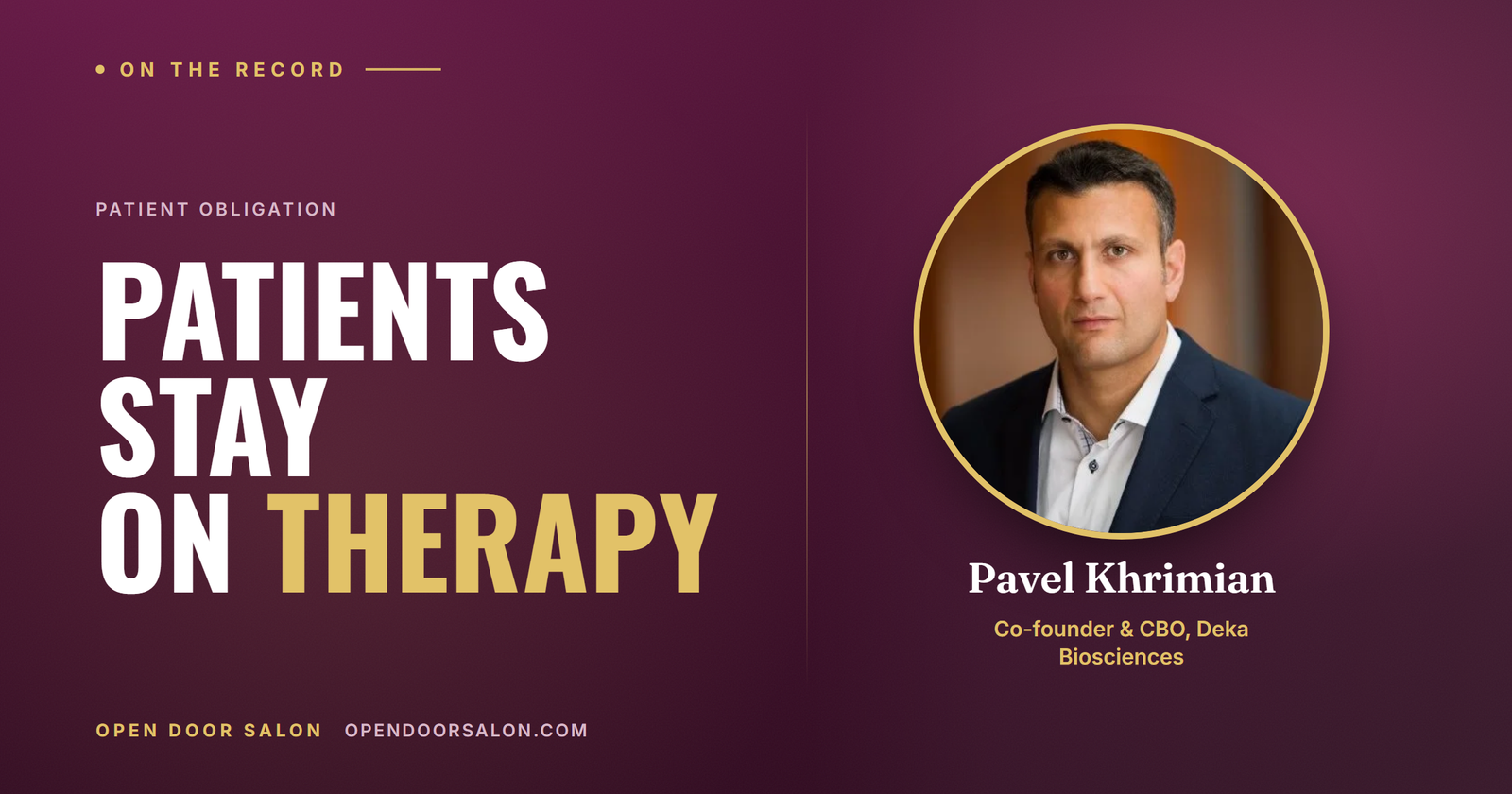
When a biotech shuts down, the patients already receiving its therapy do not stop receiving it. The company carries a fiduciary responsibility to keep treating them until they come off therapy, which means a wind-down is not primarily a legal event. It is an operational one: narrowing trial sites to the few that can still be supported, keeping drug shipping to them, and cutting cost everywhere else. Pavel Khrimian, Co-founder and Chief Business Officer of Deka Biosciences, described that work on Open Door Salon while leading his own company through exactly it, after a pharma collaboration collapsed at the diligence stage. It is the part of a closure that rarely gets discussed on the record, and the part that outlives the company.
What is the company's actual obligation to patients?
To continue treatment until each patient completes it. Khrimian states it as a duty rather than a courtesy.
"We have the fiduciary responsibility to continue to treat these patients until they come off therapy."
That obligation does not scale down with the company. A biotech that has decided to close still has people in a clinical trial, and the decision to wind down does not release the company from them. It converts the question from whether to continue into how, on a shrinking budget, with a shrinking team.
What does meeting that obligation actually involve?
Logistics, and a deliberate narrowing. Khrimian describes the practical sequence a leadership team works through once the decision is made.
"Can we narrow down the sites to select few? Where are the patients? We have to meet those obligations"
A trial running across many sites cannot be supported by a company that is shutting down. So the sites get consolidated to the number that can be maintained, patients are mapped against them, and supply is routed accordingly. Everything not required to keep that running is where the cost comes out.
"focus on making sure that patients are not left behind."
Why is this harder than it sounds?
Because the company is doing it while it is dissolving, and the work is unglamorous. Khrimian describes the mode it puts a team into:
“that’s where you get into the brass tacks, execution, logistical, operational mode where drugs shipping to the sites”
That is a supply-chain job being run by a company that is standing down, and it ran across most of a year for him. It sits alongside the other two obligations rather than replacing them, because the board and the investors still need to be kept informed while it happens.
"that's what we've lived through this for the most of 2026"
How does a leader hold this and the human side at once?
By treating them as two different jobs. Khrimian describes switching deliberately between them rather than trying to blend them.
"there's a fine balance between the hat, the human hat, and then the company hat"
The human hat is what a leader wears thinking about the employees whose jobs are ending. The company hat is what gets the drug to the sites. He answers a question about serving investors, patients and a team at once by taking the advice he was given about perspective a step further than the usual version.
"before you get into somebody else's shoes, there's one other step you have to go through. Take your own shoes off"
Is this specific to companies that shut down?
No. The gap between a therapy existing and a patient receiving it shows up across the sector for reasons that have nothing to do with insolvency. Approved products sit unavailable because of manufacturing and access problems that begin after the FDA says yes, and individual patients are reached only through one-off contracts negotiated with insurers case by case. A wind-down is a sharper version of a structural problem, not an exception to it.
What does this mean for how a closure should be run?
That the sequencing is not optional. A company deciding whether to pivot or close is also deciding how much runway it needs to meet obligations that continue past the decision. Khrimian's account suggests the patient commitment should be modeled as part of the closure, not discovered during it, because the cost of continuing treatment is real and it lands after revenue has ended.
His broader point about conduct applies here too. The board, the investors and the trial sites are all people the same leadership team will meet again, and how a company behaves on the way out is what the sector remembers. The same standard governs what a company owes the team whose program ends, including at companies that are not closing at all.
"we didn't burn bridges along the way. It's an ecosystem. It's a small world."
Brands that want to reach the people making these decisions can work with Open Door Salon.
Drawn from the recorded, on-the-record conversation with David Esposito and Pavel Khrimian on Open Door Salon. Quotes in this post are Khrimian's, verbatim from the episode transcript.
This episode was made possible by Lab Thread.

Nobody went into science for the admin. Lab Thread is the integrated lab management platform that scientists actually enjoy; Built to fit the way you work, from first idea to final report. Everything connected. Nothing lost. Never in your way.
Visit labthread.com to learn more, or book a demo