
What Is the COINS Act? A Guide for Biotech Dealmakers
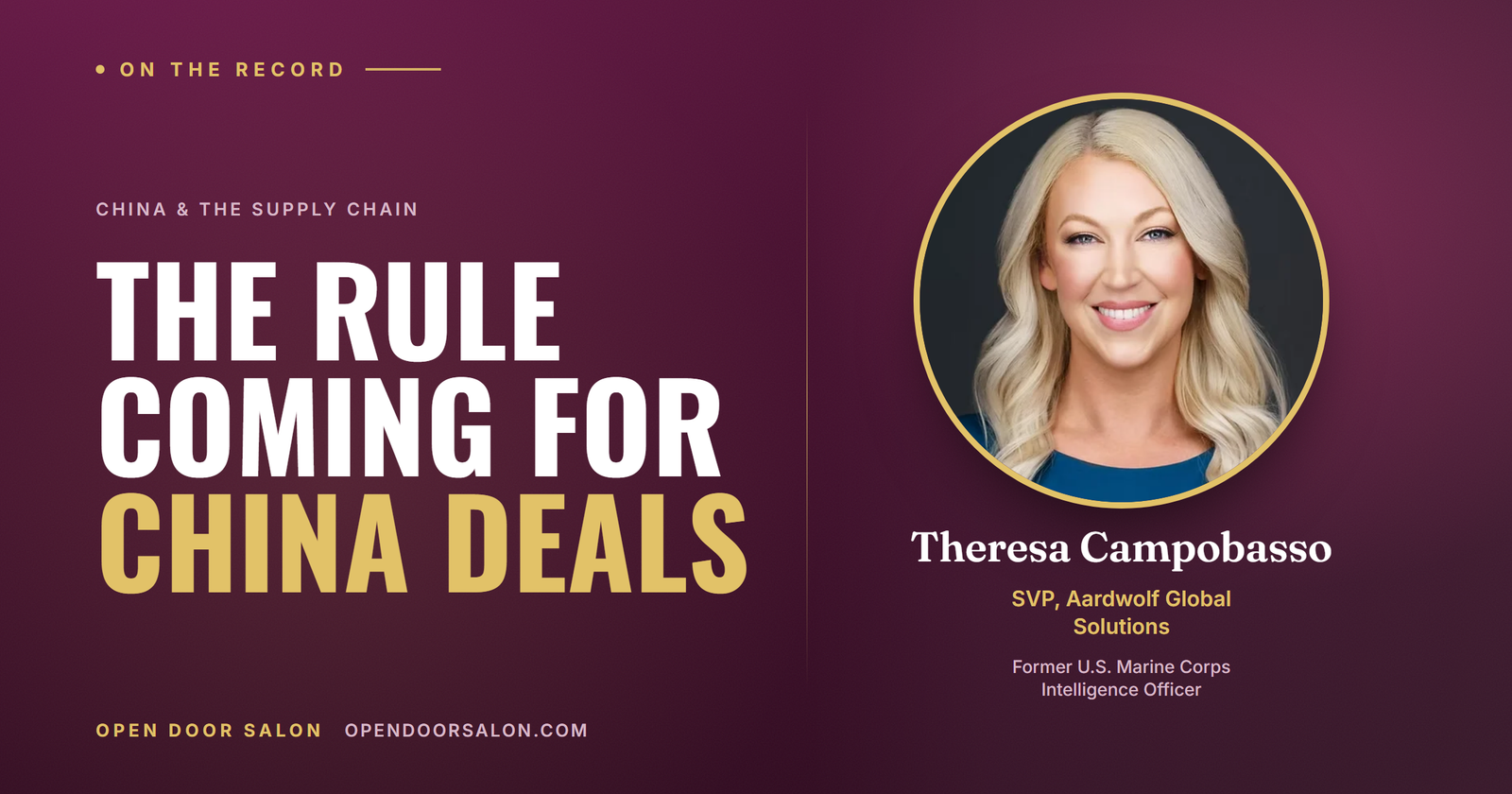
The COINS Act is the Comprehensive Outbound Investment National Security Act, the law that puts some American investment in Chinese technology under Treasury screening. It was enacted in December 2025 and does not cover biotechnology yet. A bipartisan House bill from June 2026 would add it, which would extend US rules from who life sciences companies buy from in China to who they invest in. For a read on what that would do, we turned to a recent Open Door Salon conversation with Theresa Campobasso, a former US Marine Corps intelligence officer who was then SVP at Aardwolf Global, advising on supply-chain security across the life sciences.
What the COINS Act covers, and what the House bill would add
The COINS Act covers sectors such as semiconductors, artificial intelligence and quantum computing, and Treasury can add more by regulation. The Biotech Investment National Security Act would add biotechnology. Where BIOSECURE governs federal procurement, this proposal reaches the deal itself, and Campobasso described a broad scope.
"Any licensing deals, any joint ventures, any equity investments in China could be subject to both Treasury and Department of War reviews."
The bill amends the Comprehensive Outbound Investment National Security Act, and Campobasso notes it followed two recent pharmaceutical deals each potentially worth more than $10 billion. The intent, as she reads it, is to take a tool that has so far touched only government buyers and point it at the private capital flowing into Chinese biotech.
The investigation running underneath it
The House bill did not appear in a vacuum. Campobasso points to a parallel federal inquiry that is quietly shaping the ground.
"The United States International Trade Commission formally instituted this investigation, documenting the degree of subsidization of Chinese biotechnology firms, market overcapacity, and the extent to which Chinese state support and pricing practices are affecting US market competitiveness."
Its report is due to the House and Senate appropriations committees by January 22, 2027, and its framing matters: it treats Chinese biotech pricing as a market-distortion problem, the same lens applied to other industries before tariffs and restrictions followed. It is the evidentiary base a wider rule would stand on.
Why it goes further than BIOSECURE
The BIOSECURE Act, enacted alongside COINS, reaches companies through federal contracts. Earlier drafts named five Chinese companies; the enacted law works from a government list. Campobasso's read is that the House bill is designed to widen that perimeter substantially.
"It was originally intended to extend the BIOSECURE-style restrictions from just those five named entities to whole categories of Chinese biotech companies more broadly."
That is the shift that matters for dealmakers. BIOSECURE was about who you can buy from. The House bill is about who you can invest in, and it would apply to categories of companies rather than a list of designated ones, which makes it far harder to plan around by simply avoiding a handful of names.
Will existing deals be grandfathered in?
This is the question many investors are quietly asking, and Campobasso's answer is direct. Because the regulation is threat-based rather than a matter of trade or compliance, she does not expect existing arrangements to be protected.
"I would be very surprised if there was a grandfathering, because we're looking at real, legitimate risks: a substantiated and evidence-driven pattern of behavior for Chinese biotechnology companies to adversely leverage American patient data and to steal intellectual property."
The companies treating a signed deal as permanently safe may be the ones most exposed when a rule lands.
The red flags that are knowable in advance
Much of the risk, Campobasso stresses, is identifiable before a deal closes, if the right questions get asked.
"If it's a Chinese company that receives funding from the Chinese state, or if it has a Chinese Communist Party structure within the company itself, which many do, those are two big red flags."
Those structures are common and frequently undisclosed, but they are not invisible. The problem, in her view, is that standard diligence stops before it gets there.
What dealmakers can do before biotech is added
Campobasso's practical point is that the gap between a signal and a statute is the window to act. The companies that fare best are the ones mapping their exposure now.
"There are ways for investors, for executives, for anybody listening to this to buy down their risk right now, today, before these things are enacted into regulation."
In practice that means investigating domestic and alternative partners before a rule forces the question, and stress-testing each deal against a single scenario: if this partner becomes a restricted entity tomorrow, what happens to the business? Whether the House bill passes, or Treasury adds biotechnology on its own under the COINS Act, is still open. What looks settled, in Campobasso's telling, is the direction. The regulatory line around US-China biotech is moving from the loading dock to the cap table, and the companies reading the signals early will have the most room to move. For sponsors and partners navigating that shift, that is the conversation Open Door Salon exists to host. You can work with us here.
The diligence question most teams are not asking
The gap she keeps returning to is not effort, but scope. Business-development teams run thorough diligence on IP ownership, clinical data, regulatory pathway, and financial terms, and then stop, because that set of checks has always been enough. What it does not surface is who else has a claim on a molecule, or what happens to the deal if the partner is designated a restricted entity tomorrow. Those are the questions a screening regime will effectively ask on a company's behalf, after the fact and at far higher cost. Asking them now, before signing, is the cheapest version of the same exercise.
Anne Herold Li returned to Open Door Salon with Raja Mikkili to name the clause that most deal documents still get wrong: who owns the data a collaboration generates, usually settled in four sentences nobody read.
This piece is drawn from the recorded, on-the-record conversation with Theresa Campobasso on Open Door Salon. The COINS and BIOSECURE Acts became law in December 2025; the bill to add biotechnology was still a proposal in October 2026. Check current congressional coverage for its status.