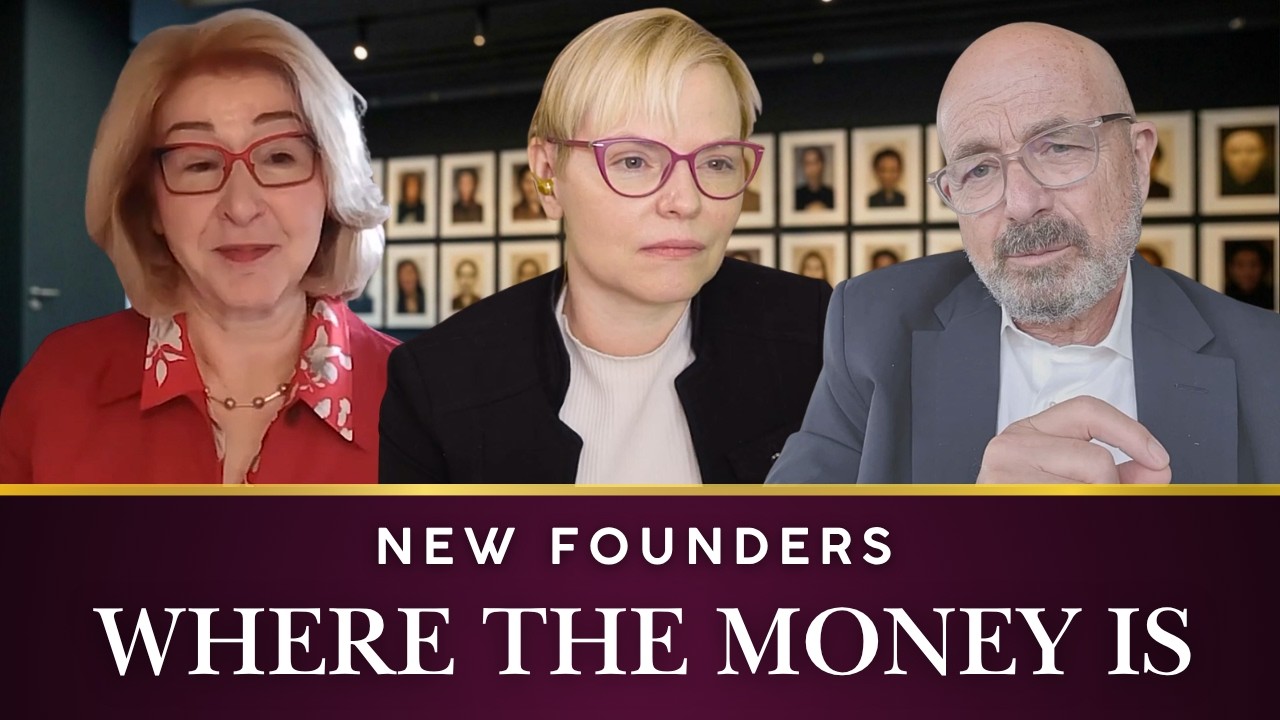
Sara Jane Demy and Jeremy Levin on Where Biotech Money Goes When Venture Capital Stops
What you’ll learn
- Why the A, B, C round path is not currently available, and what founders are doing instead
- How family offices became a direct source of biotech capital, and the kind of bets they make
- Where the new biotech hubs are forming beyond Boston and San Francisco
- Why biotech CEOs now treat Chinese clinical data as good and reproducible
- What the United States still has, and why innovation migrates rather than stops
For thirty years the path was legible. A biotech founder raised a seed round, then an A, then a B, then a C, and if the science held up the company went public. Sara Jane Demy has just come out of her own Biotech CEO Summit, where that path was the main topic of conversation, and the consensus in the room was that it is not currently available.
Jeremy Levin, who ran Teva Pharmaceutical Industries and before that sat on the executive committee of Bristol-Myers Squibb, agrees with the diagnosis and has a specific answer about where the money went instead. Their conversation with host Lori Ellis covers the collapse of the venture path, the capital that quietly replaced it, and why both of them think the competitive question about China has already moved past the one most people are still asking.
The A, B, C round path is not there right now
Sara Jane Demy puts it plainly. Looking for an A round, then a B, then a C, in conventional venture funding is no longer a plan a founder can rely on.
That model just does not seem to be there right now
Her qualifier matters as much as the claim. The exception, she says, is a blue-chip management team backed by a blue-chip investor group, the kind that can raise nine figures in a single A round. Everyone else is operating in a different market from the one the playbook describes. Investments are still happening. They are not happening in the shape or at the frequency founders were taught to expect.
Where the money actually went: family offices
Levin’s answer is not a smaller version of venture capital. It is a category of capital that behaved differently ten years ago and has since organized itself.
Family offices used to hand their money to venture funds and let those funds deploy it. In several parts of the country they have now pooled directly, and the aggregate is not marginal.
which total billions and billions and billions of dollars
What makes them worth a founder’s time is the mandate rather than the size.
Their interest is novel, long term, and they’re making bets, not inconsiderable, and they should be considered.
Levin names the Miami Biotech Collective as somewhere a founder can simply go and ask what they are working on. Sara Jane Demy adds Houston, where a hub is forming around MD Anderson, and surprising Midwestern states starting to bubble up. The geography of American biotech capital is widening at exactly the moment its traditional instrument has tightened.
The rest of the non-traditional stack
The CEO summit discussion went further than private capital. Sara Jane Demy lists grant money, some of it federal, alongside collaboration money from patient advocacy organizations, disease foundations and other non-profits. For smaller public companies she describes a different tactic entirely, which is sustained public storytelling on social media to drive trading volume and, through it, attract capital.
None of this is presented as superior to venture funding. It is presented as what is actually available, and as a reason to stop treating one financing route as the only one.
Why biotech CEOs now trust Chinese clinical data
The most concrete reversal in the conversation is about credibility. Fifteen years ago, Sara Jane Demy says, the industry had doubts about the quality and the veracity of science coming out of China, and people wanted to stay away from it. That has changed.
there is a belief that the science is good and a demonstration that the science and the information that comes out of China is good and reproducible
Her evidence is what her own members say. At the Biotech CEO Summit, chief executives discussed China as a place to run clinical trials and to source research, on grounds that were practical rather than ideological. It is more cost effective and more time effective, and the data now holds up.
The question is not whether China leads, but when
Levin’s framing is sharper. He argues that debating whether China is a force in biotechnology is the wrong exercise.
The question here is not, is China a force in biotech? The question is, when will it become the dominant force?
His reasoning is about strategy rather than capability. China, he says, has articulated a clear direction for twenty-five years and built an industry underneath it, aligning capital, education, clinical trials and its regulator toward the same end. China’s own published strategy does set a 2035 horizon: the goal of becoming the world center of biological science and technology and the innovation highland of the biological industry, with pharmaceutical innovation named among the frontier technologies it is targeting. We have written separately on whether China has passed the US in research spending. The trajectory is visible in output: Category 1 innovative drug approvals rose from 12 in 2019 to 46 in 2024.
What the United States still has
Levin is direct about the disruption on the American side, and he is equally specific about what has not been lost. The engine of innovation is still here. So are the capital markets, the appetite for risk, and a base of entrepreneurs willing to build.
His warning is about direction of travel rather than collapse. If the choices are not made, he argues, the consequence is not that the work stops.
innovation won’t stop. It absolutely won’t. It’ll simply migrate.
Capital follows it. Uncertainty in a market pushes large pharmaceutical companies toward certainty, wherever certainty happens to be, and that is a decision made company by company rather than announced.
The advice, in three words
Asked what he tells founders operating in this environment, Levin does not lead with financing mechanics.
Number one, be fearless. You are the future.
The practical half is to stop assuming a single route exists. Do not get trapped in the lane that runs from seed funder to venture capitalist, he says, and go open doors that were not on the map five years ago.
The resignation written on a napkin
Lori Ellis closes by asking each guest for the hardest decision of their career. Sara Jane Demy names the choice to join the Biotechnology Innovation Organization, a move she made because a friend nudged her, and reveals mid-answer that the friend was Levin. She went on to run BIO’s investor-conference and business-development program, then founded her own company.
Levin turns the question around and answers with the easiest decision that carried the biggest consequence. His management team had argued against an acquisition. By his own account he wrote out a resignation, on a napkin, and handed it over.
I, Jeremy Levin, will resign from Bristol-Myers Squibb in the event that the CTLA-4 trial does not succeed.
The company was Medarex. Bristol-Myers Squibb announced the acquisition in July 2009 at sixteen dollars a share, roughly 2.4 billion dollars, and the lead candidate it brought in was ipilimumab. Approved as Yervoy, it became one of the drugs credited with opening the modern era of cancer immunotherapy. Levin says the decision took two seconds, because if the company would not make that bet he did not want to be there anyway.
The question here is not, is China a force in biotech? The question is, when will it become the dominant force?
Key takeaways
- The conventional path has narrowed. Seed to A to B to C in venture funding is not reliably available unless both the management team and the investor group are blue chip.
- Family offices have organized. Capital that once flowed through venture funds is pooling and deploying directly, and in aggregate it runs to billions.
- The mandate is the draw, not the size. Family office interest is novel science on a long horizon, which fits early biotech better than a fund clock does.
- The map of American biotech is widening. Miami, Houston around MD Anderson, and Midwestern states are forming hubs outside the two traditional coasts.
- Non-dilutive and collaboration money is doing real work. Grants, patient advocacy organizations and disease foundations are funding companies that cannot raise a conventional round.
- Chinese clinical data has crossed a credibility line. The industry doubted its quality fifteen years ago and now treats it as good and reproducible.
- The China question has moved on. The useful debate is no longer whether China is a force in biotech, but when it becomes the dominant one.
- Innovation migrates, it does not stop. Where certainty is unavailable in one market, both the work and the capital move to where it is.
- Conviction still decides big deals. Levin forced through the Medarex acquisition by staking his own resignation on the CTLA-4 trial result.
Key Questions, Answered
Why are biotech companies running clinical trials in China?
It's more cost effective. It's more cost effective and time effective.
Sara Jane Demy says her member CEOs discuss China as a place to run trials and source research on practical grounds, not ideological ones.
Do investors trust clinical data from China?
there is a belief that the science is good and a demonstration that the science and the information that comes out of China is good and reproducible
A direct reversal from ten to fifteen years ago, when the industry doubted the quality and veracity of Chinese science and stayed away.
Will China become the dominant force in biotech?
The question here is not, is China a force in biotech? The question is, when will it become the dominant force?
Levin argues the competitive debate has already moved past whether China is a player, and that the useful question is timing.
What does the United States still have going for it in biotech?
the extraordinary capital markets, the willingness of people to take risks in a way that is remarkable
Levin is specific that the innovation engine, the capital markets, the risk appetite and the entrepreneur base are all still in place.
What happens to biotech innovation when funding tightens?
innovation won't stop. It absolutely won't. It'll simply migrate.
Levin's warning is about direction of travel rather than collapse: the work continues elsewhere, and capital follows it.
Is venture capital still funding biotech startups?
That model just does not seem to be there right now
Sara Jane Demy says the conventional A, B, C round path is not currently available unless a team is blue chip and backed by blue chip investors.
What other funding sources are biotech CEOs turning to?
a lot of that includes grant money, some of it from the federal government, other grant money or collaboration money with patient advocacy groups
Sara Jane Demy reports her CEO summit discussing grants, patient advocacy and disease foundation money, and public storytelling to drive trading volume.
What advice do you give biotech founders right now?
Number one, be fearless. You are the future.
Levin leads with conviction over financing mechanics, then tells founders to stop assuming a single route from seed funder to venture capitalist.
What is replacing venture capital in biotech funding?
In the past, family offices would give venture capital the money and let them go and deploy
Levin points to family offices, which used to route their money through venture funds and have now pooled and started deploying directly.
How much capital do biotech family offices represent?
which total billions and billions and billions of dollars
Levin describes family offices in certain parts of America coming together into groups whose combined capital runs to billions.
What kind of bets do family offices make?
Their interest is novel, long term, and they're making bets, not inconsiderable, and they should be considered.
The mandate is what matters: novel science on a long horizon, which is closer to what early biotech needs than a fund clock allows.
Where are the new biotech hubs forming?
There are other hubs, too. Yeah, like in Houston, Houston, another one growing up around MD Anderson.
Beyond Boston and San Francisco, Levin names the Miami Biotech Collective; Demy adds Houston around MD Anderson and surprising Midwestern states.
What was the hardest decision of Jeremy Levin's career?
I, Jeremy Levin, will resign from Bristol-Myers Squibb in the event that the CTLA-4 trial does not succeed.
He answers with the easiest decision that had the biggest impact: a resignation written on a napkin to force through the Medarex acquisition, which brought in ipilimumab.
Resources
- Bristol Myers Squibb: agreement to acquire Medarex (July 22, 2009) The primary source behind the napkin story. Announced at 16.00 dollars per share, roughly 2.4 billion dollars aggregate, with ipilimumab named as the lead candidate.
- Biotech in the Balance: Saving a Strategic Industry in an Age of Distrust Jeremy Levin's book, published May 2026, which Lori Ellis references in the introduction.
- Development Strategy of Emerging Industries (2035) China's published 2035 objective of becoming the world center of biological science and technology, naming pharmaceutical innovation among its targeted frontier technologies.
- Demy-Colton Sara Jane Demy's company, which runs Biotech Showcase, BioFuture and the Biotech CEO Summit referenced throughout the conversation.
- Ovid Therapeutics The company Jeremy Levin co-founded and chairs, developing medicines for epilepsies and seizure-related disorders.


Need the life-sciences signal but short on time?
Get the free quarterly briefing: every guest from the quarter, in one sitting. What decides whether a therapy reaches a patient, gets funded, and can be trusted.