
Will the BIOSECURE Act Be Expanded? What Comes Next
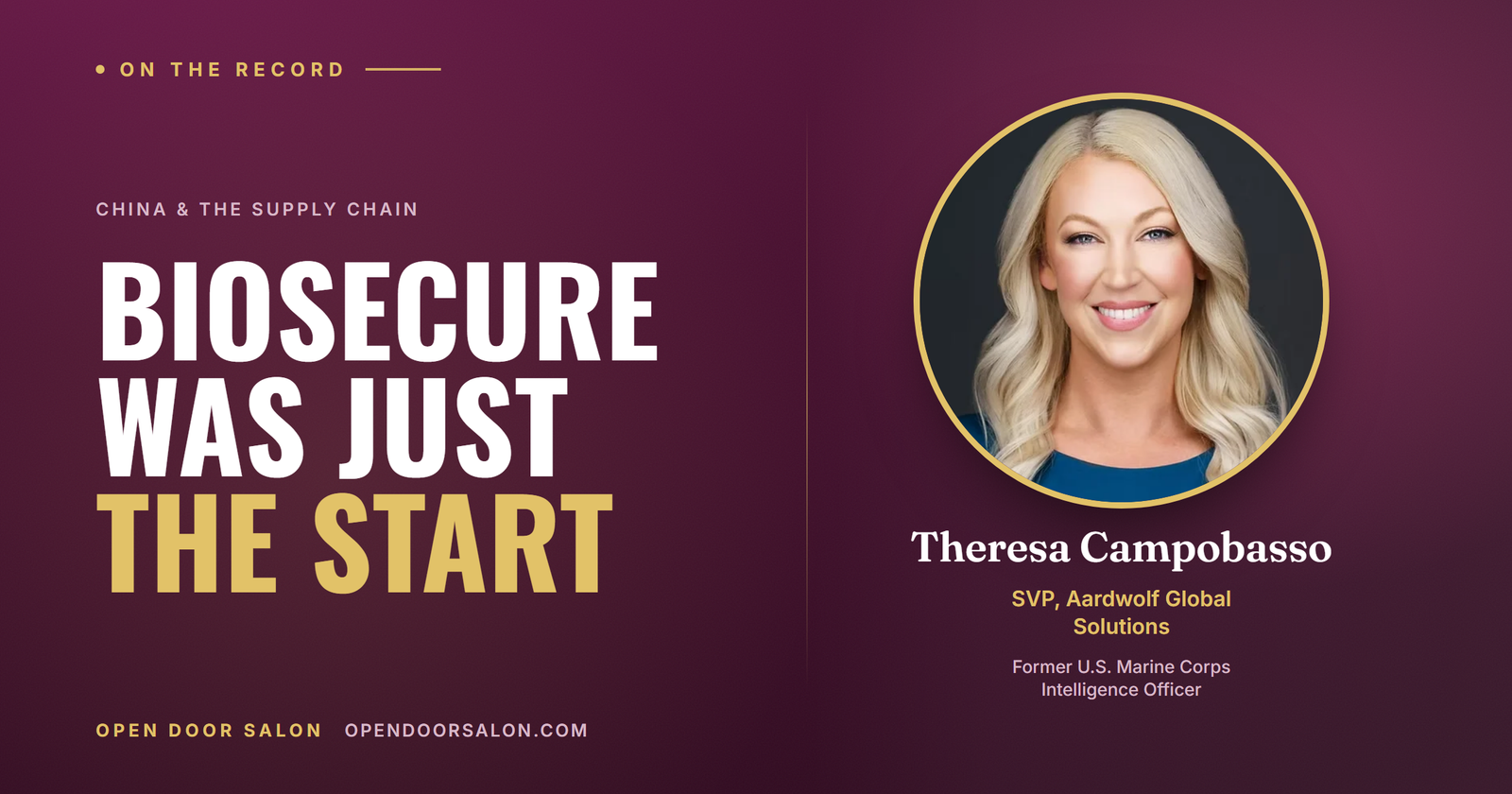
The BIOSECURE Act is often read as the finish line for US regulation of Chinese biotech. In a recent Open Door Salon conversation, Theresa Campobasso, a former US Marine Corps intelligence officer and Senior Vice President at Aardwolf Global, made the case that it is closer to the starting line, and explained where the rules are most likely to widen next.
What BIOSECURE covers today
As written, the law is narrow and specific.
"It is an act that is focused on five Chinese companies: BGI or Beijing Genomics Institute, MGI Tech, WuXi AppTec, WuXi Biologics, and Complete Genomics. If you are a company in the US that has any federal contracts, you may not use those five companies for genomic sequencing, for any drug-development services, for anything that touches American patient data."
Five named companies, federal contractors only, three use cases. That precision is exactly why Campobasso reads the law as a signal rather than a ceiling.
Why it is an early signal, not the end
The gap, in her telling, is between the size of the problem and the size of the current law.
"I absolutely do believe that the BIOSECURE Act is not the end-all be-all. I believe it should instead be seen as an early signal of where the regulatory environment is going. Because the problem it was intended to resolve is so much larger than those five companies and those three use cases, I think we're going to see that regulatory perimeter expand."
In other words, the narrowness is not a limit on intent. It is a first move.
Expansion axis one: more entities
The first place Campobasso expects growth is the covered-entity list itself, and she notes the pressure is already visible in Congress.
"I think we'll see more and more of these letters, more and more either specific names or types of entities or use cases added to legislation."
A short, named list is easy to plan around by avoiding a handful of companies. A list that keeps growing, or shifts from named companies to categories, removes that escape hatch.
Expansion axis two: more use cases
The second, and in her view more consequential, expansion is in what the rules cover.
"There are a couple key areas where US companies do have a lot of business and research relationships that are not included right now: active pharmaceutical ingredients or APIs, raw materials, the chemical precursors that most drugs are built from. Right now those are free and clear."
Those inputs sit at the base of the drug-manufacturing chain, and they are precisely where US dependence on a small number of overseas sources is deepest, which is what makes them the obvious next target.
The investment-side companion: the COINS Act
BIOSECURE expanding is only half the picture. Campobasso points to a parallel bill, the COINS Act, that would extend the same logic from procurement to investment, putting US licensing deals, joint ventures, and equity in Chinese biotech under government review. Read together, the two trace a single direction: the regulated line is widening on both the buying side and the investing side at once.
How to read where it is headed
Campobasso argues this is more predictable than it looks, if you watch the right sources.
"The way I try to stay up on it is I will set some automation to flag different articles as they get published. As hearings are published, you can read those and get a great sense of the follow-on actions and the topics that are being discussed."
What the five named companies signal
The specific names on the list are less important than the logic behind them. The covered uses, genomic sequencing, drug-development services, and anything touching American patient data, point at the categories regulators consider most sensitive: the places where Chinese access to US biological and health data, or to the pipeline that produces it, carries the clearest national-security weight. Read that way, the five companies are examples of a concern, not the boundary of it. The same logic applied consistently reaches well beyond the original list.
Why planning around names is a trap
That is the practical danger for a company building its strategy around the current text. Avoiding five named firms is straightforward; it is also brittle. If the perimeter shifts from named entities to categories of company, or from a short list to a growing one, a plan built on dodging specific names collapses the moment the list changes. Campobasso's argument is that the durable response is to understand a partner's actual structure, funding, and government ties, the things that would land it on any future list, rather than to track which names happen to be covered today.
When the conversation in those texts turns to APIs or medtech, she says, that is the tell. Whether or not the BIOSECURE Act itself is amended, the companies mapping their exposure against where the line is heading, rather than where it sits today, will have the most room to adjust. That is the conversation Open Door Salon exists to host. You can work with us here.
This piece is drawn from the recorded, on-the-record conversation with Theresa Campobasso on Open Door Salon. The bills referenced are proposed US legislation; consult current congressional coverage for their status.