
Who Actually Funds Global Health?
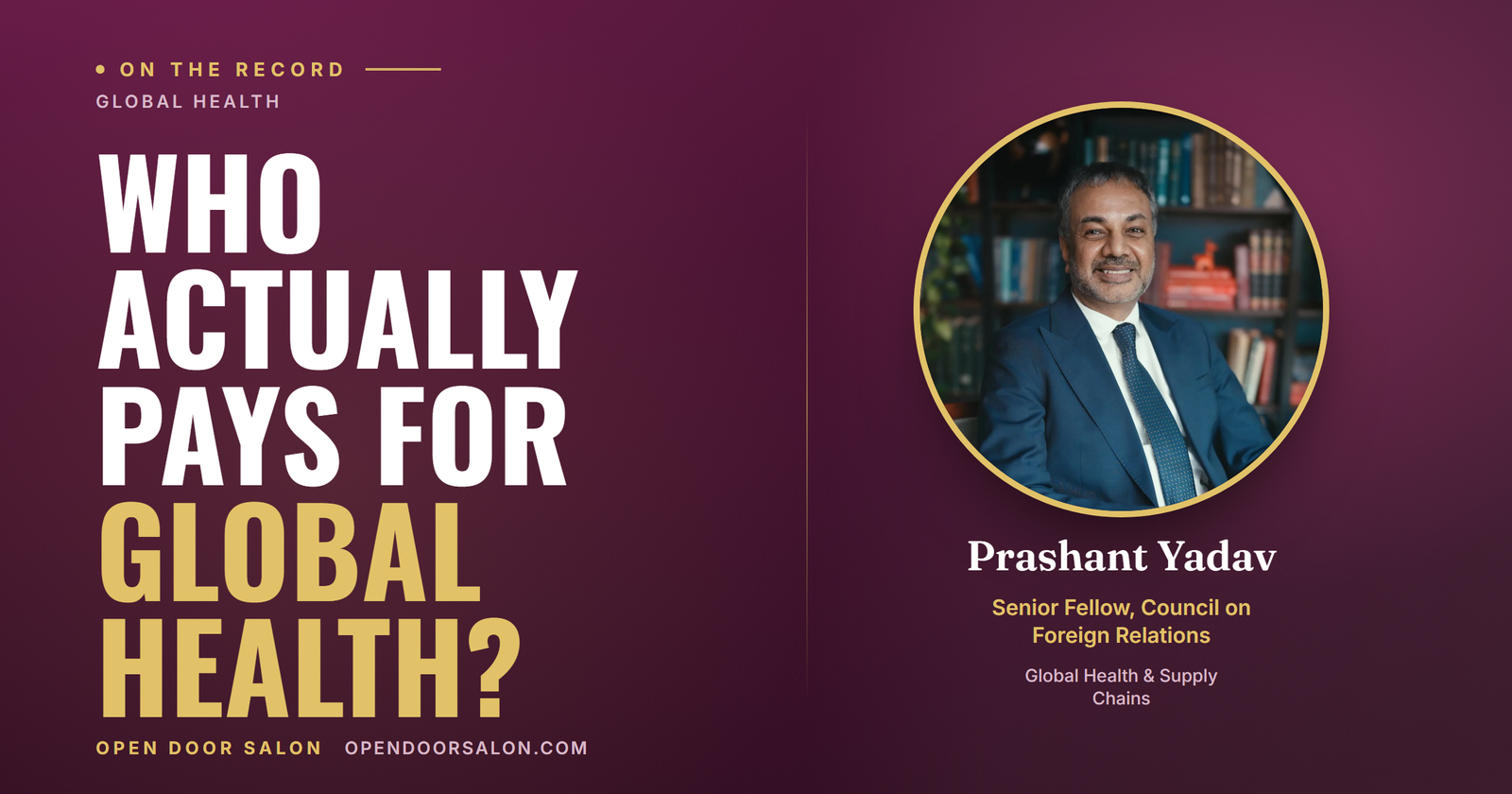
When global health funding is in the news, the story is usually about cuts and gaps. The more useful question, the one Prashant Yadav pressed on Open Door Salon, is who has been paying all along, and why so few others have stepped up. Yadav, Senior Fellow at the Council on Foreign Relations, started by correcting a common assumption.
The United States is still the largest funder
Despite the headlines about retrenchment, the basic fact has not changed. The US remains the biggest single source of global health money.
"The United States has been the largest funder of global health historically, but even now is the largest funder of global health."
There has been disruption in how programs move from one structure to another, but the scale of US financing is still, by a wide margin, the largest in the world. Any honest conversation about the funding gap has to start there.
The disproportionate-share problem
That fact leads directly to the uncomfortable one. If one country carries most of the load, the system is fragile by design.
"The US does carry a disproportionate share of financing for many global health functions."
Yadav's point was not that the US should pay less. It was that a global system resting this heavily on one funder has a built-in single point of failure, and that the imbalance is rarely named plainly.
Why aren't the other wealthy economies stepping up?
The question Yadav kept returning to was about everyone else. He excepted the consistent funders, then asked the obvious thing.
"Why aren't they bringing up their share?"
He extended it past the traditional donors to the large emerging economies whose wealth has grown substantially: India, China, Brazil. Their economies are far bigger than they were a generation ago, yet their share of global health financing has not grown to match. The capacity exists. The contribution has not followed. China’s growing weight shows up in research too, where its R&D spending recently passed the US for the first time.
And the recipient governments themselves
Yadav did not let recipient countries off the hook either. Part of a durable answer, he argued, is more domestic ownership.
"Why aren't recipient country governments in Africa or in Asia carrying more responsibility?"
This is not a call to abandon support. It is a recognition that systems funded entirely from outside are systems that can be switched off from outside, and that domestic financing is part of what makes health systems resilient.
What countries are doing as the old model frays
The most striking shift Yadav described is happening at the country level, born of necessity. Leaders in lower- and middle-income countries have stopped waiting for rescue.
"Their leaders have started taking things more in their own hands. They have started to accept that a global architecture is not going to come to save them."
Many of those leaders are elected and answer to constituents who need care now. That accountability is pushing a kind of self-reliance that the old donor model never required of them, even as fiscal constraints make it hard.
The gap nobody is fully filling
So who fills the space the traditional model leaves behind? The honest answer from the conversation is that no one is fully filling it yet. Private philanthropy is growing and some Gulf states are showing interest in humanitarian response, but Yadav was clear that this does not yet add up to a true backstop. The result is a system in transition, with more actors and less coordination, where the populations with the least margin are the ones most exposed if the new pieces do not come together. (For organizations weighing how these shifts reshape the field, Open Door Salon works with sponsors who care about it.)
The same conversation also examined whether the FDA is still the global gold standard, what happens to clinical trials when a war disrupts them, and how China is reshaping global health.
Prashant Yadav and Anna Titkova joined host Lori Ellis for the full conversation on Open Door Salon. More on Prashant Yadav and Anna Titkova.