
What Happens to Clinical Trials During a War?
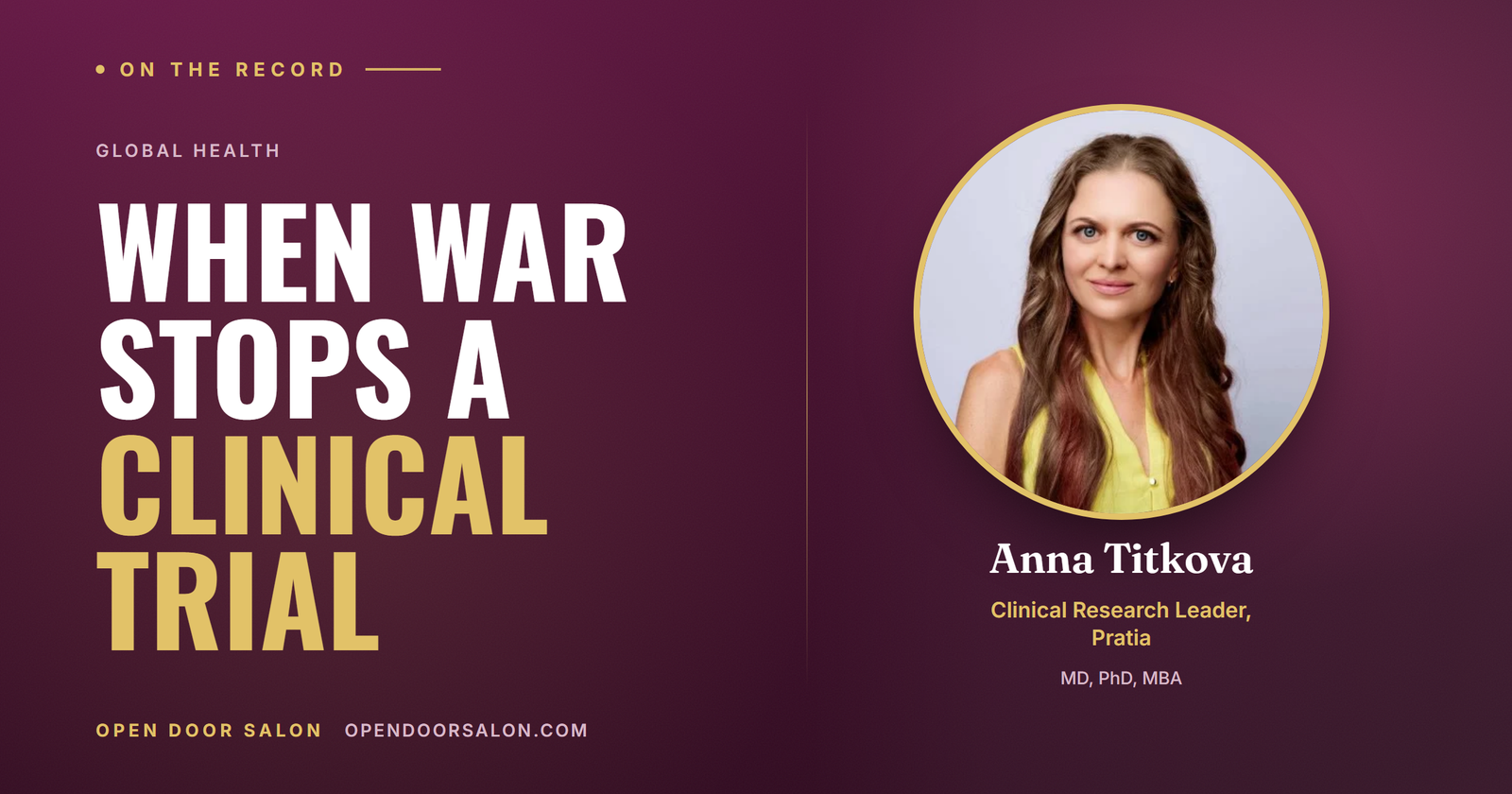
When a war begins, the clinical trials running inside the conflict zone do not pause cleanly. Supply stops, sites lose access, and the patients enrolled in those trials, many of whom have no other treatment option, are left exposed. Anna Titkova, Clinical Research Site Network Leader at Pratia, ran clinical research operations in Ukraine when the 2022 invasion began. On Open Door Salon she described what that looked like from the inside, and what it should teach an industry that tends to treat trial sites as line items.
A trial is not just where data is made. For some patients it is the treatment.
The first thing to understand is that clinical research is often care, not just data collection. For patients with no approved options left, a trial is the treatment keeping them alive. Anna Titkova framed the population plainly.
"For our patients... they were vulnerable even before the war."
When the dependence is that direct, a disruption to the trial is a disruption to care itself. That is the lens the rest of this story needs.
What actually happened when the war started
The immediate effect was that supply stopped. Shipments of trial material into Ukraine halted, and the patients who relied on them, inside trials and outside them, were suddenly cut off from care.
"Everything was stopped. The shipments were stopped... our patients, not only in clinical trials but outside of clinical trials, they appeared to be out of medical care."
Titkova's team worked to transfer patients to sites outside Ukraine that were never set up to receive them. The logistics were improvised under fire, and the clock was the disease, not the calendar.
One patient makes the cost concrete
The abstraction collapses into a single case. Titkova returns often to a young woman with Hodgkin lymphoma who had exhausted every available option in Ukraine and was, in her words, literally dying. One clinical trial fit.
"She started this participation in this clinical trial in December 2021 and she passed three chemotherapy with positive outcomes, with positive results, and then the war started, treatment was stopped."
A patient responding to treatment, then cut off by events that had nothing to do with her disease. That is what the phrase "trial disruption" actually means for the person inside it.
Why trials are sited where they are, and why that is a problem
Here the conversation widens. Prashant Yadav, Senior Fellow at the Council on Foreign Relations and an expert on pharmaceutical supply chains, explained that trial siting is driven heavily by risk avoidance.
"People usually are very risk averse. They want to go to places where their chances of disruption are minimal to zero."
From a sponsor's point of view that is rational: a site going dark mid-trial creates real problems. But the same logic quietly pushes research away from the populations and health systems that most need access, and it narrows the data too.
The hidden cost of retreating to the safest places
The deeper risk is that instability pushes the whole enterprise toward only the easiest locations. Titkova put the choice to the industry directly.
"Are we building a global research ecosystem that remains inclusive during these times of instability, or we're just retreating towards only the safest and easiest locations where it's easy to operate?"
This is not only an equity argument. Genetic diversity in trial arms and data drawn from many different health systems make the science itself more reliable. Retreat to the safe zones and you lose both the patients and the quality of the evidence.
What continuity actually requires
The practical lesson is that systems have to be built to flex before the disruption arrives, not after. For displaced patients the gap is often the most basic one: a person who has fled to a new country, without the language or any contacts, cannot navigate a health system however well funded it is. Continuity planning that assumes stable conditions is planning for a world that no longer reliably exists. The trial networks that held up in Ukraine did so because people improvised relationships and routes across borders, not because a protocol anticipated war.
Leadership when the information is incomplete
None of this comes with clean answers, and Titkova does not pretend otherwise. Her definition of leadership through the crisis is the most honest standard in the conversation.
"Leadership during the crisis is not about having all of the answers. It's about making the best decisions possible with imperfect information, but keeping at least some humanity inside yourself, inside your business, and inside your communication."
That is the throughline for any organization running research in unstable places: decide with incomplete information, keep the patient in view, and build for the disruption you cannot schedule. The companies thinking about that now, before the next crisis, are the ones whose trials, and whose patients, will still be standing when it comes. (If your organization is weighing how to support this kind of work, Open Door Salon partners with sponsors who care about it.)
The same conversation raised a related worry about regulatory trust: whether the FDA is still the global gold standard, who actually funds global health, and how China is reshaping global health.
On the machinery of running trials, Robert Califf, twice FDA Commissioner, argued the slow part is not the agency: is the FDA the clinical-trial bottleneck?
Anna Titkova and Prashant Yadav joined host Lori Ellis for the full conversation on Open Door Salon. More on each guest: Anna Titkova and Prashant Yadav.