
How China Is Reshaping Global Health
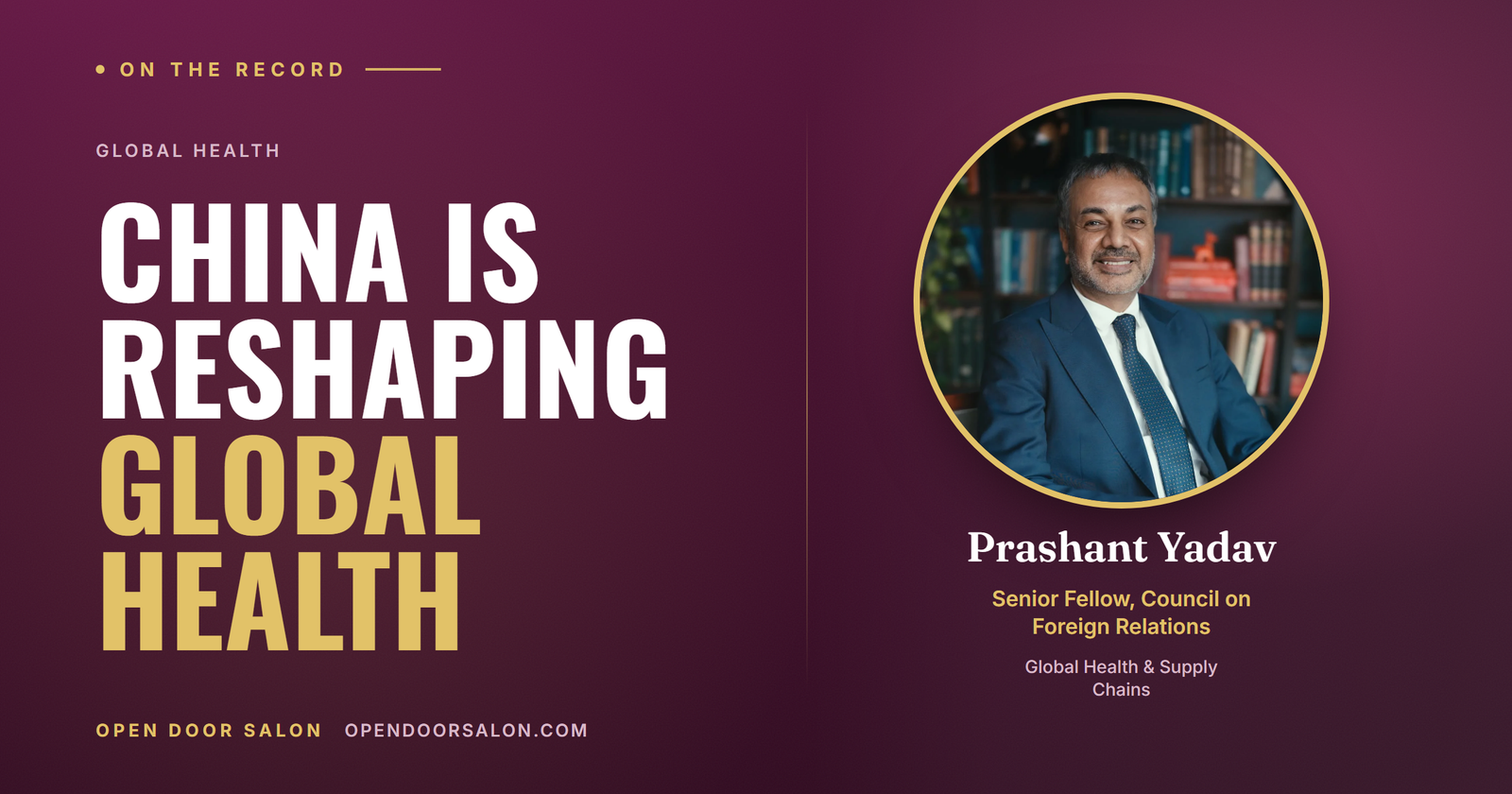
As the traditional sources of global health funding wobble, attention turns to who might fill the space. China is the name that comes up most. On Open Door Salon, Prashant Yadav, Senior Fellow at the Council on Foreign Relations, offered a more precise read than the usual headline: China is expanding its role, but on a model that works very differently from the one it would replace.
China is expanding, and it has the resources
The starting fact is real. China has both the money and the ability to move quickly on infrastructure.
"China has a resourcing both in terms of money resourcing but also in terms of providing quick infrastructure."
That capacity is not in question. What Yadav wanted to examine is the shape of how it gets deployed, because the shape is what determines whether it actually strengthens global health.
A different model of partnership
The expansion comes with a distinct approach. Yadav described it plainly.
"China is expanding its bilateral health diplomacy and its infrastructure, but not necessarily with the same model of partnership."
The previous system, built largely on US and European funding, came with civil-society engagement and accountability structures. China's bilateral model, as Yadav read it, is lighter on those. The money moves, but the surrounding architecture of accountability does not move with it in the same way.
Build the hospital, or cut the malaria?
The clearest way Yadav drew the contrast was through what gets funded. The China model favors the large, visible project.
"The China partnership model, it has been more about giving money for a large infrastructure project."
He set that against the slower, less photogenic work that older programs did.
"Let's build a large hospital, now, as compared to health programs which reduce the number of people who have malaria."
A hospital is something a political leader can stand in front of. A decade-long decline in malaria cases is harder to campaign on, even though it may save more lives. The incentive structure quietly favors the building over the outcome.
Why the accountability gap matters
The missing piece is not a detail. The accountability and civil-society engagement that came with the old model were part of what made the funding effective and hard to misdirect. Strip that out and you can still build things, but you lose the mechanism that checked whether the money actually improved health. Yadav's concern is not that China is involved; it is that a model without those checks is a weaker foundation for a global health system, whoever runs it.
Filling the gap is not the same as filling it well
This is the heart of Yadav's argument. Even if China takes on a larger role, the terms would reshape what global health support means.
"Even if China does come in to fill in the gap and takes on a larger mantle here, it would be a very different model."
A different model is not automatically a worse one in every respect, but Yadav was clear that it is not the way he would choose to run the global health architecture. Substituting one funder for another without preserving accountability changes the system's character, not just its budget line.
What to actually watch
For anyone tracking this, the signal is not the dollar figure or the ribbon-cutting. It is whether the accountability and civil-society structures that made the old system work get rebuilt in the new one, by China or by anyone else stepping in. Infrastructure is the easy part to see and the easy part to fund. The harder, quieter machinery of accountability is what determines whether a reshaped global health system actually serves the patients it is supposed to. (For organizations mapping how this realignment affects their work, Open Door Salon partners with sponsors who care about it.)
The same conversation also examined who actually funds global health, whether the FDA is still the global gold standard, and what happens to clinical trials when a war disrupts them.
Prashant Yadav and Anna Titkova joined host Lori Ellis for the full conversation on Open Door Salon. More on Prashant Yadav and Anna Titkova.