
Why Government AI Projects Fail: The FDA’s First CIO
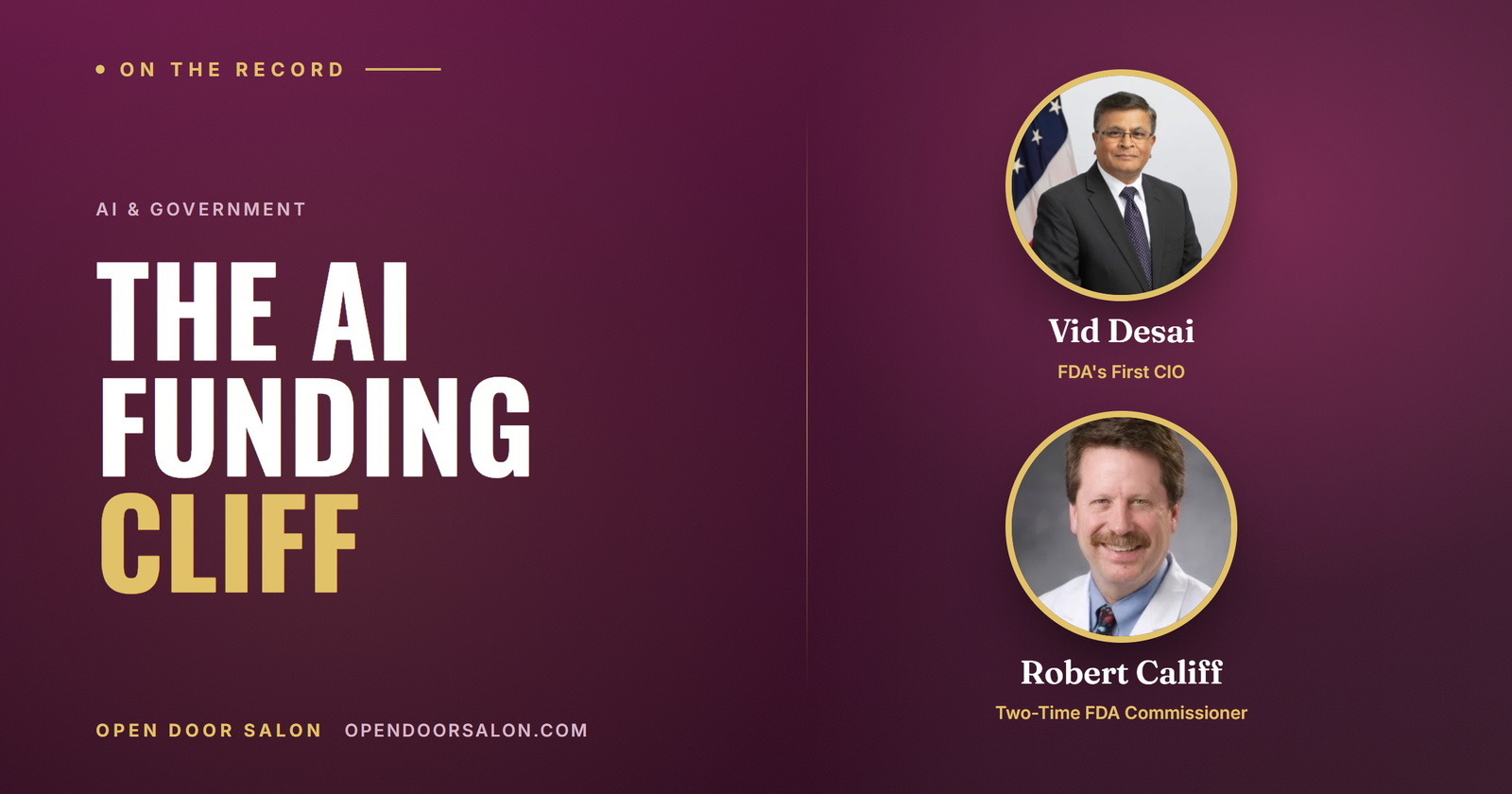
Government AI projects usually fail for budgetary reasons rather than technical ones. That is the assessment of Vid Desai, who served as the FDA's Chief Technology Officer and then as its first Chief Information Officer reporting directly to the Commissioner. Temporary money launches a program, roughly 40 to 50 percent of the initial investment is needed just to keep it operating, and when the temporary funds expire there is often no plan to replace them. Desai described the pattern on Open Door Salon using the FDA's own AI tool, Elsa, as the example, alongside Robert Califf, the two-time FDA Commissioner.
Why did the FDA's Elsa AI tool run into trouble?
Elsa was announced and then found within months to be hallucinating. The easy story is that the agency rushed an immature technology. Desai's account complicates that, because the groundwork predated the announcement: model testing and proof-of-concept work were underway while he and Califf were still at the agency, with the Oncology Center of Excellence among the most enthusiastic participants. The unsolved problem was not whether the models worked. It was what happens after launch.
AI is is is great, but it's not cheap
What is the funding cliff that kills these programs?
Desai's mechanism is specific and applies well beyond the FDA. Agencies fund innovation through temporary instruments, including the non-recurring expense fund, which exists to surge money into things like cybersecurity or crisis response. Those funds buy impressive launches. They do not buy operations.
eventually those funds go out and then what do you do?
By his estimate, 40 to 50 percent of an initial investment is needed for day-to-day operation. If nobody has secured recurring funding by the time the temporary money expires, the program contracts or shuts down. He has watched it happen before, pointing to COVID-era programs and infant formula oversight programs that were reduced or ended when their funding ran out. Nothing about that sequence is unique to artificial intelligence. AI simply makes it more visible, because the operating cost does not fall after launch the way a traditional software project's does.
How do you make a technology change stick in government?
Desai's answer is that announcements are not changes. He uses the phrase podium policy for the pattern of announcing before the groundwork exists.
Unless you change the funding, fundamentally, nothing changes within the agency
Changing the funding means working with Congress, or reworking user fee programs, or redirecting internal funds. It is slow, unglamorous, and it is what makes a change survive the next administration. His observation is that this kind of work makes a team look slower in the short term, and that the current pattern favors speed of announcement over durability. As he put it, the announcements get headlines, but when oversight arrives a good deal of it gets reverted.
Will AI reduce the number of people an agency needs?
Califf does not think so, and his reasoning is the most counterintuitive part of the conversation. He expects AI to surface demand that was always there and never met, rather than to shrink headcount. The evidence he cites is the user fee negotiations he was involved in twice.
the biggest demand from the mature industries and that is I'm talking about mostly drugs and devices was for more meetings not for faster timelines
Industry was not asking the agency to go faster. It was asking for more access, and the FDA did not have the people to provide it. If routine work is automated, the freed capacity meets a backlog of human interaction that has been suppressed by understaffing for years. Califf draws the same parallel to clinical medicine: remove the billing burden from doctors and nurses and you do not get fewer clinicians, you get attention flowing to a large amount of unattended human need.
What question should executives be asking about AI?
Desai closed the section with an example from outside healthcare that reframes the whole deployment question. IKEA found its AI could handle about half of routine call center questions. Rather than cut staff, the company examined the half the AI could not answer, discovered most were requests for design help, and built a new service around it with retrained staff.
I think I think AI is all about asking the right questions
His point is that the question determines the answer. Ask an AI how to cut costs and it will tell you how to cut costs. Ask how to grow revenue or improve service and you get an entirely different set of options. Most leaders, in his view, have not learned to ask the second question. That framing is a useful counterweight to a hospital CIO's argument that AI will not cut corners, and it contrasts with the supply-chain mapping work described in why BIOSECURE will not protect pharma from China, where AI is doing narrow work that a budget can actually sustain.
The broader institutional context, including what the current staffing picture does to the agency's capacity to run any of this, sits in is the FDA still the gold standard.
Watch the full conversation with Vid Desai and Robert Califf on the episode page. If you want to reach the decision-makers in that room, start here.
Drawn from the recorded, on-the-record conversation with Robert Califf and Vid Desai on Open Door Salon. Figures and program details verified against primary sources where cited.