What Is Venture Philanthropy? How It Funds Drug Development
Venture philanthropy is one of the least understood funding models in life sciences, largely because the name suggests charity and the practice looks like investing. It is a nonprofit deploying capital into companies on investment terms, with returns recycled into the mission rather than distributed to partners.
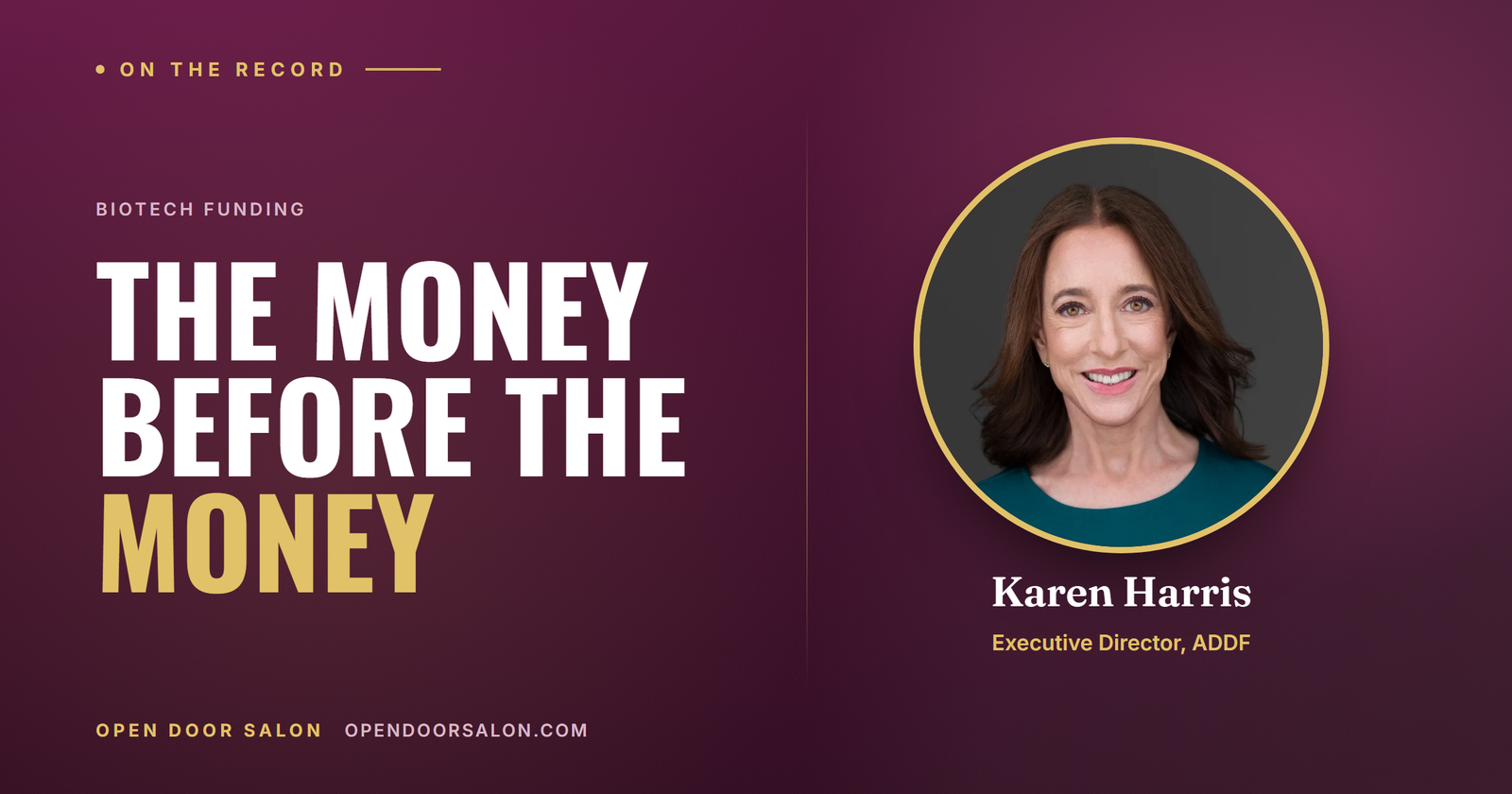
The Alzheimer's Drug Discovery Foundation is among the clearest working examples, and Karen Harris, who leads its mission-related investing, described the mechanics on Open Door Salon alongside seed investor Mahesh Narayanan of Neuvation Ventures.
Where does venture philanthropy invest?
The stage is the definition. Harris is precise about it.
We're investing primarily in the IND enabling phase to phase 2A, and we view venture as completely complementary, and what we're doing is trying to get our companies to an inflection point where venture will invest, where pharma will invest.
That window, from the work required to file an investigational new drug application through early human testing, is the hardest place in drug development to raise conventional money. The science is real but the risk is high, the timeline is long, and the evidence a venture fund needs does not exist yet. It is a genuine gap, and it is the gap this model exists to fill.
Is venture philanthropy competing with venture capital?
No, and both parties say so independently, which is the useful part.
Harris describes the ADDF working closely with VCs specifically to pull further investment into its portfolio companies. The measure of success is not a return in isolation. It is getting an asset to a point where somebody else will fund it.
Narayanan describes the same relationship from the receiving end. He expects considerably more validation than a venture philanthropy funder does at the earlier stage, and he puts the difference down to risk capacity. Funders like the ADDF, he says, are willing to take more risk at that stage than his fund is able to.
Read together, the two funders work in sequence: venture philanthropy carries an asset to the point where venture capital will take it on. A founder who understands the sequence stops pitching the wrong funder.
What does venture philanthropy want that a VC does not?
The financial mechanics differ less than the orientation does. A nonprofit funder is underwriting a mission, so a portfolio company that gets acquired early is not automatically a win if the science stops advancing. That shapes what they ask about.
It also shapes the support. Harris describes the ADDF's science team working closely with companies on clinical trial design, helping structure a specific project correctly, and connecting companies with key opinion leaders. That is a different service than a board seat.
What she wants from a founder, though, is the commercial instinct a purely scientific team often lacks.
What I like to see most is a scientist who also understands that this has to be a commercial venture as well.
It is the same trait she and Narayanan reach for when they describe how they actually read a founder, and it is the one that does not show up in the science.
Why the model matters more in some diseases than others
The gap venture philanthropy fills is widest where the science is hardest and the timelines longest, which describes neurodegeneration precisely. Nonprofit money is one answer to a vacated middle; pooled family-office capital is a private answer to the same vacancy. Harris lists the funders a program in this field needs.
For Alzheimer's anyway, it takes a village. So you need the government funding, you need university funding, you're gonna need venture funding, venture philanthropy and pharma.
Trials in this area are expensive enough that the foundation actively helps companies maximize the number of separate funding sources they can assemble. In a field where a single trial can consume more capital than a seed fund holds, no one pocket is sufficient.
What happens to the returns?
This is the mechanic that separates the model from a grant, and it is the part most founders have not thought through. A grant is spent. A venture philanthropy investment is structured on investment terms, so when a portfolio company succeeds, capital flows back to the foundation and is redeployed into the next set of programs. The Cystic Fibrosis Foundation is the model at scale, having secured more than $4 billion to reinvest in drug development from its stake in the CF therapies it helped fund.
Two consequences follow. The funder is a genuine counterparty who will negotiate terms rather than simply award money, which is why Harris is across the table structuring deals at all. And the incentive is durable in a way a grant cycle is not: a foundation recycling returns can keep funding the same hard problem for decades without depending on fresh donations at the same scale. In an indication where a single program can take fifteen years, that patience is the actual product.
How a founder should approach it
Three practical implications follow. Match the funder to your stage rather than pitching everyone at once. Expect a nonprofit funder to ask harder questions about scientific rationale and softer ones about near-term commercial return, and prepare accordingly. And treat a venture philanthropy round as a bridge with a destination, because that is explicitly how the funder sees it.
The model is also a partial answer to the problem running underneath the whole conversation. If early-stage neuroscience is the hardest money in life sciences to raise, a funder built specifically to carry assets across the gap is not a charitable footnote. It is infrastructure.
Open Door Salon convenes these conversations on the record. If your company wants to reach the operators and investors in this room, that is what sponsorship is for.
Drawn from the recorded, on-the-record conversation with Karen Harris and Mahesh Narayanan on Open Door Salon.