Mike Goguen and Christian Schubert on What Gets a Biotech Pitch Funded
What you’ll learn
- What separated the five investments from the roughly six hundred opportunities a corporate venture fund reviewed last year
- Why the size of the problem is the first test in biotech, before the team or the technology
- What actually loses a pitch inside the first twenty minutes
- Whether warm introductions still move a founder to the front of the line
- Why raising less money early correlated with bigger outcomes in one investor’s own look back at the data
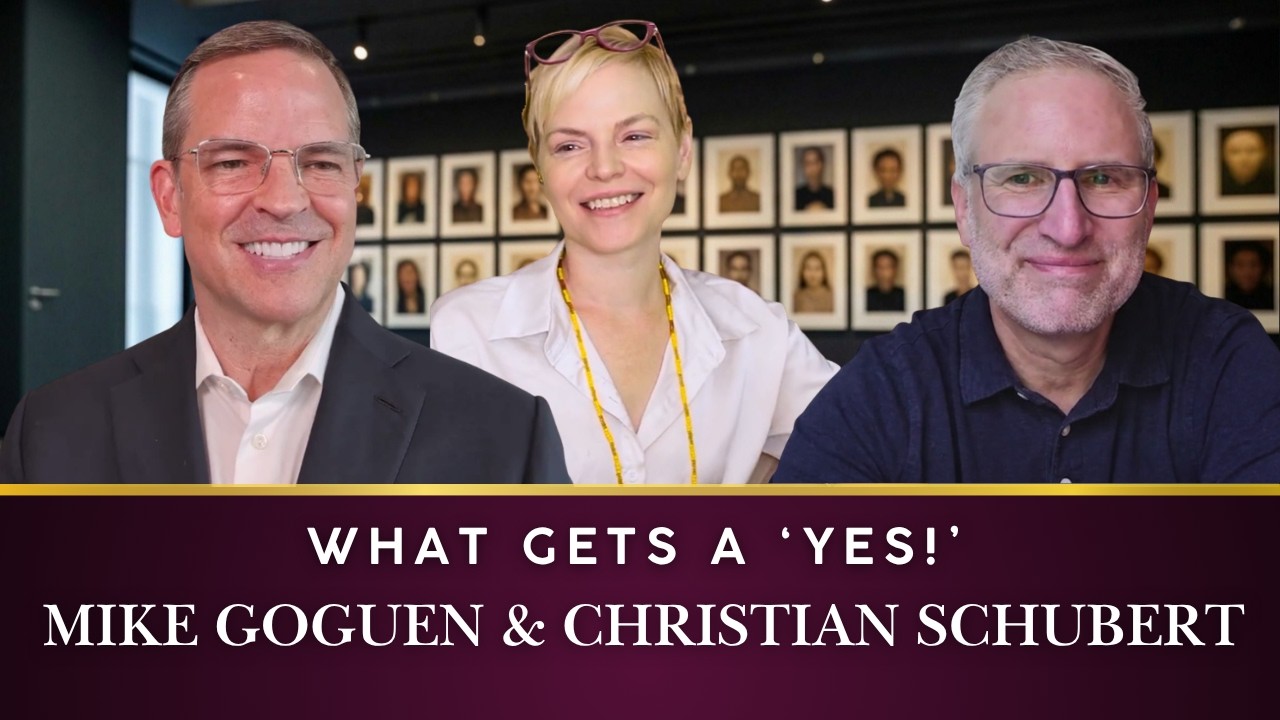
Two investors sat down with Lori Ellis and answered the question founders spend years guessing at: what actually separates the pitch that gets funded from the one that does not. Mike Goguen is founder and managing partner of Two Bear Capital, and spent twenty years as a general partner at Sequoia Capital before that. Christian Schubert is Vice President and Global Head of AbbVie Ventures, the strategic venture arm of AbbVie. One writes checks from a fund. The other writes them off a pharmaceutical balance sheet. They disagree about less than you would expect.
What did the five companies that got funded actually have?
AbbVie Ventures reviewed roughly six hundred investable opportunities last year and made five new investments. Christian Schubert’s account of how that number collapses is arithmetic before it is judgment. The top one or two percent are visible to everyone in the market, he says: the science aligns, the target is druggable, the work is testable in the clinic, and there is freedom to operate. Most people can also spot the eighty to ninety percent that are clearly not investable, where the gaps are simply too wide to bridge with money.
So I think for us the real opportunity, and this is where the five came from, are in the middle. It’s the five to 10% where you’re intrigued enough. They show enough promise to warrant some deeper work.
Deeper work means weeks, sometimes months, of rolling up sleeves to derive a differentiated insight that turns into an investment thesis. The five came out of that band, which is the part of the market where an answer has to be manufactured before it can be acted on.
Why does the problem have to be big enough before anything else matters?
Mike Goguen starts from a different place. His first test is the size of the problem, and his reasoning is specific to biology. In technology, he says, founders will roughly build what they said they would build, and the open question is whether it is the thing customers need. Biotech carries a risk that does not exist in software: the science may simply refuse to work.
Given that there’s risk in it not actually working the way they hope it’s going to work, you sure better be shooting for a big enough impact.
Only after that does he look at the founder, and the attribute he names first is obsession. Across thirty years, sitting on boards himself, he has watched founders build companies that became hundred-billion-dollar outcomes, and the recurring trait is someone fixated on a specific disease for a reason that predates the company. He also wants more than one shot on goal, which is why he leans toward platforms over single molecules at the earliest stage.
We look for some innovation that will generate multiple assets.
What loses a pitch in the first twenty minutes?
Christian Schubert’s version of the early filter is about honesty under questioning. His team digs quickly and deeply, even in a non-confidential setting, to find the gaps in a founder’s understanding and to see how openly those gaps get discussed.
It’s that interplay in those first, you know, 20 minute conversations. Oftentimes they’re actually without any slides or support materials. It’s just a conversation.
Mike Goguen loses interest at a different signal: a founder whose motivation runs through the arithmetic of an exit. Those founders, in his experience, lack the resilience the work demands, and resilience is the word Schubert reaches for too.
You’re going to get knocked down many, many times over … and you have to just get back up and keep going.
How much diligence goes into the team, not just the founder?
Asked how much scrutiny the wider team receives, Mike Goguen answers immediately: not enough. He has served on more than eighty company boards across three decades and calls insufficient team diligence a repeated failure mode. What he means is temperament. How does this person think? How fast do they commit? How curious are they when the data turns?
Schubert adds a failure he has watched more than once: experienced leaders arriving from large organizations, accustomed to big teams and delegation, into a setting where no day resembles the last. He describes early-stage leadership as sitting somewhere between a social worker and a fireman, and says the clean division of executive roles usually does not arrive until a Series A or later.
Do warm introductions still move you to the front of the line?
Both answered plainly, and the answer is yes.
I wouldn’t call it an even playing field.
Mike Goguen frames it as a bandwidth constraint. A trusted colleague vouching for a company gets read before a cold email because attention is finite. Schubert is more categorical.
I can’t think of a single investment we’ve done over the last 24, 36 months that did not come through some channel of a previously known entity.
He is careful that a channel need not be a person. AbbVie Ventures runs innovation competitions with strategic partners, and companies that come through those have measurably higher odds of follow-on funding. What the warm introduction supplies is early credibility, and a reference who can speak to why this team and why now.
Why would an investor tell a founder to raise less money?
This is the counterintuitive one. Looking back at a wide set of Silicon Valley startups, Mike Goguen found something he did not expect.
The amount raised, especially in the early stage, was almost inversely correlated with the success.
He is careful not to turn that into a rule, and offers a mechanism: a scarcity mentality has a focusing effect on what a team chooses to fund, and a very large seed round raised on the right buzzwords may dull exactly the thinking that early-stage work depends on. The test he applies is whether a first check gets the company to a genuine inflection point at which the next round becomes straightforward.
Schubert has a structural version of the same conversation. Because AbbVie Ventures invests off a corporate balance sheet, it generally stays below twenty percent ownership, which means sizing a round so the valuation still lets institutional investors come in later without a down round.
What separates a useful no from a vague one?
Both men were direct that most nos are badly delivered. Goguen argues the constructive version names the specific experiment that would change the answer, and says vague passes help nobody. Schubert has operationalized his.
For us it’s actually the no but, right, and that but is, let’s work with you.
AbbVie Ventures launched a venture partner program this year, embedding R&D scientists with twenty and thirty years of experience directly into deal flow. Schubert describes an investment they are about to close where the conversation started two and a half years ago and the company today looks nothing like the one that first walked in.
He also names something founders rarely get told: a no is sometimes a function of where a fund is in its own deployment cycle, not a verdict on the science. Anyone raising should understand the position of the funds they approach. Founders working through what happens when the traditional path to an IPO closes will recognize the dynamic.
What does a fundable company look like in 2027?
Neither expects the fundamentals to move. Schubert’s list holds steady: transformative science, a clear path to the clinic, product market fit, freedom to operate, and scarce resources pointed at the experiments that matter most. He frames the market as a capital allocation problem rather than a capital availability one, and is candid that enthusiasm for platform and AI companies will cool where the technology has not produced transactable assets.
Mike Goguen agrees that early-stage fundamentals and early-stage valuations barely move with the cycle, a point he also made in an earlier conversation about what founders can control in a hard market. What he expects of a 2028 startup is awareness of the convergence he built his firm around. He studied electrical engineering at Cornell in the early 1980s and chose technology partly because biology was not yet knowable enough. Genomics changed that, and he describes the moment tech people realized there are three billion instructions of code in every cell as the moment many of them came back.
The greater your positive impact on people, the greater the economic benefit should be.
The amount raised, especially in the early stage, was almost inversely correlated with the success.
Key takeaways
- The work is in the middle. The top one or two percent and the bottom eighty to ninety percent are obvious to everyone. Diligence concentrates on the five to ten percent where the answer has to be manufactured.
- Problem size is the first filter. Because the biology may refuse to work, the potential impact has to justify the risk that it does not.
- Obsession outranks credentials. The recurring trait across three decades of boards is a founder fixated on a disease for reasons that predate the company.
- Team diligence is the repeated failure. Mike Goguen has served on more than eighty boards and still answers not enough when asked how much scrutiny the wider team receives.
- Warm introductions still work. AbbVie Ventures cannot point to an investment in the last two to three years that arrived without a prior connection, though a channel need not be a person.
- Big early rounds correlated with worse outcomes. A scarcity mentality has a focusing effect on what a team chooses to fund.
- A useful no names the experiment. The constructive version says what would change the answer. The vague pass helps nobody.
- A no is sometimes about the fund. Where a fund is in its own deployment cycle can decide an outcome that looks like a verdict on the science.
Key Questions, Answered
How many biotech pitches does a corporate venture fund review before it invests?
We do review thousands of opportunities across the organization.
AbbVie Ventures reviewed roughly six hundred investable opportunities last year and made five new investments.
Where do venture investors actually spend their diligence time?
So I think for us the real opportunity, and this is where the five came from, are in the middle. It’s the five to 10% where you’re intrigued enough. They show enough promise to warrant some deeper work.
The obvious winners and the obvious passes are visible to everyone, so the work concentrates in the uncertain middle.
What makes biotech riskier to fund than technology?
Given that there’s risk in it not actually working the way they hope it’s going to work, you sure better be shooting for a big enough impact.
Software founders generally build what they promised. In biology the science itself may refuse to cooperate, so the potential impact has to justify that risk.
Why does a founder’s obsession outweigh their credentials?
The number one attribute we focus on is ... passion and almost obsession.
Mike Goguen ranks obsession with the problem above scientific expertise, and looks for a founder fixated on a disease for reasons that predate the company.
Why does resilience matter so much for early stage biotech founders?
You’re going to get knocked down many, many times over ... and you have to just get back up and keep going.
Christian Schubert names resilience alongside passion, because the work involves repeated setbacks against a short runway.
What loses a biotech pitch in the first twenty minutes?
It’s that interplay in those first, you know, 20 minute conversations. Oftentimes they’re actually without any slides or support materials. It’s just a conversation.
Investors probe for the gaps in a founder’s understanding and watch how openly those gaps are discussed.
Why does an investor read one company before another?
I wouldn’t call it an even playing field.
Mike Goguen frames the advantage as a bandwidth constraint on investor attention.
How often do funded biotech deals come through an existing connection?
I can’t think of a single investment we’ve done over the last 24, 36 months that did not come through some channel of a previously known entity.
A channel need not be a person. Innovation competitions and prior relationships both count.
Should a biotech founder raise less money in the early rounds?
The amount raised, especially in the early stage, was almost inversely correlated with the success.
A look back at Silicon Valley outcomes surprised him. He offers a scarcity mentality as the mechanism, and declines to turn it into a rule.
What makes a venture capital no useful to a founder?
For us it’s actually the no but, right, and that but is, let’s work with you.
A constructive pass names the experiment that would change the answer, and keeps the conversation open.
Resources
- Two Bear Capital Mike Goguen’s early-stage firm, investing where technology and life sciences converge.
- AbbVie Ventures AbbVie’s strategic venture arm, which Christian Schubert leads.
- Mike Goguen on LinkedIn Founder and Managing Partner, Two Bear Capital.
- Christian Schubert on LinkedIn Vice President and Global Head, AbbVie Ventures.


Need the life-sciences signal but short on time?
Get the free quarterly briefing: every guest from the quarter, in one sitting. What decides whether a therapy reaches a patient, gets funded, and can be trusted.