
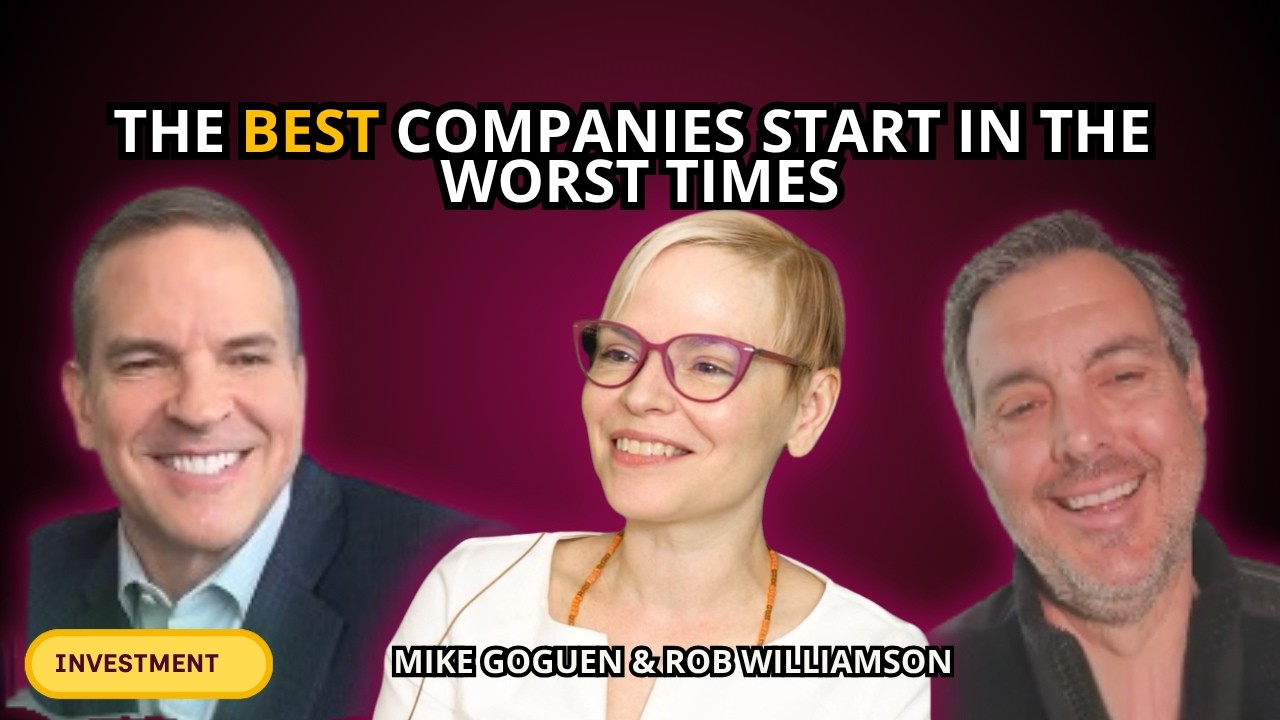
Mike Goguen & Rob Williamson: “The Best Companies Start in the Worst Times”
What you’ll learn
- Why capital efficiency, not the funding climate, separates the biotechs that survive a downturn
- What Goguen means by “beware the kindness of strangers”, and how founders minimize dependence
- How to spot real AI in drug discovery versus window dressing
- Why an early-stage biotech can’t win the AI salary war, and what recruits talent anyway
- Whether we’re in an AI bubble, and how to exploit one without being blinded by it
Two people who have spent their careers on opposite sides of the term sheet agree the funding environment is hard right now. Where they converge is on what a founder can actually control inside it.
Mike Goguen is founder and managing partner of Two Bear Capital, an early-stage firm investing at the intersection of advanced technology and life sciences. He spent twenty years as a general partner at Sequoia Capital, joining in 1996 and leaving in 2016, before founding Two Bear in 2019. The firm is in its second main fund with roughly 25 portfolio companies, about a third of them deep biotech concentrated in oncology and neurological disease.
Rob Williamson is founder and CEO of Traverse Therapeutics, a stealth biotech building an AI platform for targeted drug delivery across the blood-brain barrier. An economist by training and a former BCG partner, he founded his first biotech, a genomics company, in 1999 and has spent more than two decades building life-sciences companies and bringing drugs toward the market. He also sits on the board of a public radio-oncology company.
Capital efficiency is the screen, not the climate
Goguen does not treat the funding environment as the variable that matters most. “The capital efficiency of some of the companies we back is a core consideration,” he says, and he looks for “founders who do things a little more cleverly or have more clever ideas on the amount of capital required to get to milestones.”
The environment still matters. But he points at a buffer founders underuse: pharma, which “gets to be somewhat immune to the vagaries of the stock market,” and has become one of the leading customers of biotech startups. Keep a pulse on what pharma actually needs and financing remains possible in a market that has been punishing for two years.
Williamson, raising right now, does not soften the picture. “No one’s saying, oh this is easy,” he says. He sees the market splitting into two shapes: enormous bets where “an investor just throws a ton of money into an idea and a management team,” and disciplined early-stage rounds built around capital efficiency, in a market where VCs now want a single asset with a binary outcome. As an economist, watching a company spend “willy-nilly” in an easy market “drives me nuts.”
Beware the kindness of strangers
A line he has used since his Sequoia years. “I used to say beware of the kindness of strangers.” The definition is blunt: “everybody is a stranger other than your founders and the folks in the company.” Future investors are strangers. So are partners. Each is a dependence you are quietly counting on.
The instruction is not to eliminate dependence, which is impossible, but to shrink it: grants and non-dilutive capital early, a cleverer model. What he is drawn to is a founder whose plan says “I don’t care how bad the environment is.” If the market turns out better than their worst case, they do better. If it does not, they still get there.
The best companies start in the worst times
The episode takes its title from here, and Goguen frames it as selection pressure, not optimism. “Some of the best companies were founded during some of the worst times,” he says, and the mechanism is “almost Darwinian because when the times are really easy… lots of money getting thrown at a category and it’s kind of hyped… the quality bar sort of goes down a little bit.”
The mechanism is the kindness of strangers again. Founders see a peer raise “a series ABCDEFG,” assume that capital will always be there, build accordingly, “and then all of a sudden the environment changes and you’re kind of screwed.”
Is the race worth the run?
Goguen’s first test is not the team. It is the ceiling. “Is the race going to be worth the run?” If everything works, does it matter? He is explicit about the case he will not fund: a drug “you’re working in oncology lets you live a month longer, and is still terminal and it has horrible side effects. Not that.” A commercially successful drug is not automatically a drug Two Bear wants.
Only then does he look at founders, and here he is deliberately contrarian. “They can be first-time founders, so I actually like first-time founders. Science founders never started a company before.” Then the firm commits: “we sort of jump in that kayak with the founder in class five rapids and we grab a paddle for the whole duration.”
The commitment has a stopping rule, the sharpest thing he says about how his firm differs. “We’re going to give up when the biology tells us to give up.” Not when a category cools. Sentiment gets blinders; the assay does not. Keep executing and, often enough, “pharma wakes up and says, holy cow, like we wouldn’t have given you the time of day before.”
Your product-market fit is pharma
Williamson runs the same logic from inside a pre-seed company, already talking to strategics “not because I think we’re going to do a deal with them anytime soon, but because I need to understand what they want, what their pain points are.”
There is a second-order benefit. When one program runs under a pharma partnership, “the rigor and demands for the pharma partner program bleeds into the rest of the organization.” Goguen agrees and adds the caveat that keeps it honest: “what a pharma company wants today might be very different than what they want six months from now.”
What actually kills a deal
Williamson is direct about where transactions die. Something crystallizes a deal, a hot category or maturing data. After that, “what kills a transaction once it’s catalyzed… is really time.” IP attorneys can kill it. Bankers “can get greedy and just piss off the other side.” What carries it through is committed management on both sides pushing it to close.
He also thinks the posture matters more than the price. “The best way to get… bought, if you’re the company being acquired, is to not really want to get acquired,” he says. “If you want to get acquired… it’s like dogs sense fear.” Goguen’s version is a win-win test: if either side senses the other does not have that mentality, the deal gets harder. His counter to a squeeze is unsentimental. “The best counter to that, by the way, is called competition.”
Williamson adds that M&A has been slower than he expected, and blames uncertainty rather than appetite. Buyers “don’t know what their environment’s going to be like 6 months from now.”
Where’s the beef?
Both are direct that AI claims in biotech have outrun AI substance. Williamson, pitching an AI-native company, finds the noise costly: “almost every company raising money says they have AI,” and much of it is “really just a repurposing of one of the three off-the-shelf LLMs.” The bubble, for him, “creates confusion” and makes real differentiation harder to explain.
Goguen’s filter dates to 1996. “I had this fallback when I was listening to a company, which was, where’s the beef?” The test is a demonstrated before-and-after, not a buzzword. “Folks are trying to do as much window dressing as they can to make themselves look relevant and hot. So you have to dig that next level down.” He staffed against it, hiring an investment team of domain PhDs.
On where AI is genuinely working, Goguen is specific: he has gotten more mileage from companies pairing computation with real biology than from purely in silico drug design. Williamson is building exactly that. A “multi-algorithm agent AI structure” mapped blood-brain barrier receptors to cell types at a scale that “you could never have done that 3 years ago.” The feedback loop itself is not finished: “we’re building that right now,” he says, a system he calls “the in silico in vitro in vivo loop.”
The talent war, and why anyone says no to the money
The constraint Williamson cannot engineer around is people. Graduates he wants are gone before he can bid: “they’re getting offered half a million comp right out to go work for the LLM platform companies,” against a pre-seed biotech budget. He got resourceful to the point of conscripting family: of one of his children, an analytics specialist, “I made him work for us for basically free for a while.”
Goguen’s answer is the only lever a small company has. If the work matters, a technical hire can weigh “I can help have an impact on this incurable disease” against a larger offer to “better invade your privacy.” He is realistic about the size of that lever: “not a great counterforce cuz the salaries are still ridiculous.”
The same discipline governs the bubble itself. “You have to be aware of when you’re in a bubble and exploit it if possible,” Goguen says. Take the higher price if it is on the table. Just never build a plan that requires the wind to keep blowing, because it “could change in a split second.”
Asked what is nearer term, Williamson points at digital twins: “digital models of organic or natural environments,” including groups building software to “mimic microgravity so you can do experiments digitally before you actually shoot the rocket up into space.” Asked what is five to ten years out, he names quantum. His AI team believes that when quantum computing works, “our AI is going to be quantum AI,” and they are already telling him how it changes drug design. He rates it “at least comparable” to the AI revolution, “but maybe even greater,” and watches the field with his own money.
Goguen, who studied simulation of complex systems at Stanford in the 1990s, frames the prize precisely: conventional computing cannot model molecular interactions at the resolution you would want. The dream is “hyper-accurate simulations of molecular biology” at a scale where “I want to predict exactly what some molecular interaction is going to be.” He is careful to note it cuts both ways: like other breakthroughs, “it could be both an existential risk or a massive opportunity.”
Asked why they stayed in an industry this hard, Williamson calls it “my vow of poverty,” then names what it bought: one of his companies helped cure hepatitis C. Goguen thinks the old trade-off has weakened. Impact funds were once tolerated with the quiet caveat that “the performance is really lousy, but at least we’re trying.” Pick the right problem now, execute it capital-efficiently, and he thinks “the answer is yes now.”
some of the best companies were founded during some of the worst times. And it’s almost Darwinian because when the times are really easy ... lots of money getting thrown at a category and it’s kind of hyped it’s the quality bar sort of goes down a little bit
Key takeaways
- The best companies start in the worst times. Easy money lowers the quality bar. Downturns force the discipline that makes a company durable.
- Capital efficiency is the core screen. Goguen backs founders who reach milestones on less, so a bad environment can’t sink them.
- Beware the kindness of strangers. Every partner and future investor is a dependence, and the best models minimize it.
- First-time science founders are a feature, not a risk. Two Bear likes domain experts with a novel idea over a polished startup résumé.
- Biotech’s product-market fit is pharma. Understand what pharma will want as partner, acquirer, or customer before you build.
- Time kills catalyzed deals. Once M&A is in motion, committed management on both sides is what closes it.
- “Where’s the beef?” Everyone claims AI. The test is a real before-and-after difference one level below the buzzwords.
- The AI talent war is real. Pre-seed biotech can’t match half-million-dollar offers, so mission and belief become the recruiting edge.
- Know the bubble, don’t depend on it. Exploit a frothy round if it comes, but build so you’re fine when sentiment reverses.
Key Questions, Answered
How should founders think about capital in a tough funding environment?
the capital efficiency of some of the companies we back is ... a core consideration. And we’re always looking for founders who do things a little more cleverly ... on the amount of capital required to get to milestones
Mike Goguen: capital efficiency is the core screen. Founders who hit milestones on less money survive environments that sink the rest.
What does ‘beware the kindness of strangers’ mean for a startup?
everybody is a stranger other than your founders and the folks in the company ... you’re counting on partners to do things. You’re also counting on new investors down the road to invest. Those are strangers. So point has always been just try to minimize that.
The only people who aren’t strangers are your founders and team. Every partner and future investor is a dependence to minimize.
What is product-market fit for a biotech company?
before you start a new biotech company ... understanding that pharma companies are likely the partners and or acquirers and or ... your customers in some sense, really understanding what they likely are to be interested in and not.
Biotech’s version of product-market fit: know what pharma will want as partner, acquirer, or customer before you build.
Do venture investors prefer experienced founders or first-timers?
they can be first-time founders, so I actually like first-time founders. Science founders never started a company before.
Two Bear backs first-time science founders. Domain conviction and a novel idea beat a prior startup résumé.
Why have biotech M&A deals been slower than expected?
what kills a transaction once it’s catalyzed ... is really time. And it takes a strong management team ... on both sides to drive a deal.
Rob Williamson: once a deal is catalyzed, time is what kills it. It takes committed management on both sides to push it through.
What actually changed to make AI matter in drug discovery?
in the biotech world you were getting better and better instrumentation ... we were getting more visibility into biology that manifested as data ... And then over here you had what started out as the large language models.
Better instrumentation turned biology into data just as large language models matured. The two streams crossing is the real breakthrough.
What kind of AI biotech is worth backing?
a lot of the purely in silico AI drug design companies ... invent molecules from whole cloth. At least in our company so far, we’ve got a lot more mileage from they still have a big biological piece.
Goguen is wary of pure in-silico drug design. His firm gets more mileage from AI paired with a real wet-lab biology loop.
Can an early-stage biotech compete for AI talent?
they’re getting offered half a million comp right out to go work for ... the LLM platform companies. And I’m a biotech, you know, that’s really pre-seed ... I cannot attract these people.
Rob Williamson: LLM platforms offer new grads half a million. A pre-seed biotech can’t match it, so belief in the mission becomes the lever.
Are we in an AI bubble, and what should investors do?
you have to be aware of when you’re in a bubble and exploit it if possible ... you just have to be conscious of ... you can’t get blinded by it. You have to recognize that it could change in a split second
Recognize the bubble and use it, but never depend on it. Build so you’re fine when the wind blows the other way.
How do you tell real AI from hype?
the buzzwords are all getting thrown around and ... folks are trying to do as much ... window dressing as they can to make themselves look relevant and hot. So, you have to dig that next level down.
Everyone claims AI. The test is ‘where’s the beef’: dig one level down to a real before-and-after difference.
Resources
- Two Bear Capital Mike Goguen’s venture firm (founded 2019), investing at the intersection of tech and life sciences.
- Sequoia Capital Where Goguen spent 20 years as a General Partner (1996–2016) before founding Two Bear.
- Mike Goguen on LinkedIn Founder and Managing Partner, Two Bear Capital.
- AlphaFold (Google DeepMind) The protein-structure-prediction system Goguen cites as a computational-biology breakthrough.
- Traverse Therapeutics : Rob Williamson Williamson’s stealth AI biotech developing targeted drug delivery across the blood-brain barrier.


Need the life-sciences signal but short on time?
Get the free quarterly briefing: every guest from the quarter, in one sitting. What decides whether a therapy reaches a patient, gets funded, and can be trusted.