
Why Are Trade Secret Lawsuits So Hard to Win in Biotech?
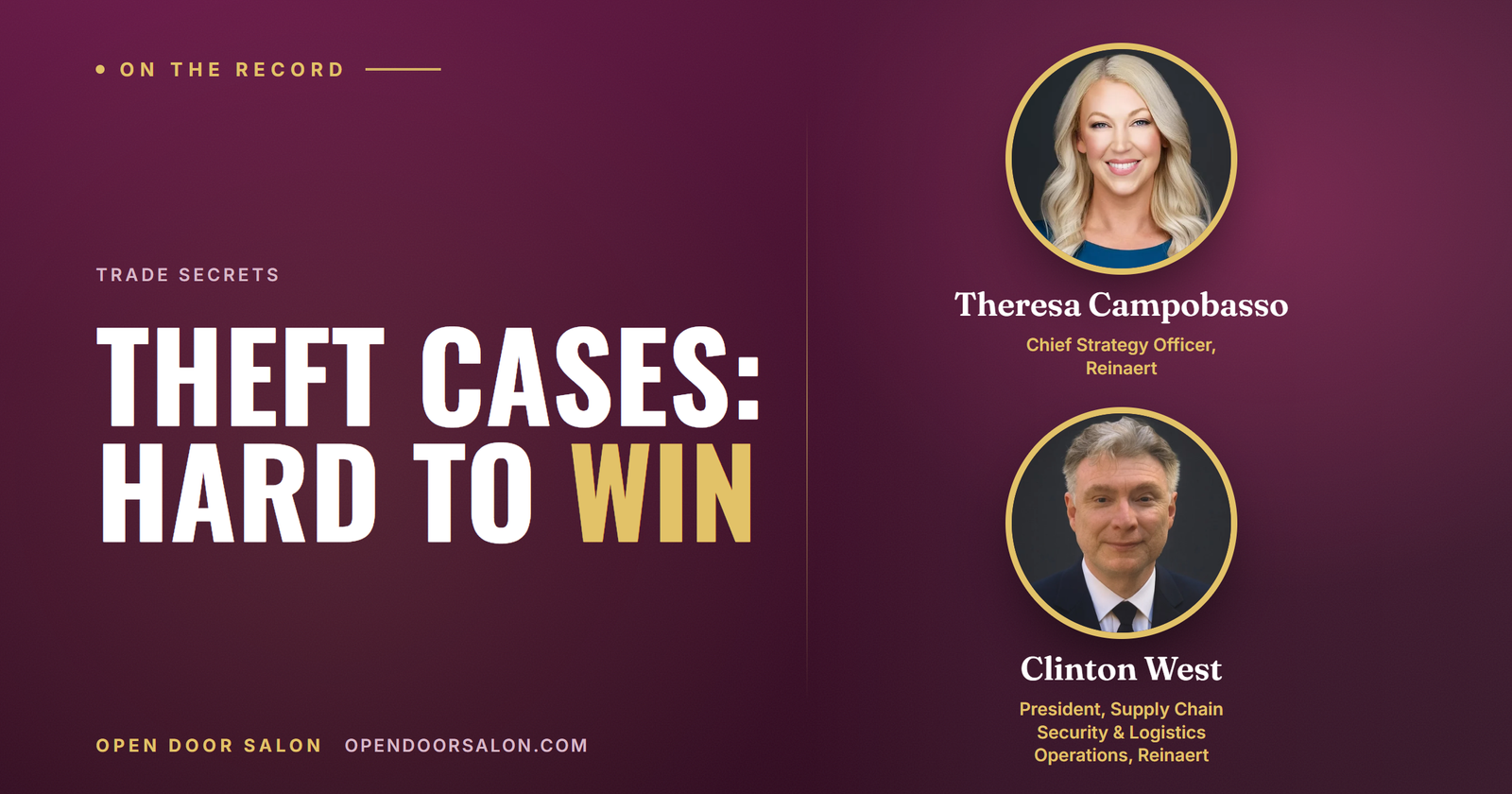
Trade secret lawsuits are hard to win for three reasons: the evidence of theft is usually circumstantial, the strongest proof can be too sensitive for open court, and the lawsuit can damage the company that brings it. That was the read of two guests on Open Door Salon. Theresa Campobasso is chief strategy officer of Reinaert and a former U.S. Marine Corps intelligence officer. Clinton West is Reinaert’s president of supply chain security and logistics operations and a former CIA supply chain risk leader.
Lori Ellis asked them how often these suits succeed, with the September lawsuit Beam Therapeutics filed against YolTech Therapeutics and Serapha Bio in the background. Beam alleges that a former scientist took its trade secrets to a Chinese startup. Serapha has denied the claims, YolTech says it built its technology through its own research, and the case has not been decided.
Why is trade secret theft hard to prove?
Because the indicators that look damning in a timeline rarely amount to proof. Campobasso put it plainly:
It’s really hard to prove certain things in international court.
She gave the defenses a company should expect: the employee had a manager’s approval to work weekends before time off, or believed the access was part of normal duties. Each signal on its own may not be a smoking gun, and a court asks for more than a pattern. Our earlier post on how to detect insider threats in biotech covers those signals in detail.
Why do some cases never reach court?
In counterintelligence cases, Campobasso said, the evidence itself can be the obstacle. Lawyers call the problem graymail, where proving the case would mean disclosing classified or highly sensitive material:
Oftentimes they can’t even make it to court because ... the content of the case is either so sensitive or in some cases classified and you can’t actually litigate it openly.
Private companies face their own version. Proving that research was taken can mean exposing more of the proprietary methods the company is trying to protect, so many disputes settle out of court or stop short of litigation.
Why do startups avoid suing?
Because a lawsuit puts the company’s own value on trial. Campobasso described the fear she sees:
A lot of times folks we see do not want to engage in open litigation because they’re afraid that their startup value or their research value will be reduced to near zero depending on the outcome of that litigation.
Can going public hurt an investigation?
Yes. West pointed to sources and methods, the questions an investigator asks first:
How did this company actually find out about it? Is there a nexus to the government as well?
If the government is already involved, a public filing can disturb that work:
The government might not want you to openly acknowledge this because there’s an active investigation ongoing.
His summary was shorter:
Tipping your hand too early can be a bad thing.
What does a lawsuit mean for investors in the asset?
It puts the asset itself in question. Lori Ellis pointed to that consequence of the Beam case. Once an asset licensed from a developer is tied up in litigation, investors and acquirers hold something whose ownership is disputed. She said such cases are becoming more common. She asked what diligence would have caught the risk before the deal. West’s answer started with defining what the review is for, and with mapping the people and entities around the counterparty as well as the counterparty itself. Our post on what foreign investor due diligence misses walks through that method.
Why do small biotechs absorb the loss?
Cost. West said many cases never surface at all:
Some of these small biotech companies don’t have the money to go after litigation and they just have to eat that cost and they’re not going to bring that up and they’re just going to move along.
Clear agreements on who owns what before a collaboration begins are the subject of our earlier post on who owns the data in a collaboration agreement.
Is it still worth going public?
Campobasso thought so in Beam’s case, for reasons beyond the outcome:
It’s great that this organization chose to really go after and publicize the activity, because that helps educate people about what to look for.
West described a shift he has watched before. A decade or more ago, reporting a cyber breach to the government felt like an admission of failure; today the government thanks the company for the report and offers help. He sees biotech heading the same way, with industry and government working together to measure the damage a theft does to a company and to the country. Our earlier post on the routes intellectual property usually takes out of a company covers where that damage starts.
The full conversation is on the Open Door Salon episode page, with more about Theresa Campobasso and Clinton West.
Companies that want to reach the leaders who follow this conversation can learn about sponsoring Open Door Salon.
This post is drawn from the recorded, on-the-record conversation between Lori Ellis, Theresa Campobasso and Clinton West on Open Door Salon; quotes are lightly edited for clarity, and the full episode is the record.