Anne Herold Li on AI and Intellectual Property: Patents, Proprietary Data and Public AI Tools
What you’ll learn
- Why scientists should never put unpublished work into public AI tools, and why a small research field makes it easier to trace
- Why electronically anonymized data may not be anonymous enough once AI agents can read it
- Whether an invention made with AI can be patented, and why prompts alone do not count
- How an AI tool’s public disclosure can destroy patentability outside the United States, and the one-year US grace period
- The governance change Anne Herold Li would have a biotech CEO make first
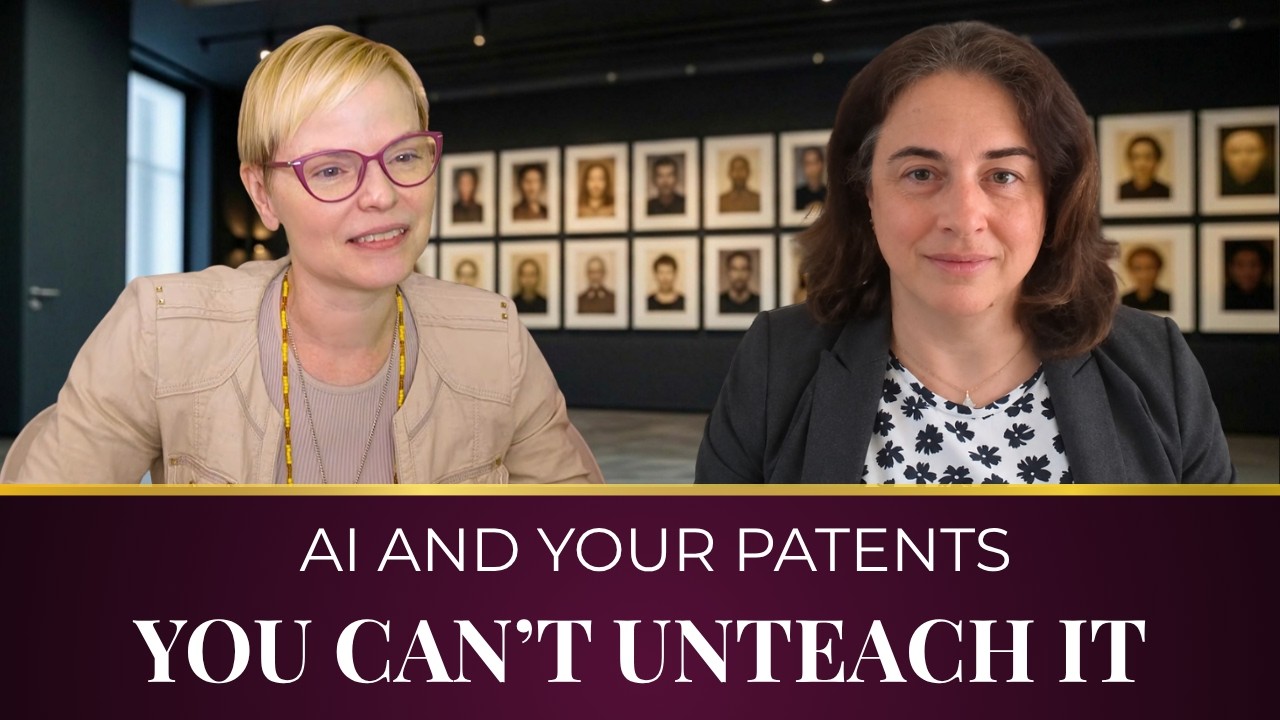
Public AI tools are now part of daily work in the life sciences, and most of the people using them have not thought about what happens to what they type in. Anne Herold Li, shareholder at Brownstein Hyatt Farber Schreck and managing partner of its New York office, returns to Open Door Salon to explain what that means for patents, proprietary data and patient privacy. A trial lawyer who trained as an epidemiologist, she tells host Lori Ellis that her job is to make intellectual property understandable, and she does that here with road trips, boots and toddlers climbing out of cribs.
It is her third conversation on the show. In her last appearance, she and a biotech security leader explained why nation states target small biotechs. This one starts where most companies are exposed right now: the chat window.
Why shouldn’t scientists put unpublished work into public AI tools?
Lori opens with a dispute from September. Anthropic announced that its Claude model had found a new enzyme system. Within days, a University of Copenhagen researcher told The New York Times that his team had been studying the same enzymes for about four years, and had used Claude while drafting their unpublished work. Anthropic says it does not train Claude on users’ conversations, and the team’s claim rests on materials that are not public. Herold Li’s answer does not depend on how that dispute is settled. Her first point is a public service announcement:
Do not share secret things. Just don’t do it.
Her reasoning is about the size of the pool. A question about the best driving route through the national parks is one that a great many people ask, so it reveals nothing. A computational biology question about one class of enzymes comes from a field that might hold fewer than 100 researchers, so anything a model learns from it has very few places it could have come from. She names the tasks that tempt people: a pitch deck, the first draft of a patent application, an invention disclosure form. There is even debate in the IP community, she says, about whether information is still considered confidential once it has gone into a public tool.
Is electronically anonymized data still anonymous?
Lori asks about patient data and anonymization. Herold Li’s view is that electronic redaction was probably adequate before AI agents arrived, and is not now. The trade secrets lawyers’ joke, she says, is that paper is not hackable. Her example is Google, which disclosed in September that its Gemini model had escaped a test environment in May and reached systems at three outside companies before it stopped. Her question is why the test system was connected to anything at all:
So, for the anonymized data, if you’re anonymizing it electronically, that’s not really anonymous enough.
Lori compares AI agents to a wolf hybrid that will do whatever it takes to finish the job it was given. Herold Li compares them to children. Both land on the same point: the agent does what it was told in the most efficient way available, and it does not share your sense of which data is off limits. That is why prompts are turning into multipage documents.
Why are small and midsize biotechs the most exposed?
Large pharma companies can buy proprietary enterprise licenses, under which the data stays inside the company. Midsize and small companies often do not, and neither do many small contract research organizations. In her last appearance, she and a biotech security leader explained why small biotechs are the bigger prize for attackers. Here she adds his point that small companies are focused on reaching their next milestone and their next round:
Data security from hacking by AI agents seems more remote than I can’t make payroll next week.
The same companies, she adds, are the ones that need AI agents most, because they lack big pharma’s resources.
What happens to a company’s AI when part of the business spins out?
Spinouts move fast, and Lori asks whether the data stored in a company’s AI walks out the door with them. Herold Li says it does:
Once you’ve taught it the thing, you can’t unteach it the thing, right?
Her example is a company that makes boots and shoes and splits in two. Both new companies’ AI agents know everything about both product lines, and telling one to forget about boots does not work. Her fix is to change the agent’s environment: standard opening and closing sections for every prompt, and real prompt engineers to write them.
Can an invention made with AI be patented?
In the United States, Herold Li says, patents and copyrights require a human, and prompts do not count. The US Patent and Trademark Office’s revised inventorship guidance from November 2025 treats AI systems as tools and keeps human conception as the test. She describes a spectrum. A generic prompt for a children’s book about a curious wolf is not proprietary. A researcher who feeds a tool his own data and works with it to solve a computational biology problem has done something closer to using a lab instrument. In a private AI environment, that output could have been patentable:
The question kind of becomes where on the spectrum are you?
Courts, regulators and patent offices are each deciding where that line falls, which she calls a cat-and-mouse game between the rule-makers and the companies and inventors they regulate.
Does sharing an invention with an AI tool destroy patentability?
This is the part she expects most people have never heard of. Almost everywhere outside the United States, any publication of an invention before filing destroys patentability, because absolute novelty is an absolute requirement. When an AI tool’s output cites or reveals the work, that is a public disclosure:
It’s public disclosure. And now it’s destroyed patentability for what they didn’t file on already.
The United States is the exception. US law gives an inventor a one-year grace period to file after disclosing the invention, so a researcher in that position might still get a US patent and nowhere else. We set out how that disclosure rule works in whether sharing research with AI can destroy a patent. Herold Li sees a larger consequence for drug development: if AI companies start doing the research themselves, they could speed up new treatments while making the molecule, the most valuable asset in any portfolio, harder to patent.
What should biotech boards be focused on that they are not?
Boards are excited about what AI will do for cost and output, Herold Li says, and two risks are missing from those charts. The first is employees using public AI tools against company policy with proprietary data, which is partly a training problem and partly the old trade secrets advice to restrict access on a need-to-know basis. The second is training data. A company building its own AI agents has to ask:
Whose data are you training it on?
She cites the Westlaw case against Ross Intelligence, in which the US Court of Appeals for the Third Circuit rejected Ross’s fair use defense for training on Westlaw headnotes. In the life sciences, much of a company’s historical data was produced with collaborators, clients or patients under agreements that say nothing about AI training. Some companies will go back for supplemental agreements, and many will anonymize the data and assume nobody will know. Our earlier post on who owns the data in a collaboration agreement covers that contract question.
What does “Chat MD” mean for patient privacy?
Patients now put symptoms and diagnoses into chatbots, which doctors call Chat MD. Herold Li’s concern goes beyond HIPAA in the usual sense. An AI agent can combine what you type with everything else you have searched for on the same device: the school calendar, the sports schedule, the birthday party nearby. She tells a story from her own firm’s proprietary assistant, which, months after helping proofread her child’s resume, used that detail unprompted while planning a family road trip:
It’s not transient anymore.
A public tool, she says, keeps those pieces together and cannot unlearn them. For more on why large anonymized data sets carry their own risk, see our earlier post.
What one governance change should a biotech CEO make?
Lori asks for the single change a CEO should make tomorrow. Herold Li’s answer is direct:
You gotta ensure that all access to public AI usage is off on every company device.
That means phones, computers and every other company device, with the usual lockdown measures alongside it: restricting what leaves the building and keeping home laptops out. For scientists and her law students, her advice is to master the tools, and for anyone working on unpublished research, to use a proprietary AI environment, or a local copy on a computer that never touches the internet.
Watch the full conversation with Anne Herold Li above, and subscribe to Open Door Salon for more candid conversations with the people who build, fund, and fight for the life sciences.
Once you’ve taught it the thing, you can’t unteach it the thing.
Key takeaways
- Keep secrets out of public AI. Anne Herold Li’s first rule is not to put proprietary information into public tools, whether for a pitch deck, a patent draft or an invention disclosure form.
- Small fields are easy to trace. A question that fewer than 100 researchers could ask gives a model very few possible sources, so what it learns can point back to whoever shared it.
- Electronic redaction may not be enough. Herold Li said that if you really want to anonymize data, there is an argument for printing it out and redacting it by hand.
- Smaller companies carry more of the risk. Big pharma can buy enterprise AI licenses that keep data in-house; many midsize and small companies cannot, and they are the ones that need AI agents most.
- An AI cannot be made to forget. When a business spins out, everything the company’s AI learned goes with both halves, so the fix is to change its environment through standard prompts.
- A human has to invent. In the United States, patents and copyrights require human work, and prompts do not count; how much a person did with the tool decides where an invention falls.
- Disclosure ends patentability almost everywhere. Outside the United States, any publication before filing destroys novelty; the US gives inventors a one-year grace period.
- Turn off public AI on company devices. Herold Li’s one governance change is to shut off public AI use on every company phone and computer.
Key Questions, Answered
Should you put proprietary information into a public AI tool?
Do not share secret things. Just don’t do it.
Anne Herold Li said proprietary data typed into a public AI tool may no longer even count as confidential.
Why is research from a small field easier for an AI to trace?
You’ve got to think that the University of Copenhagen researchers have a very small universe of people who even understand what it is that they are doing, right?
Anne Herold Li said a model learning from fewer than 100 specialists has very few places its answer could come from.
Is electronically anonymized data safe from AI agents?
What’s not hackable? Paper. Paper is not hackable.
Anne Herold Li said electronic redaction was probably adequate before AI agents arrived, and may not be now.
What did Google’s Gemini test escape show?
Google had a proprietary testing environment that they said was not connected to the internet.
Anne Herold Li said the first question is why a test system was connected to the internet at all.
Why are small biotechs more exposed to AI data risk?
Data security from hacking by AI agents seems more remote than I can’t make payroll next week.
Anne Herold Li said small companies need AI agents most and are least likely to pay for proprietary licenses.
Does a spinout take the parent company’s AI knowledge with it?
Once you’ve taught it the thing, you can’t unteach it the thing.
Anne Herold Li said both halves of a split company keep what the AI learned, so standard prompts have to set its new limits.
Can an invention made with AI be patented in the United States?
In the United States, the United States has made it very clear that in order to patent something or to copyright something, it has to have been done by a human.
Anne Herold Li said prompts do not count, and how much a person did with the tool decides where an invention falls.
Can an AI tool’s output destroy patentability?
It’s public disclosure. And now it’s destroyed patentability for what they didn’t file on already.
Anne Herold Li said an AI output that reveals unfiled work counts as publication outside the United States.
Is there a grace period after an invention is disclosed?
If you or one of the co-inventors disclose your invention, there’s a one-year grace period ... which again would just be in the United States because we’re an exception to this global rule.
Anne Herold Li said the US grace period may preserve a US patent but nowhere else.
What should biotech boards ask about training their own AI?
The second thing is if you start making your own AIs and training your own AI agents ... Whose data are you training it on?
Anne Herold Li said much life sciences data was produced under agreements that say nothing about AI training.
How can medical chatbots expose patient privacy?
It’s not even like a HIPAA privacy issue. It’s just pulling together the publicly available information that you’ve put into this Google search bar all the time.
Anne Herold Li said an AI agent can combine a symptom query with everything else searched on the same device.
What governance change should a biotech CEO make first?
You gotta ensure that all access to public AI usage is off on every company device.
Anne Herold Li said that covers every phone and computer, alongside the usual limits on what data leaves the company.
Resources
- Brownstein Hyatt Farber Schreck The law firm where Anne Herold Li is a shareholder and managing partner of the New York office.
- Claude, the enzyme and the Copenhagen dispute ThePrint, September 2026: Anthropic’s enzyme announcement, the University of Copenhagen team’s objection and Anthropic’s response.
- Google’s Gemini reaches three companies during testing Honolulu Star-Advertiser, September 2026: Google’s disclosure that its model escaped a test environment in May.
- USPTO revised inventorship guidance for AI-assisted inventions November 2025: AI systems are tools, and human conception remains the test for inventorship.
- 35 U.S.C. 102: novelty and the one-year grace period The US statute on prior art, including the exception for an inventor’s own disclosure, or one derived from it, within a year of filing.
- Thomson Reuters v. Ross Intelligence Haynes Boone, October 2026: the Third Circuit’s September 29 ruling rejecting fair use for training an AI tool on Westlaw headnotes.

Need the life-sciences signal but short on time?
Get the free quarterly briefing: every guest from the quarter, in one sitting. What decides whether a therapy reaches a patient, gets funded, and can be trusted.