
Are There Alternatives to Chinese Biotech Suppliers?
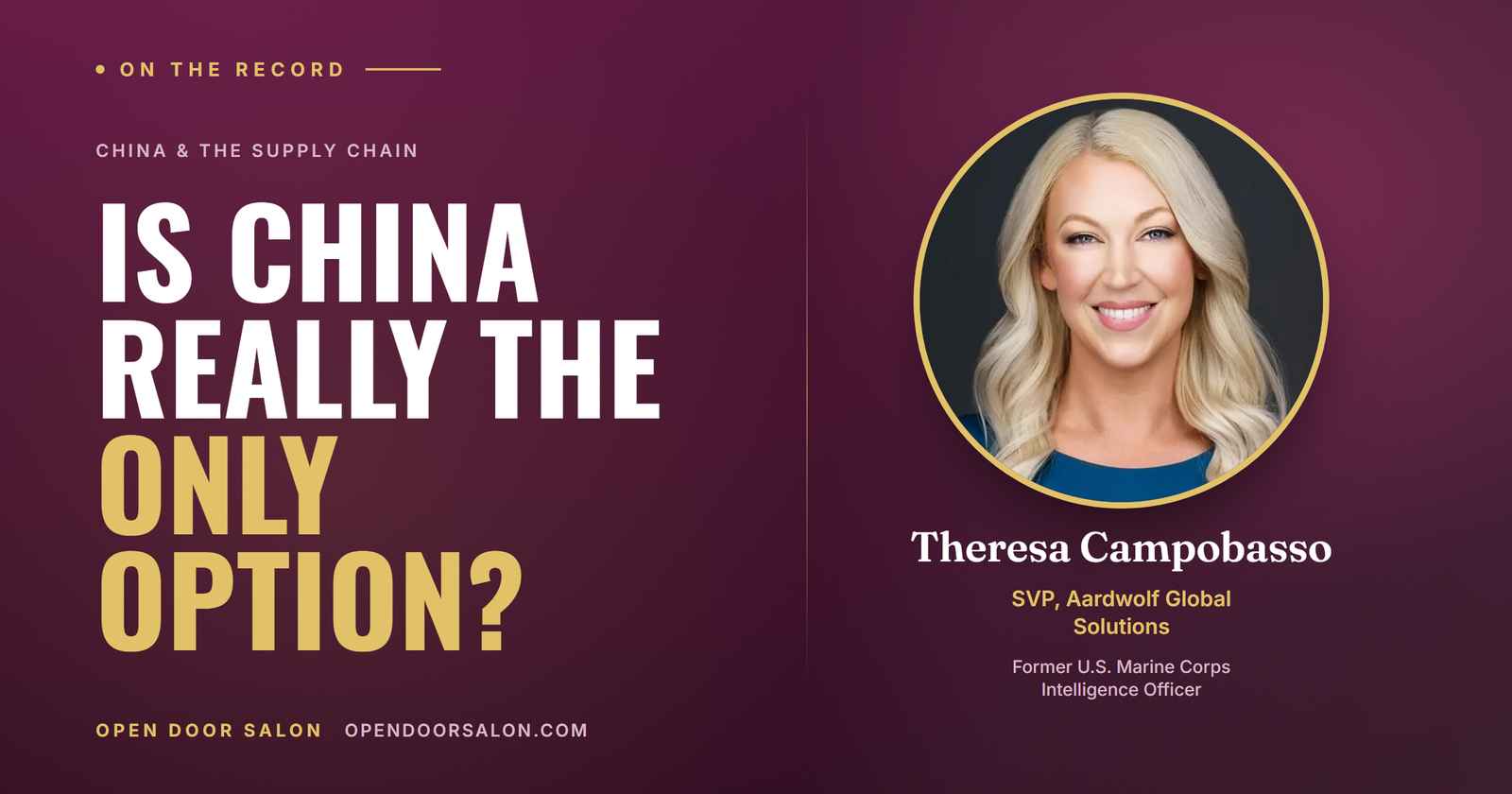
A lot of life-sciences sourcing runs on a quiet assumption: that for a given molecule, material, or piece of research, a Chinese supplier is faster, cheaper, and effectively the only option. Theresa Campobasso, Senior Vice President at Aardwolf Global Solutions and a former U.S. Marine Corps intelligence officer who provided counterintelligence support to the Defense Intelligence Agency, opened our series on China and the life sciences. Her response to that assumption is not to attack China. It is to test the assumption.
Are there alternatives to Chinese biotech suppliers?
More often than companies assume. The belief that there is no other option is usually inherited from a long-standing relationship rather than tested against the current market, and Campobasso pushes back on it directly:
"I think there is a perception that China is the only way to go. There are no other alternatives because they've been working with Chinese companies for such a long time. I would test that assumption."
Her point is not that alternatives always exist. It is that most companies never check, and that the field has moved.
Why the "only option" belief persists
The assumption survives because it is rarely examined. A relationship that has run for years starts to feel like the only path, and the question of whether anyone else can supply the same material simply stops getting asked. Campobasso's prompt is to ask it again, on purpose:
"Is that true that this Chinese organization is the only source for this material? It's the only source for this type of research, and I think there's been a proliferation of innovation to get away from some of those bottlenecks."
In other words, the supply landscape that justified the assumption a few years ago may not be the landscape you are actually operating in today.
The hidden cost of the cheaper, faster path
The faster-and-cheaper case is real, but Campobasso's work is about the part of the ledger that does not show up on the invoice. Two patterns sit underneath some of these relationships:
"There are patterns and trends around things like intellectual property theft or some challenges around hidden or obfuscated state ownership in private companies that is fairly common in China."
She also pointed to the speed differential in Chinese regulatory approval, which can hand a partner a structural advantage and, in some cases, a route to a counterpart's intellectual property. The cost of that, she noted, is "real economic impact to individual businesses and a loss of advantage." A lower unit price can carry a higher exposure that only becomes visible later.
China is not the absence of innovation
This is where the convener stance matters, because the easy version of this story is anti-China, and Campobasso refused it. She was explicit that genuine science is coming out of China: That scientific rise now shows up in the budgets, with China’s research spending passing the US for the first time.
"I certainly don't want to misrepresent and say that there's no original innovation coming out of China. When we look at volumes of papers published, there are many areas of both basic and applied science and technology where China vastly outperforms most other countries."
The argument is not that Chinese capability is fake. It is that "the only option" and "the best option for this specific need, all costs counted" are two different claims, and companies tend to treat the first as settled when only the second is worth deciding.
How to actually test the assumption
The test is not a gut call. It is the same data-and-analytics work that now makes deep supply-chain mapping possible:
"It's obviously industry dependent, but I would really urge people to dig into that and take another look, and leverage some of those tools and analytic capabilities to really determine if that assumption is correct. I wouldn't say that I find that always to be true."
The honest answer will vary by industry and by material. Sometimes the Chinese supplier really is the only viable source; sometimes the alternative has existed for a while and nobody looked. The discipline is to find out rather than inherit the answer, and it runs on the same sub-tier mapping capability that surfaces hidden ownership. It is the same exposure the BIOSECURE Act leaves open for private companies.
Join the conversation
If you own sourcing, the "only option" assumption is one you can actually test, and the answer changes your risk and your leverage. The people on the other sides of this problem see parts of it you cannot, and the fastest way to close the gap is to get those views in the same room.
Open Door Salon convenes those conversations on the record. Watch the full conversation with Theresa Campobasso. And if your company needs to reach the people making these sourcing decisions, that is what sponsorship is for.