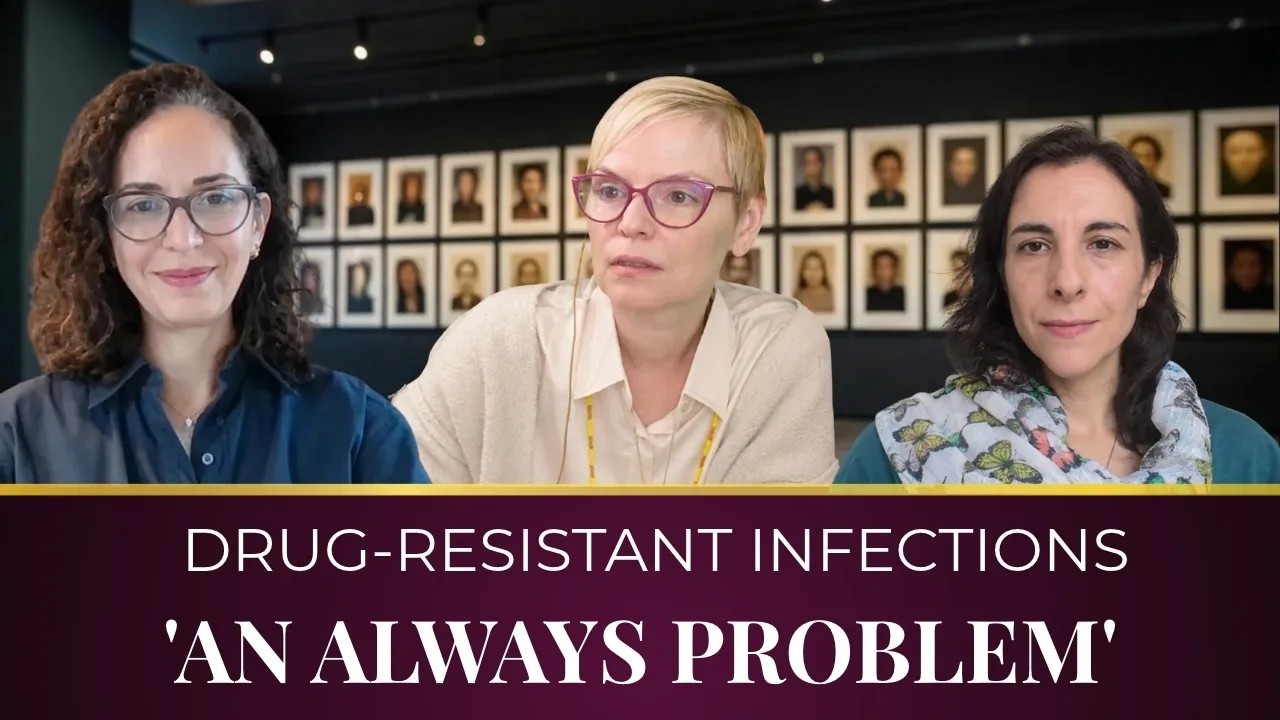
Jomana Musmar and Aula Abbara on Antimicrobial Resistance, War and the Thin Antibiotic Pipeline
What you’ll learn
- Why antimicrobial resistance is harder to fund than a single-pathogen outbreak like Ebola
- Why companies developing new antibiotics keep going bankrupt, and what one drug, one bug means
- Why deaths from drug-resistant infections are probably undercounted
- How war and attacks on health care speed up the spread of resistant pathogens
- What One Health means, and why education and governance are the first changes the guests would make
Drug-resistant infections are spreading faster than new drugs are being developed to treat them. Two guests join host Lori Ellis to explain why. Jomana Musmar is co-founder and CEO of the AMR Strategic Coalition and founder of Advisors of Global Health. Aula Abbara is a consultant in infectious diseases and general medicine at Imperial College Healthcare NHS Trust in London. Musmar has worked on antimicrobial resistance policy for more than a decade, including as executive director of the Presidential Advisory Council on Combating Antibiotic-Resistant Bacteria. Abbara has spent about 15 years on infection and public health in the Syrian conflict and other crises. The two work together on the International Society of Antimicrobial Chemotherapy’s working group on antimicrobial resistance in marginalized populations, which Abbara chairs.
Lori introduces the subject as the pipeline that seems to be ignored. The guests cover why antimicrobial resistance (AMR) is so hard to fund, why companies that develop new antibiotics keep failing, how war speeds the spread of resistant pathogens, and what they would change first.
What did the suspected plague case in Russia show about preparedness?
Lori opens with the case in Russia. In early October, media reports said a laboratory worker at an anti-plague institute in Irkutsk had died of suspected plague. Russian authorities told the World Health Organization that tests found no plague, and recorded the death as pneumonia of unknown cause. Musmar’s first observation is that the alarm had already faded. Policy is reactive, she says, and a warning sign becomes yesterday’s news within weeks:
That’s why the time is always now, not later.
Her answer is a system built in advance, with data sharing and coordination across borders, that works whatever the threat turns out to be. Abbara points to how sensitized people have become since COVID-19, through the hantavirus cluster on a cruise ship a few months ago, the Ebola outbreak in the Democratic Republic of the Congo and the case in Russia:
It also tells us that we’re probably, even in the global north, not as prepared as we might like to be, should these threats arrive on our borders.
Is AI the biggest biological threat right now?
Lori raises a report from Anthropic of a prompt asking how to make a virus more harmful. Both guests take the risk seriously and both turn the question back to what is happening already. Musmar describes the range of threats as man-made, intentional and naturally occurring, and says AI can magnify the first two. Her priority is the third:
We cannot focus on the unknown and what could be when we need to actually focus also on what is happening today and what is going around today that threatens our resilience.
Abbara has watched infections that were once under control return over the last 10 to 20 years, including vaccine-preventable diseases such as measles and diphtheria, alongside rising resistance to antimalarials and insecticides. She is blunt about who carries the burden:
To be crystal clear, sadly, it’s mostly affecting the most marginalized.
Why is antimicrobial resistance so hard to fund?
Lori cites the World Health Organization’s 2025 pipeline analysis, which counted 90 antibacterial agents in clinical development, down from 97 in 2023, with only five effective against at least one of WHO’s critical priority bacteria. Musmar’s explanation is that AMR is not one disease. She calls it an enterprise of many pathogens, which gives it none of the single image that draws attention to Ebola. Her example is drug-resistant Acinetobacter, nicknamed Iraqibacter, which she said is now common in hospitals across the Middle East and North Africa and has been a problem since the Iraq war:
For decision makers, it’s an over there problem … But it’s not an over there problem anymore because of globalization.
Abbara adds that the term itself is a problem. Patients, communities and many of the people who control funding do not know exactly what it means, and the field covers bacteria, parasites, fungi, viruses and tuberculosis at once:
People much prefer simplicity. One virus, one antiviral, one bacteria, one antibacterial, one pathogen, one vaccine.
Are deaths from drug-resistant infections undercounted?
Both guests think so. Abbara explains that patients with cancer, on dialysis or in intensive care spend a lot of time in hospital and take repeated courses of antibiotics. That puts them at higher risk of a resistant infection and sepsis. When that happens, the record rarely shows it. Musmar puts it plainly:
If somebody has cancer and they die of sepsis, the death certificate is gonna associate it with cancer, not the sepsis.
Musmar adds the cost of illness that never appears as a death. Fungal infections are rising, she says, and Valley fever in the western and southwestern United States costs people jobs, time in hospital and long courses of medication.
Why don’t new antibiotics pay?
Abbara describes the decision from a drug company’s side. A new antimicrobial costs millions to develop, and the return is uncertain:
If you’re investing in drugs for oncology or non-communicable diseases, you may get far better returns, especially if you’re aiming at a global North market.
The burden falls disproportionately on low-resource settings, she says, where patients cannot afford the newest drugs. Musmar calls it a value problem. A course of antibiotics costs very little in a high-income country, and in many lower-income countries antibiotics can be bought without a prescription, so the drugs are treated as cheap and easy. The companies that develop new ones pay the price:
But when it comes to antibiotic development, antimicrobial development to address these resistant bugs, they’re not making any money, which is why they’re filing for bankruptcy.
Her proposed fix is demand from the specialties that depend on working antibiotics. Oncology and surgery, she says, should build novel antibiotics into their treatment plans, because their patients are the ones at risk.
What should investors know about antibiotic developers?
Lori asks what impact investors should look for when these companies pitch them. Musmar, naming phage companies, antibiotic developers and diagnostics companies, says the market does not fit venture capital, which expects returns within about five years, while a new drug takes close to 10 years to reach pharmacy shelves. She still sees the case:
I think this is a long-term investment that will show dividends.
By the time resistance is common enough to make the market obvious, she argues, it is too late to start developing the drugs.
How does war spread antimicrobial resistance?
Abbara has worked on the Syrian conflict for about 15 years, through chemical weapons, the bombing of hospitals, economic collapse, earthquakes and COVID-19. She points to the conflicts of the last two or three years, from Ukraine to Sudan. The way wars are fought is changing, she says, with the deliberate targeting of civilian infrastructure, attacks on microbiology laboratories and the use of drones:
There’s been more than 3,000 attacks on healthcare in Ukraine.
We’re going back to the use of technology, not for the power of good, but for increased suffering.
She also stressed prevention, which she said is so neglected: stopping infections from developing and spreading, especially in conflict and in health care settings. Musmar’s summary is shorter:
There are no rules of war anymore.
An earlier conversation on what war does to patients’ treatment looked at the same problem from inside clinical research, and our post on what happens to clinical trials during a war follows it further.
What is One Health, and why does it matter here?
Musmar defines One Health as the interaction of water, the environment, animals, people and agriculture, each feeding the others. In a war zone, she says, sewage, chemicals, heavy metals and rotting agriculture wash into the ground and the sea. She describes data showing resistant pathogens in coastal waters and seafood, and migrating birds carrying them from Asia through the Middle East to Europe, and says the little surveillance data that exists is already alarming. Her conclusion is that no solution works in one place alone:
We are one globe.
What would the guests change first?
Lori notes how much money is going into longevity, and says she does not want to live longer on contaminated water and food. Musmar’s first change is education from the bottom up, because policy is moving too slowly from the top. She wants families to question a prescription before they fill it:
Do I need it? Do I have to have it?
Abbara agrees, and adds the top-down half:
What I’ve learned over the last few years of working in the conflict space, but also the infectious diseases and outbreaks space in conflict settings is the importance of governance and accountability.
Her example comes from a student’s research in northeast Syria, where antibiotics are used routinely in animals and as fertilizer with no regulation, and where veterinary workers can buy cheaper antibiotics meant for people. Lori closes with her own conclusion: there is no conversation about longevity that does not first deal with these problems.
Watch the full conversation with Jomana Musmar and Aula Abbara above. This page is drawn from the recorded, on-the-record conversation; quotes are lightly edited for clarity, and the full episode is the record.
This isn’t a tomorrow problem. It’s an always problem.
Key takeaways
- Preparedness fades with the headlines. Jomana Musmar said a warning sign is “yesterday’s news” within weeks, which is why she argues for systems built in advance and threat agnostic.
- The threat is already here. Before worrying about what AI might enable, Musmar and Aula Abbara pointed to resistant pathogens that are spreading now through ordinary channels.
- AMR is not one disease. Musmar called it an enterprise of many pathogens, which makes it harder to explain and harder to fund than a single outbreak.
- The market rewards the wrong drugs. Broad-spectrum antibiotics treat several bugs with one pill; Musmar said the need is one drug, one bug, and the market is not set up for it.
- The deaths are undercounted. Abbara said patients with cancer, on dialysis or in intensive care are at higher risk of a resistant infection, and Musmar added that when one dies of sepsis, the death certificate usually names the cancer.
- New antibiotics do not pay. Abbara said drug companies invest millions for uncertain returns, while the burden falls disproportionately on low-resource settings that cannot afford the drugs.
- War accelerates resistance. Abbara described attacks on hospitals, laboratories, water and power, and said prevention of infection is neglected.
- Education and governance come first. Musmar named education from the bottom up; Abbara added governance and accountability, citing antibiotics used as fertilizer in northeast Syria.
Key Questions, Answered
What did the suspected plague case in Russia show about preparedness?
We need to be threat agnostic when it comes to these things so that when they do happen, we already have a system in place. And as of today, we do not have a system in place.
Jomana Musmar said the warning faded within weeks, and that global systems for data sharing and coordination are still missing.
How does conflict affect antimicrobial resistance?
Conflict and the progression of disease that is ongoing today from conflict is something that is unfortunately pushing the fast forward button on the progression of antimicrobial resistance around the world.
Jomana Musmar said conflict speeds the spread of resistance, a field she works on with Aula Abbara.
Is AI the biggest biological threat right now?
What’s going on today is the level of resistant pathogens increasing at an insane rate and getting transmitted throughout the world through natural channels and portals.
Jomana Musmar said AI may magnify risk, but the resistant pathogens spreading today cannot be set aside while the world looks at AI.
Why is antimicrobial resistance so hard to fund?
It’s very difficult to kind of wrap your mind around it because we’re not talking about a single pathogen issue.
Jomana Musmar said AMR is an enterprise of many pathogens, so it lacks the single image that draws attention to an outbreak like Ebola.
Why does the antibiotic market fail?
It should be one drug, one bug. But unfortunately ... the market isn’t set up for that because we’ve been using what are called broad spectrum antibiotics that treat several bugs through one pill.
Jomana Musmar said the fix is a range of targeted drugs, and the economics have to change to pay for them.
Are deaths from antimicrobial resistance undercounted?
The other important thing about AMR is we’re probably vastly undercounting when we look at mortality.
Aula Abbara said patients with cancer, on dialysis or in intensive care are at higher risk of a resistant infection, and Jomana Musmar added that the death certificate usually names the cancer.
Why do drug companies avoid developing new antibiotics?
If you’re a drug company, you’re investing millions, if not more, and the return may not be so great.
Aula Abbara said oncology and other noncommunicable diseases offer better returns, especially in high-income markets.
Why don’t venture capitalists fund new antibiotics?
The problem with venture capitalists is that they need to have their return on investment immediately and immediately being within the next five years.
Jomana Musmar said it takes close to 10 years for a new drug to reach pharmacy shelves, which the venture timeline does not fit.
Why does preventing infection matter in conflict?
Very, very importantly, and it’s so neglected, is making sure that we prevent the development of infections and we prevent the transmission of infections.
Aula Abbara said new therapeutics and diagnostics matter, and prevention in conflict and health care settings matters as much.
What is One Health?
Just to define, One Health is the interaction of water, environment, animal, human, agriculture, and it’s this perpetual cycle of one augments the other.
Jomana Musmar said a solution in one area has to account for the whole system, because pathogens cross every border.
What is the first change needed on antimicrobial resistance?
To me, the education level is the most important right now, because we’re not seeing fast enough movement from the top down, so it’s got to be the bottom up.
Jomana Musmar said families should ask whether they really need an antibiotic before taking one.
How are antibiotics misused in conflict settings like Syria?
It’s the routine use of antibiotics for animals or the routine use of antibiotics as fertilizer with no regulation, no accountability.
Aula Abbara described a student’s research in northeast Syria and said governance and accountability have to shift at every level.
Resources
- WHO: antibacterial agents in clinical and preclinical development (2025) The 2025 pipeline analysis: 90 antibacterials in clinical development, down from 97 in 2023, and only five effective against at least one critical priority bacterium.
- ISAC working group: AMR in Marginalised Populations The International Society of Antimicrobial Chemotherapy working group chaired by Aula Abbara, with Jomana Musmar as a vice chair.
- Health Affairs: Former federal employees lead a coalition to address antimicrobial resistance On the AMR Strategic Coalition, the cross-sector group Jomana Musmar co-founded and leads.
- WHO Europe: 3000 attacks on health care in Ukraine verified since the full-scale invasion WHO’s May 2026 count, the figure Aula Abbara cited.
- WHO: Ebola outbreak, Democratic Republic of the Congo 2026 The Bundibugyo virus outbreak confirmed in the Democratic Republic of the Congo and Uganda in May 2026.
- ECDC: pneumonia of unknown cause, Irkutsk Oblast, Russia (suspected plague) ECDC’s 12 October 2026 update: Russian authorities reported that tests found no plague and recorded the death as pneumonia of unknown cause.

Need the life-sciences signal but short on time?
Get the free quarterly briefing: every guest from the quarter, in one sitting. What decides whether a therapy reaches a patient, gets funded, and can be trusted.