
Does Insurance Cover Alzheimer’s Blood Tests? What Changed
For most of the history of Alzheimer's diagnosis, confirming amyloid meant a PET scan or a spinal tap. Both are expensive, and one is invasive enough that plenty of patients decline it. A blood test changes that arithmetic, but only if somebody pays for it.
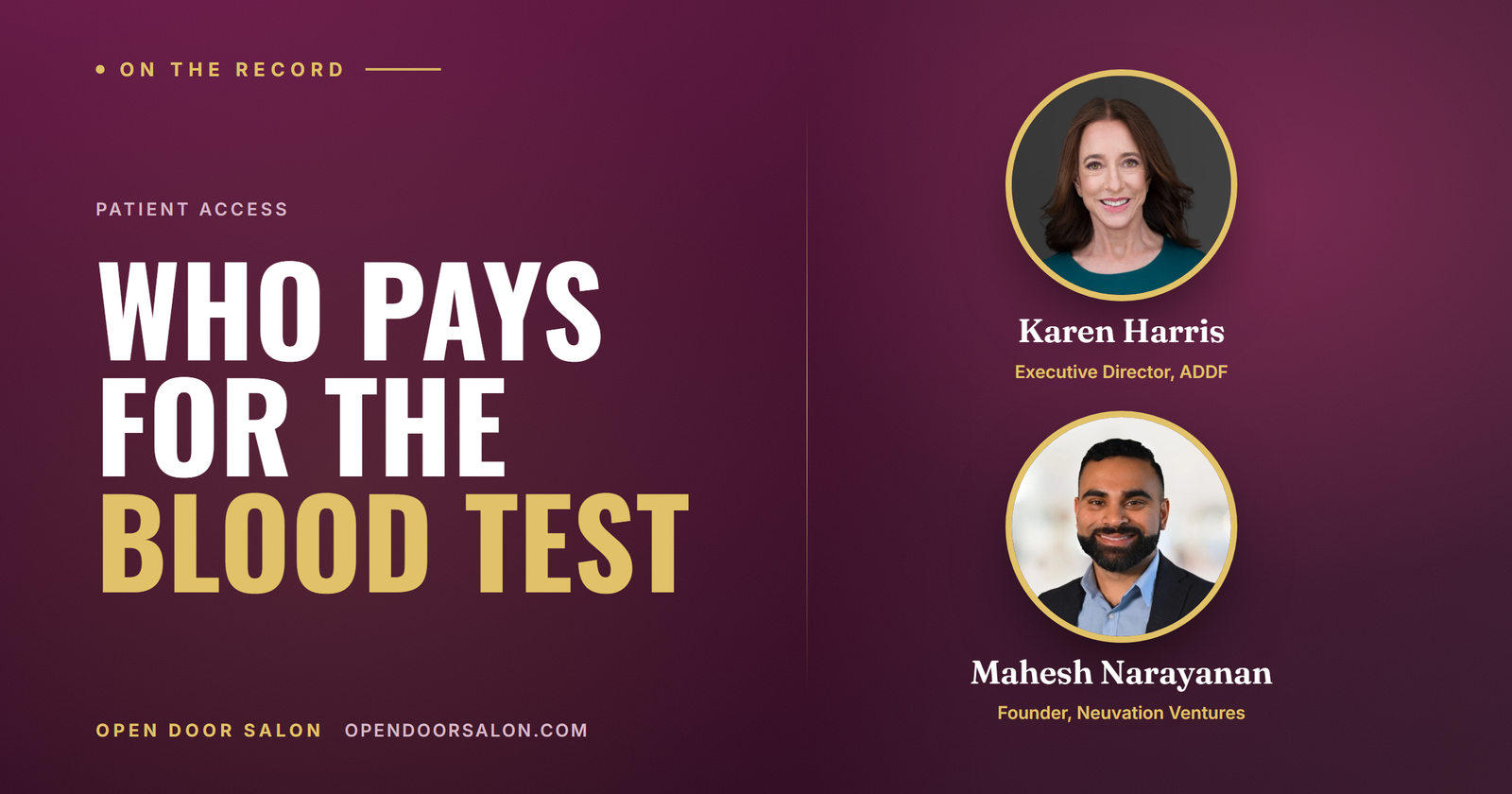
In 2026, somebody started to. Karen Harris, executive director of mission-related investing and finance at the Alzheimer's Drug Discovery Foundation, flagged it on Open Door Salon as a turning point.
Which insurer covers an Alzheimer's blood test?
Anthem Blue Cross Blue Shield began covering blood-based Alzheimer's biomarker testing effective July 1, 2026. Harris raised it in conversation as recent news, and treated it as significant well beyond one payer.
Anthem announced that they would cover the blood-based biomarker for Alzheimer's, which is huge.
The scale is what makes it more than a single policy. Anthem is the second-largest health insurer in the United States, covering roughly 40 million members across 14 states. Its members were the first commercially insured patients in the country with coverage for this category of test.
Why does a coverage decision matter more than an approval?
An FDA clearance establishes that a test works. A coverage policy establishes that a patient can actually get it. Those are different milestones, and the second one is the one that changes clinical practice.
Harris makes the argument in economic rather than clinical terms, which is the frame a payer actually uses.
The blood-based biomarkers are gonna save so much money for the healthcare system.
The logic is straightforward. A blood draw that can triage who needs confirmatory imaging is dramatically cheaper than sending everyone for a PET scan. If the test reliably rules people out, the payer avoids the expensive pathway for a large share of patients. That is the case that got made, and it is the case any diagnostics developer in this category will have to make again.
What happens on October 1, 2026?
The more consequential change is still ahead. Anthem's revised policy LAB.00046 takes effect October 1, 2026, and it does something broader than adding one product. It establishes a technology-agnostic clinical pathway covering both cerebrospinal fluid and blood-based biomarkers, and it adds a second commercial test to the covered set.
Technology-agnostic is the operative phrase. A policy written around one manufacturer's assay protects that manufacturer. A policy written around a clinical pathway creates a category, and a category is what a market needs before investors will fund the next entrant.
What this signals for diagnostics developers
The practical read for anyone building in this space is that the reimbursement path is being established in public, one policy at a time, and it is legible if you go and read it. That is unusual. Most developers spend years guessing at what a payer will want.
It also reinforces the sequencing argument both investors on the episode kept returning to. Mahesh Narayanan, managing partner and founder of Neuvation Ventures, put the failure mode bluntly.
We can make the drugs, we can get them in the market, but if physicians aren't willing to prescribe it or payers aren't willing to pay for it, those drugs end up being a failure either way.
A diagnostic that clears the FDA and never gets covered occupies exactly that position. The Anthem policies are worth reading closely not because they are the whole market, but because they are the first public description of what this category has to prove.
What does a blood biomarker test actually tell you?
It is worth being precise, because the coverage news invites a misreading. These tests measure biological markers associated with Alzheimer's pathology. The covered test reads a five-analyte panel spanning amyloid, tau, neurodegeneration and neuroinflammation, which is a fuller picture than a single-marker assay gives.
What that is not is a diagnosis. A biomarker result sits alongside clinical assessment, cognitive testing, and history. Its practical value is triage: it can help decide who genuinely needs confirmatory imaging or a lumbar puncture and who does not, and it can do that at a fraction of the cost and burden. That is also precisely why a payer is willing to fund it, and reading the coverage decision as a promise of certainty rather than a cheaper first step misunderstands what got approved.
What patients should take from it
Coverage is still uneven and it depends on your plan, your state, and the clinical criteria in the policy. A blood-based test is not automatically covered because Anthem covers one. But the direction is real, the second-largest insurer in the country has moved, and a broader pathway takes effect in October.
The wider context is a field where the science has moved faster than the systems around it. Two disease-modifying drugs are approved. Two blood tests are approved. And as the same conversation covered, early-stage companies working on what comes next still struggle to raise money, priced off a fifty-year record of failures rather than off any single company’s data. Equity is not the only money available to them either: federal and defense agencies fund brain health non-dilutively.
Open Door Salon convenes these conversations on the record. If your company wants to reach the operators and investors in this room, that is what sponsorship is for.
Drawn from the recorded, on-the-record conversation with Karen Harris and Mahesh Narayanan on Open Door Salon. Coverage details reflect Anthem policy as of publication; verify current policy language before relying on it clinically.