
Due Diligence for Licensing Drugs From China: What It Takes
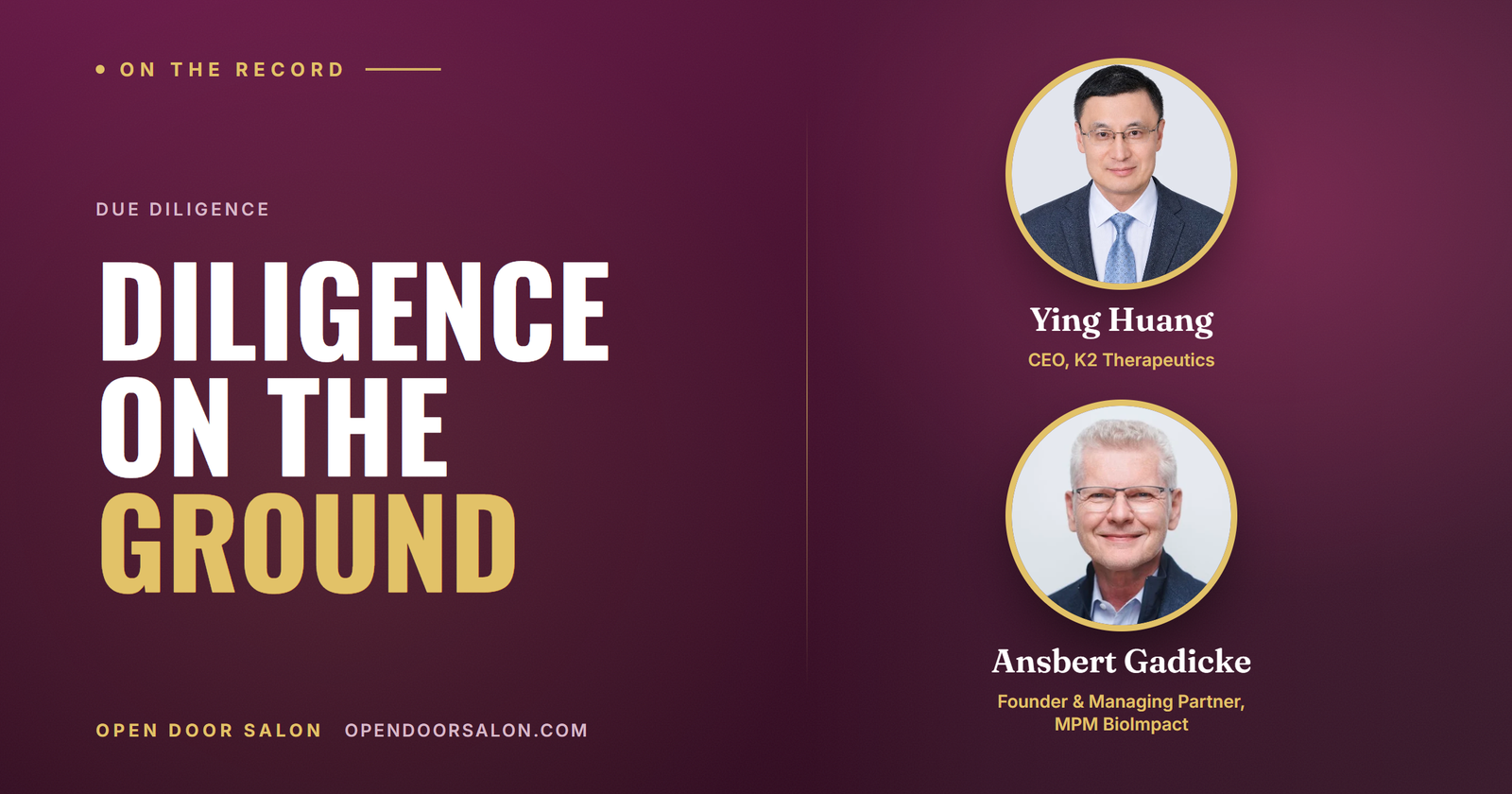
Due diligence for licensing drugs from China has to be as thorough as diligence on a US asset, and it has to be done on the ground. Ansbert Gadicke, founder and managing partner of MPM BioImpact, said that means a local, bilingual team that visits trial sites, reads patient charts in Chinese and screens every project for intellectual property problems. Ying Huang, chief executive officer of K2 Therapeutics, added checks on partner ownership and a plan for business continuity. Both spoke on Open Door Salon.
Their standard starts with history. In the early days of licensing from China, Gadicke said, large drug companies doubted the data outright. Diligence is what changed that.
How did diligence first earn trust in China’s data?
By going through the data patient by patient. When Legend Biotech licensed its cell therapy to Johnson & Johnson in 2017, Huang said, a deal for a therapy developed in China was unusual. J&J reviewed patient-level data and interviewed the study’s principal investigator, which meant working across a language barrier and sending a team to China. Huang said the J&J team had to do a lot more diligence than it would typically have done for a Western company:
Fortunately, our partner, Johnson & Johnson, did great and very deep diligence on the Legend dataset.
Gadicke recalled what the market thought before that work paid off:
At the time, several large pharma companies told me in those discussions, well, we don’t believe the data.
What does diligence on a Chinese asset require?
The same depth as a US deal, delivered by people who can work in the language. Gadicke said K2 and MPM keep teams in Singapore and Shanghai for this reason:
I think due diligence in getting products from China has to be as thorough as what you would do in the US. And I think that absolutely requires that one has a team locally. The team must be bilingual.
Site visits matter because the records are in Chinese, he said, and many investigators do not speak English well. A team that has to work through translation will learn less from the same visit.
How should licensees screen for intellectual property risk?
With a dedicated team and a firm rule. Gadicke said they run a full-time IP team that scrutinizes every project, and they will not back an asset built on someone else’s work:
We would not support or license projects that infringe on Western IP.
Huang said K2 also does deep diligence on the underlying IP before it signs a license agreement.
What should you check about the partner itself?
Who owns it, what it does and how much of your business depends on it. Huang said K2 confirms that a partner is purely a drug discovery organization, studies its ownership structure and relies heavily on in-person diligence. It also structures deals so it keeps control of global development:
Because our goal at K2 is to structure a partnership deal such that it gives K2 a control over the global development and also reduce our dependence on any single partner or single asset.
What if a partner becomes a restricted entity?
Plan for it before it happens. Lori Ellis put the question to both guests after an earlier guest raised it, and Huang said business continuity has to hold whatever either government does:
We want to ensure there’s a business continuity regardless of what happens in either country or in the politics.
Spreading risk across a portfolio of assets is part of the answer. So is location: K2 is incorporated in Singapore, which Huang said offers a buffer for cross-border collaboration. Our earlier post on what standard due diligence misses about foreign investors covers the investor side of the same problem.
What trial standards should a licensee hold partners to?
Global ones, from the first protocol. Lori asked about deaths in Chinese clinical trials that became public months later, and lawmakers’ calls for the FDA to audit trial sites in person. Huang said he agrees the FDA should audit those sites, that adverse events and deaths must be reported transparently, and that K2 designs even its China protocols to global standards:
At the end of the day, I think quality and standard is non-negotiable.
Why run trials in China at all?
Speed and scale. Huang said trials in China can enroll faster because of the large pool of available patients, which is part of why assets from China arrive with human data so early. The diligence question is whether that speed came with quality, and Huang said K2 makes sure even a study protocol in China meets the global standard. Both guests also stressed visiting trial sites in person.
For the broader context, our earlier post on why big pharma is licensing drugs from China covers the market forces behind these deals.
Companies that want to reach the leaders who follow this conversation can learn about sponsoring Open Door Salon.
This post is drawn from the recorded, on-the-record conversation between Lori Ellis, Ying Huang and Ansbert Gadicke on Open Door Salon; quotes are lightly edited for clarity, and the full episode is the record.