
Konstantina Katcheves and Daphne Karydas on How Pharma M&A Deals Actually Get Done
What you’ll learn
- Why strategy comes before deal structure for both a chief business officer and a chief financial officer
- How long the relationship runway runs before a transaction, and what acts as the catalyst
- Who the internal champions are, and which function carries the most weight at each stage of an asset
- Why partnerships and licensing deals most often break down in the contract details
- What public and private M&A change about premium, flexibility and stakeholder management
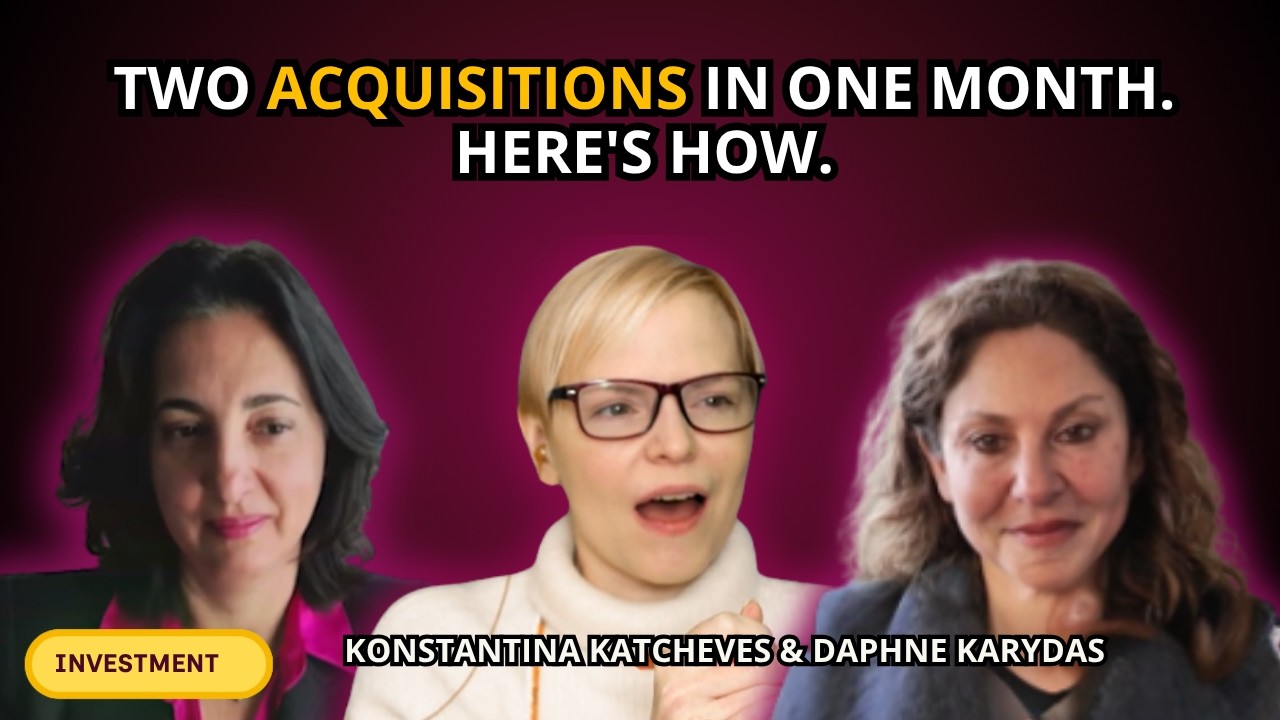
Two of the seats that decide whether a biotech acquisition happens were on one call. Konstantina Katcheves, who goes by Tina, is chief business and strategy officer at Acadia Pharmaceuticals. Before Acadia she was at Teva Pharmaceuticals, and earlier she was interim head of strategy and business development at Bristol Myers Squibb, where she says she led the company through its acquisition of Karuna Therapeutics; the Karuna and RayzeBio merger agreements were signed three days apart in December 2023. Daphne Karydas is president and chief financial officer of Flare Therapeutics. She spent about fifteen years on Wall Street, at Goldman Sachs and then on the buy side, before operating roles at Allergan and Syndax Pharmaceuticals.
Lori Ellis opened by saying she does not know much about mergers and acquisitions, and suspects fewer people do than claim to. What they describe is a process measured in years, in which the signature is a late step and much of the hard part is internal.
Why does the industry need M&A at all?
Katcheves starts with strategy and treats deal structure as a second-order question. “We’re pretty much agnostic to the type of deal so long it solves for a strategic question,” she says. Acquisition, partnership, co-development: the instrument follows the problem. Her reason for looking outside is a claim about where science comes from. “Innovation doesn’t happen in one place. It happens all over the world. So, we’re not going to just home grow everything,” she says, which she applies to large pharma, to a mid-cap like Acadia, and to smaller biotechs.
Karydas gives the structural version. Capital and infrastructure sit in one half of the industry, new science in the other. “The larger companies need the smaller more innovative companies and or programs, assets. The smaller companies need access to not just capital, but infrastructure and capability that is just inefficient to create on your own,” she says. The word the conversation settles on is symbiotic.
How long before a deal is a deal?
Corporate strategy gets revisited constantly, Katcheves says, and once a company sets it, “this is your North Star as an organization” for the next three to five years. Deals accumulate against it slowly. “You could be talking and being engaging with and paying attention to a company for years before you know, the opportunity’s ripe for transaction,” she says. She adds one movement in the other direction: “we have seen partnering go earlier and earlier, you know, where there’s more and more risk.”
Karydas puts the same runway at up to a decade and gives the banker a job inside it, long before a transaction exists. “They’re also getting to know both sides of the table,” she says, learning which acquirers want what, and which programs may come available.
What actually starts a transaction moving?
Katcheves names three tests a target has to pass: strategic alignment, science against a real unmet need, and the fiscal discipline Karydas represents. Then something has to trigger it. “There’s something, a catalyst of some sort that often precipitates a transaction. Often that catalyst can be, you know, a data readout. That catalyst could be a need to raise money,” she says. The second arrives with operating signals that show up well before the cash runs out.
What follows is mechanical: early diligence, a closer look at the data, valuation, a term sheet, a contract. Competition sits over the whole sequence, because supply is thin. “Quality assets are still, you know, limited, particularly looking at late-stage opportunities,” Katcheves says, and companies of every size hunt them. She also refuses to treat signing as the end. “We’re talking about getting a deal done, at some point there’s also living with the deal and living with the transaction,” she says.
Who inside the company has to say yes?
This is where both spend the most time. Strategic fit and good science are table stakes, and the deal still dies without someone carrying it. “You need to have an internal champion,” Karydas says, and usually more than one. Clinical has to believe the program, commercial has to want to sell it, and above a certain size the corporate level has to be satisfied the returns hold up.
Katcheves describes what that costs. “The organization typically has a day job,” she says. Commercial teams are delivering medicines, R&D is running the pipeline, and business development arrives with an idea that becomes their work. That is also why the internal case matters. “That’s the group that’s going to live with the deal. So, we can’t underestimate the criticality of that piece,” she says. A Bristol Myers Squibb acquisition now widely credited with opening the modern era of cancer immunotherapy was opposed by its own management team, and the executive who pushed it has described on this show how he forced it through.
Which function carries the most weight depends on the asset, Karydas says. For a product already on the market, commercial has the strongest voice. For an earlier program, clinical development and the scientists judging the mechanism do. Katcheves adds the question that never leaves the room for an unapproved asset: “There’s still a question of needing to assess the likelihood of approval. What is the PTRS of the transaction?”
Why can an acquisition be cleaner than a partnership?
Karydas argues the acquisition is often the simpler instrument. The questions are finite: does this asset make sense, is there a price, can we move fast enough. Integration is real work that happens after ownership is settled. Partnerships and licensing deals keep both parties in the arrangement indefinitely, and that is where she sees them break. “Where they fall apart, in my experience, is in the contract,” she says. Enthusiasm survives the term sheet, then meets the question of who holds which rights in which future scenario. “The devil is in the details,” she says, and a deal can end on a threshold that never appeared in the headline terms. Data ownership is one of those details, and a collaboration agreement written more than a few years ago likely says very little about it, according to a trial lawyer who appeared on this show.
Katcheves agrees and extends it earlier. “Daphne’s point is spot on. M&A can be cleaner,” she says. Preclinical deals carry small headline numbers and enormous complexity, because the parties have to negotiate a joint research plan, and every layer is another place a deal can break.
What changes when the target is public?
“Public company M&A is different than private company M&A,” Katcheves says. A public target already has a price the market has set, so the negotiation runs through the premium. A private target allows more flexibility on structure, with a different stakeholder problem on the target’s side. The categories only take you so far. She says she has never had a single cookie-cutter deal, and asks Karydas whether she has. She has not.
Why is business development an apprenticeship?
Asked for the strangest thing either had seen, both struggled to name one. Karydas ran through her mental catalog and found the surprises stop looking strange once you have seen enough of them, like discovering at the eleventh hour that a third party’s consent was needed, and that it would not be given, for a reason that made no sense to her. “It’s that collective experience that ultimately gets you to be better prepared and more agile,” she says.
Katcheves puts a name on it. “Business development is kind of an apprenticeship kind business,” she says, and the curriculum is exposure. The complicated deals teach the most, and “the ones that don’t go well teach you even more, right? Because you learn what not to do.” One of her more complicated deals was a site acquisition, where integration, the wind-down of one company’s operations, the ramp-up of another’s, and the contract ran at once. She says that creates disparities in leverage.
Why stay in a hard industry?
The decision to leave Wall Street took Karydas seven years. She had the variety of covering the whole sector and could exit a thesis that stopped working, and admits she was something close to a commitment phobe about it. “It took me literally 7 years to make it,” she says. Her reason for staying goes back to her first job out of college, in Merck’s vaccine division, working on a pediatric vaccine; she says she realized then that she liked knowing the work would matter to patients. “I lost my sister to ovarian cancer,” she says, and describes that as what keeps the industry worth it.
Katcheves was promoted into her first global executive role and straight into a reorganization, where one of the first asks was to reduce her own team. “This is people’s livelihood, their sense of self,” she says, and was not sure she knew enough yet to make those calls. She had planned on medicine, found during interviews she did not want hospitals or a bench, and took a science degree to law school and into the business side. “I wouldn’t leave it,” she says of this industry. The advice they close on is for a team facing its first deal: expect a windy road, and bring in someone who has seen where these go sideways.
So, every deal is a bespoke new experience that you go through. Like, I haven’t had a single cookie-cutter deal
Key takeaways
- The instrument follows the strategy question. Katcheves says she is agnostic between an acquisition, a partnership and a co-development deal, so long as the transaction answers a strategic question the company already has.
- Sourcing is external by necessity. Her stated reason is that innovation happens all over the world, which applies to large pharma, to a mid-cap, and to the biotechs looking for a partner of their own.
- The runway is measured in years. Katcheves describes engaging a company for years before the opportunity is ripe. Karydas puts some deals at up to a decade in the making.
- A catalyst starts the clock. Katcheves names a data readout or a need to raise capital as the two events that most often turn a long relationship into a transaction.
- Bankers work both ends of the table. Karydas describes them building relationships with innovators and acquirers years before there is anything to transact.
- No internal champion, no deal. Karydas says clinical has to believe the program, commercial has to want to sell it, and the corporate level has to be satisfied the returns hold up.
- Weight shifts with the stage of the asset. Commercial leads on a marketed product; clinical development and the scientists lead earlier, where PTRS is still the open question.
- Contracts end deals that valuations did not. Karydas says partnerships fall apart on rights and future scenarios, after the term sheet and the enthusiasm are already in place.
- Living with the deal is its own job. Katcheves treats the years after signing as a separate discipline, which is also why the functions who will run the asset have to endorse it first.
- Business development is learned by exposure. Katcheves calls it an apprenticeship business, and says the deals that go badly teach the most.
Key Questions, Answered
Why does the life sciences industry need mergers and acquisitions?
We’re pretty much agnostic to the type of deal so long it solves for a strategic question
Konstantina Katcheves treats the deal structure as a second-order question. The transaction has to answer a strategy question first, and the instrument follows from that.
Why do large pharma and small biotech companies need each other?
The larger companies need the smaller more innovative companies and or programs, assets. The smaller companies need access to not just capital, but infrastructure and capability that is just inefficient to create on your own
Daphne Karydas describes a symbiotic ecosystem. Capital, clinical development and commercial infrastructure sit on one side; new science increasingly sits on the other.
How long does a pharma deal take to come together?
You could be talking and being engaging with and paying attention to a company for years before you know, the opportunity’s ripe for transaction
Katcheves describes years of engagement before a company is ready to transact. Karydas puts some deals at up to a decade in the making.
What role do bankers play in biotech M&A?
They’re also getting to know both sides of the table. They’re looking at the innovators and where, you know, there’s an opportunity to potentially transact in the future
Karydas gives the banker a job that runs long before any transaction: holding relationships at both ends and understanding where each acquirer wants to go.
What triggers a biotech acquisition?
there’s something, a catalyst of some sort that often precipitates a transaction. Often that catalyst can be, you know, a data readout. That catalyst could be a need to raise money
Katcheves names the two most common catalysts. A data readout, or a company that needs capital to keep developing the program.
What happens after a biotech deal is signed?
we’re talking about getting a deal done, at some point there’s also living with the deal and living with the transaction
Katcheves refuses to treat signing as the finish. Especially in partnerships, the years after the signature are their own set of problems.
Why does a biotech deal need an internal champion?
you need to have an internal champion. And sometimes it’s multiple champions uh that, you know, and stakeholders that need to buy in
Karydas says strategic fit and good science are table stakes. Without someone inside the acquirer carrying the case, the transaction does not move.
Who has to live with a biotech deal after it closes?
That’s the group that’s going to live with the deal. So, we can’t underestimate the criticality of that piece
Katcheves on why internal buy-in is worth the effort it costs. The functions asked to endorse a deal are the ones who will run it afterward, on top of a day job.
Which internal team decides whether a deal happens?
So, I would say the people internally that have the strongest weight, it kind of depends on the type of deal that you’re looking at
Karydas says it moves with the asset. Commercial leads on a marketed product; clinical development and the scientists lead on an earlier program.
What is PTRS in a biotech transaction?
there’s still a question of needing to assess the likelihood of approval. What is the PTRS of the transaction?
Probability of technical and regulatory success. Katcheves says R&D still has to weigh the remaining risk on any asset that is not yet approved.
What is the most common threat to a biotech deal?
quality assets are still, you know, limited, particularly looking at late-stage opportunities
Competition. Katcheves says the supply of quality late-stage assets is thin and companies of every size are pursuing the same ones.
Why do biotech partnerships fail more often than acquisitions?
where they fall apart, in my experience, is in the contract
Karydas says licensing and partnership deals keep both parties in the arrangement, and the impasse arrives in rights and future scenarios that the headline terms never covered.
How is public company M&A different from private company M&A?
Public company M&A is different than private company M&A because they’re you know, you’re what’s out there is out there in the public markets
Katcheves says a public target arrives with a price the market has already set, so the negotiation runs through the premium. A private target allows more structural flexibility.
Resources
- Acadia Pharmaceuticals leadership Acadia’s own executive leadership listing, which names Konstantina Katcheves as chief business and strategy officer. Verified 2026-09-04.
- Flare Therapeutics leadership Flare Therapeutics’ own team page, which lists Daphne Karydas as president and chief financial officer. Verified 2026-09-04.
- Karuna Therapeutics Form 8-K, March 2024 The SEC filing reporting completion of the Bristol Myers Squibb merger, under an agreement dated December 22, 2023. Konstantina Katcheves is named as a director of the merger subsidiary. Verified 2026-09-04.
- RayzeBio Form 8-K, February 2024 The SEC filing reporting completion of the Bristol Myers Squibb acquisition, under an agreement dated December 25, 2023, three days after the Karuna agreement. Verified 2026-09-04.
- Syndax Pharmaceuticals Form 10-K certification The 2020 annual report certification signed by Daphne Karydas as chief financial officer of Syndax Pharmaceuticals, the company the legacy page had recorded incorrectly. Verified 2026-09-04.

Need the life-sciences signal but short on time?
Get the free quarterly briefing: every guest from the quarter, in one sitting. What decides whether a therapy reaches a patient, gets funded, and can be trusted.