
Is Health Data in ChatGPT Protected by HIPAA? Usually Not
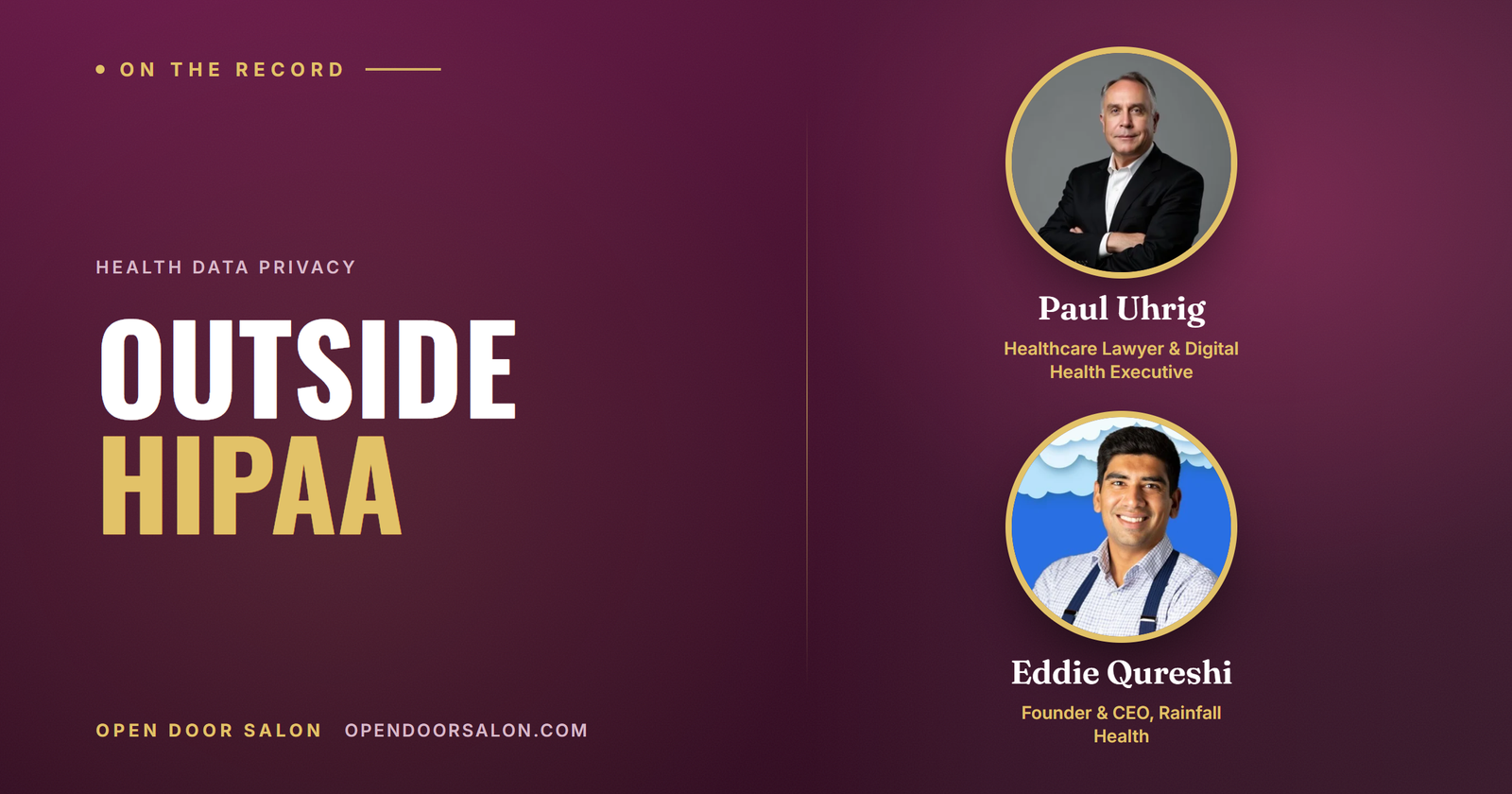
Usually not. When a patient puts their own medical records or symptoms into ChatGPT, Claude or another consumer AI app, that information generally leaves HIPAA, which covers health plans, most healthcare providers and the companies that handle patient data on their behalf. Paul Uhrig, a healthcare lawyer and former chief legal and digital health officer at Bassett Healthcare Network, said on Open Door Salon that outside HIPAA the governing rules are the Federal Trade Commission’s and some state laws, so protection depends largely on what the app’s maker says it does with the data. The FTC explains its side in its guidance on consumer health information outside HIPAA.
Lori Ellis asked whether people outside healthcare understand that once information goes into a chatbot it is no longer theirs in the same way, and who should be explaining it to them. Uhrig and Eddie Qureshi, founder and CEO of Rainfall Health, answered from the legal side and the patient side.
When does health data leave HIPAA?
When the patient moves it to an app that HIPAA does not cover. Uhrig framed it as a long-running question about where the line sits:
When is data in the HIPAA world, right, as you suggested, and then when is it outside of the HIPAA world, which is what happens when I put my data into an app.
He said most patients know the law exists but not where it stops:
I think a lot of patients at least have some familiarity with HIPAA, but this information goes outside of HIPAA.
Who decides what happens to the data?
The patient, to start with. Qureshi said the fundamentals are those of a consumer, and the people around the patient are advisors rather than owners:
You are a steward and a guide regardless of whatever you do, whether you’re the administrator, whether you’re the clinician. Ultimately it’s the patient’s choice.
He added that patients increasingly act like consumers because they see the contrast with other parts of their lives: products delivered in hours, their own health data taking months. The same habit is showing up in the exam room, where patients who connect their records to ChatGPT or Claude now arrive with sharper questions and sometimes a plan of care.
What protects health data outside HIPAA?
Mostly the vendor’s own representations, with the FTC and state laws behind them. Uhrig said the problem to solve sits under the non-HIPAA scheme, governed by the FTC and some state laws, and comes down to one thing:
It really gets down to what is the vendor saying.
He was careful not to paint the industry as a whole as the risk:
Many vendors are obviously honorable. They have limited uses of the data. They’re upfront about it and they comply with it.
The concern is the minority who are not, which connects to the bad actors the conversation opened with. Health data can also matter well beyond the individual, as our earlier post on why anonymized clinical data is a national security risk explains.
Why don’t consent screens protect patients?
Because almost nobody reads them, including the experts. Uhrig described a scene he has watched repeatedly:
We all click through the consents in these apps. I accept it, right?
He said he has heard privacy experts admit at conferences that they do not read the terms either and simply hit accept, and that the room laughs because everyone recognizes it. His conclusion was that the laughter points at something that needs fixing:
People are ill-informed as to what someone may be saying they’re doing with that data, right?
Do patients know their data leaves HIPAA?
Often not, which was the premise of Lori Ellis’s question. Talking with people outside life sciences and healthcare, she said, she wonders whether the industry assumes a level of understanding the public does not have: that once information goes into Claude or ChatGPT, even something as ordinary as a slide deck, it is no longer entirely yours. Uhrig agreed it was not an easy question, and said the gap has two levels. The first is regulatory: the information is now under a different scheme from the one patients have heard of. The second is practical: the disclosures meant to explain that are long and go unread.
What would better consent look like?
Shorter, plainer and enforced. Uhrig said the explanation should not run to 30 pages, and put the rest as three questions:
How do we simplify it? How do we put it in plain English or other relevant languages here in the United States? And then who’s going to enforce it, right?
A clear disclosure only protects a patient if someone checks that the data is used for the stated purposes and no others.
Who should educate patients about this?
The conversation did not settle on a single owner, and Uhrig called it a hard question. The pieces he described point to shared work: vendors that state their data use plainly, regulators that enforce it, and health systems that talk with patients about the tools they already use. For what hospitals are accountable for after surgery, see our earlier post on what the CMS TEAM model asks of hospitals. Health systems deciding whether to adopt these tools face a separate problem: why hospital AI pilots stall before they scale.
Companies that want to reach the leaders who follow this conversation can learn about sponsoring Open Door Salon.
This post is drawn from the recorded, on-the-record conversation between Lori Ellis, Paul Uhrig and Eddie Qureshi on Open Door Salon.