
Is the FDA the Clinical Trial Bottleneck? Califf Says No
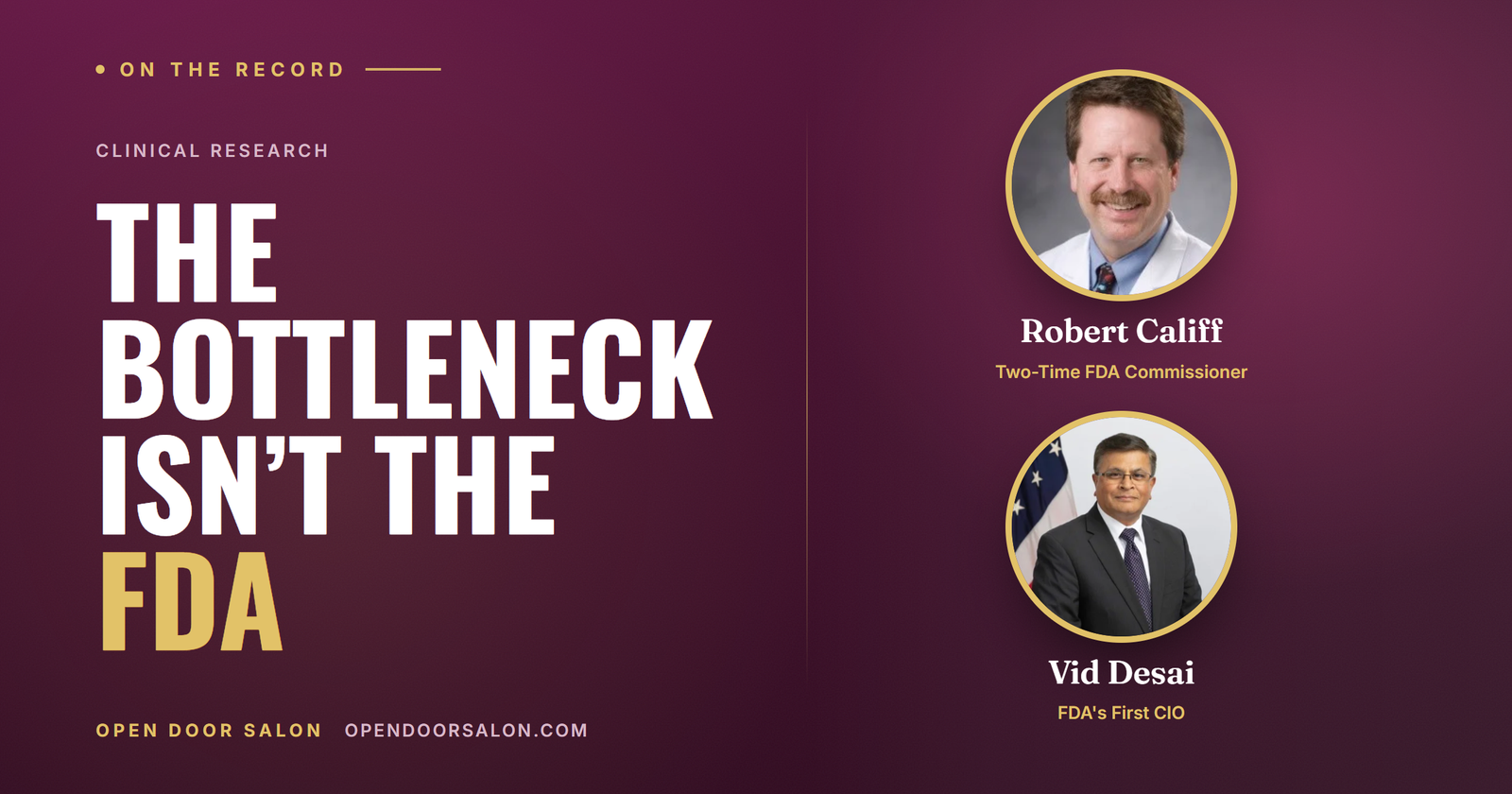
No, according to Robert Califf, the only person to have served twice as FDA Commissioner. Operation TrialBlazer, the Department of Health and Human Services initiative launched to accelerate US clinical research and reverse the movement of trials overseas, is aimed largely at the FDA. Califf supports the attention and questions the target. In his assessment the binding constraint sits with research sites that are slow, expensive, and structured to protect revenue and guard against litigation, not with the agency's review clock. He made the case on Open Door Salon alongside Vid Desai, the FDA's first Chief Information Officer. The same capacity problem shows up in the agency’s tooling, where government AI projects like Elsa fail for budgetary, not technical, reasons.
What is Operation TrialBlazer?
It is an HHS initiative, run with the FDA, NIH, ARPA-H and others, to accelerate and modernize clinical development from the investigational new drug stage through late-stage pivotal trials. Its components include an expedited IND pilot that lets sponsors partner with academic medical centers or CROs on a rolling submission platform, guidance clarifying that one high-quality late-stage trial with confirmatory evidence can support approval in many cases, and updated guidance on master protocols covering basket, umbrella and platform designs. The stated motivation is competitive: reducing development timelines and reversing the trend of companies moving trials abroad, primarily to China.
One note on the name, since it trips nearly everyone. It is TrialBlazer, a play on clinical trials, not Trailblazer. Califf joked about the confusion on the recording.
I can never figure out is it trailblazer or trailblazer? It's it's spelled both ways.
He is broadly supportive of the attention the initiative brings. His reservation is about where it points.
Is the FDA actually the bottleneck?
Califf's answer was direct.
I don't think the FDA is the place to focus the activity. The issue is we have research sites that take forever and are very expensive and bureaucratic
His diagnosis of why sites are slow is unsentimental. The bureaucracy exists, in his words, for a reason that has nothing to do with science.
mostly to protect finances and protect from lawsuits
Contracting alone can consume enormous time, and he noted it can take a year to get the average contract written. None of that is regulatory review. It is the layer between a sponsor deciding to run a study and the first patient being enrolled, and it is largely invisible in policy conversations that focus on the agency.
How much faster and cheaper is the alternative?
The comparison that drives sponsor behavior is not subtle.
You can do a phase one trial in China for a third the cost and 6 months quicker than you can in the US and Europe.
A third of the cost and six months faster is a gap large enough to move programs on its own. Califf, who has run trials in China and helped start a joint American-Chinese university there, adds a structural observation about where that efficiency comes from.
they're developing large clinical research networks to do the clinical trials needed so that they won't waste their money on ineffective products like we do so much in the US
He also names a factor that is rarely stated plainly in policy discussions.
We also have a lot more lawyers in US than in China. And so it makes everyone conservative in terms of what they're willing to do.
Why does the litigation and revenue structure matter so much?
Because it explains why site-level delay is so resistant to policy. A regulatory timeline can be shortened by guidance. A contracting process built to manage financial risk and legal exposure across independent institutions cannot, because each institution is behaving rationally in its own interest. Califf's framing throughout the conversation is that the American system is fragmented and somewhat paralyzed by conflict-of-interest concerns, in contrast to a unitary national effort. The fragmentation is not a bug that someone forgot to fix. It is the accumulated result of decades of reasonable institutional self-protection, and that is precisely what makes it hard to legislate away.
What would actually move the number?
Califf did not offer a program, and it would be inventing something to claim he did. What his analysis implies is that an initiative aimed at IND submissions and review guidance addresses a real but smaller share of total elapsed time than site startup, contracting and enrollment. If the goal is to keep trials in the United States, the intervention has to reach the sites. Desai's contribution to the same theme was that durable change requires funding to be rewired rather than announced, which is the same lesson he drew from technology programs at the agency.
It is worth pairing this with the enrollment side of the problem. Our conversation on why a patient recruitment executive could not find a trial for her own cancer covers the recruitment layer, and what happens to clinical trials during a war covers what happens when sites themselves become unavailable. Together they describe a system where the regulator is rarely the slowest part.
The trust question underneath all of this, whether the FDA remains the global reference point, sits in is the FDA still the gold standard.
Watch the full conversation with Robert Califf and Vid Desai on the episode page. If your organization wants to reach the decision-makers in that room, that is where to start.
Drawn from the recorded, on-the-record conversation with Robert Califf and Vid Desai on Open Door Salon. Figures and program details verified against primary sources where cited.