Non-Dilutive Funding for Brain Health Startups: Where It Is
Every dollar a founder raises from a venture fund costs a piece of the company. Every dollar from a federal grant does not. In brain health specifically, the second pool is larger and more accessible than most early-stage founders assume.
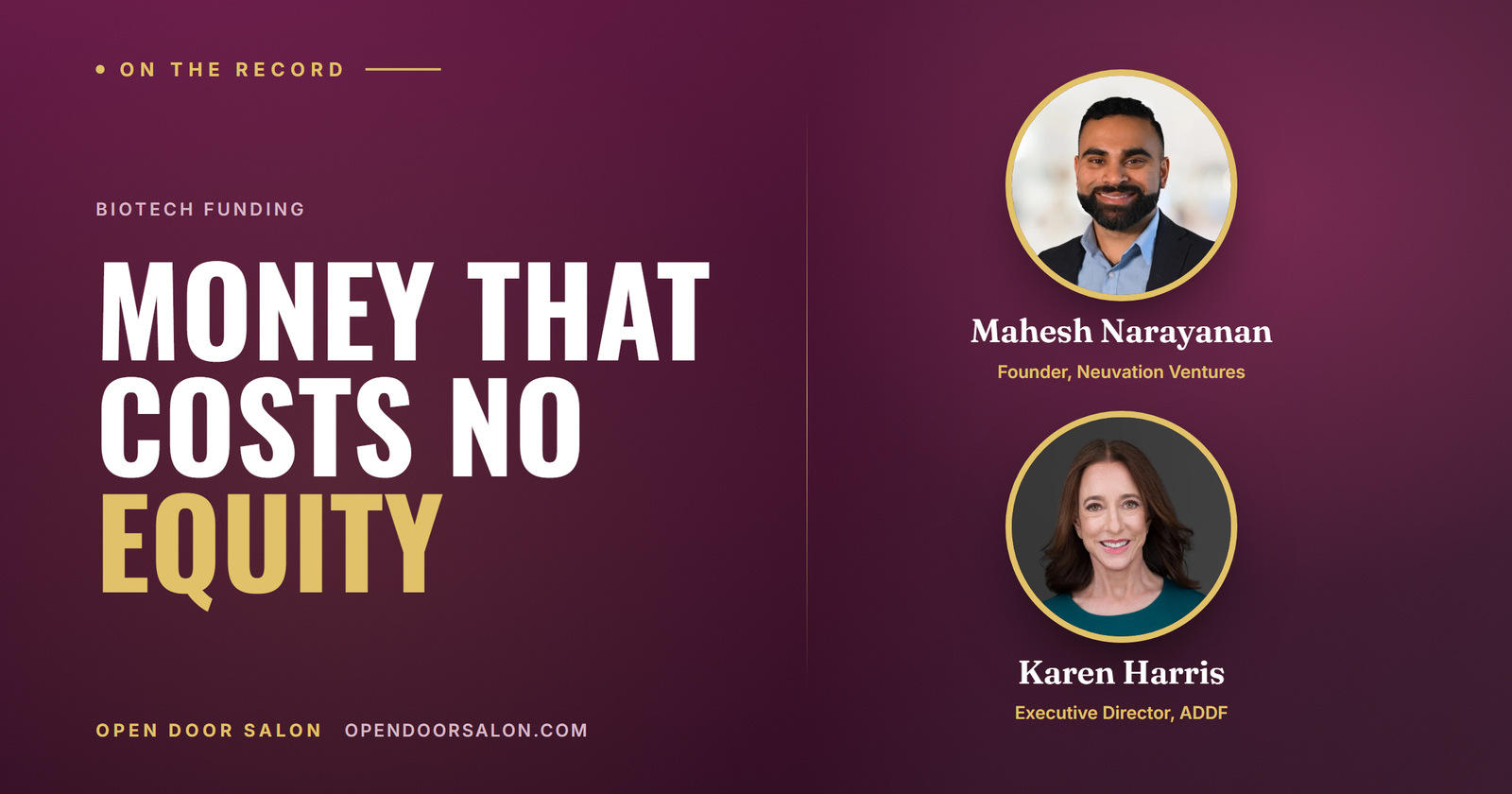
Mahesh Narayanan, managing partner and founder of Neuvation Ventures, a Baltimore seed fund investing in brain health, described on Open Door Salon how routinely his portfolio uses it.
How much federal money goes to Alzheimer's research?
Narayanan put a figure on the NIH side of it.
I believe almost $4 billion annually has been spent by NIH on Alzheimer's.
That number checks out. Federal Alzheimer's and dementia research funding for FY2026 sits at roughly $3.9 billion, after a $100 million increase signed into law in February 2026.
The figure that makes the point harder is the one neither guest mentioned: before the National Alzheimer's Project Act passed, annual federal funding for this disease was under $500 million. The category did not grow incrementally. It grew by roughly eightfold, because a law changed. A policy decision can still move this field faster than a result can, which is what happened again when a major insurer started paying for a blood-based Alzheimer’s test.
Which agencies fund brain health?
NIH is the obvious one, and Harris noted that the Alzheimer's Drug Discovery Foundation connects with NIH quarterly. But Narayanan's list is wider, and the wider part is where founders under-search.
He named the Department of War, DARPA, and ARPA-H as having created specific programs, alongside NIH's BRAIN Initiative. He also pointed to programs aimed at neurodevelopmental conditions rather than only neurodegenerative ones, which is a distinction that matters if you are building for autism, learning differences, or pediatric neurology rather than dementia.
Why brain health has a dual-use advantage
The reason defense agencies fund this work is not incidental. It is structural, and Narayanan is direct about how far it extends across his portfolio.
Practically every company that we have invested has a dual use component at this point, where we have engaged with someone within the federal agencies that are helping fund something non-dilutively. And then we are supplementing that with our venture capital.
The overlap is easy to see once stated.
Whether it's concussions, whether it's strokes, anything related to the cardiac, there's always some kind of components there that the army and the military in general are very interested in.
Traumatic brain injury, concussion protocols, cognitive performance, and neural interfaces all have obvious military relevance. A company building diagnostics or therapeutics in those areas can make a defense-funding argument that an oncology or dermatology company simply cannot. That is a genuine structural advantage of the category, and it is available to a seed-stage company.
How non-dilutive and venture money fit together
The pattern Narayanan describes is not either-or. Federal money funds a piece of the work non-dilutively, and venture capital supplements it. For a founder, that changes the shape of a round: the same milestone gets reached with less equity sold, or a larger milestone gets reached with the same equity. The venture half of that pairing still has to be won on its own terms, and both investors are unusually specific about what they are actually judging when they meet a founder.
Harris frames the same idea from the philanthropy side, and her phrasing is the one worth keeping.
For Alzheimer's anyway, it takes a village. So you need the government funding, you need university funding, you're gonna need venture funding, venture philanthropy and pharma.
Her own foundation is the venture philanthropy leg of that list, and it invests on investment terms rather than granting, which is what keeps the capital recycling into the next set of programs.
Trials in this area are expensive enough that the ADDF works actively to help portfolio companies maximize the number of distinct dollars they can bring in. Treating federal funding as a separate track from the venture track, rather than a fallback when the venture track fails, is the operating posture both investors describe. It matters more in this category than most, because the venture track in neuroscience has been unusually narrow for reasons that predate any individual company. The narrowing is not confined to neuroscience: a summit convener and a former Teva chief executive describe the conventional A, B, C round path as no longer something a founder can rely on across biotech generally, which is part of why the non-dilutive track has stopped looking like a fallback.
What non-dilutive money costs you instead
It does not cost equity, but it is not free. Federal applications run on their own timetable, and that timetable rarely matches a company's runway. Grant cycles are measured in months, reporting obligations continue for the life of the award, and the scope you proposed is the scope you are accountable for delivering.
The practical consequence is that non-dilutive funding works best as a parallel track started early, not as a rescue when a round stalls. It is also not the only pool sitting outside the traditional equity round: two chief executives describe private family-office capital stepping into the same gap. A founder who begins the application when cash is short has usually already missed the window. That is what Narayanan is describing when he says his companies engage a federal agency and the fund supplements it: the two are running at the same time, by design.
What a founder should do about it
The specific programs change, so the durable advice is about how to search. Look past NIH to the defense and advanced-research agencies. Check whether your indication has a neurodevelopmental program as well as a neurodegenerative one. And articulate the dual-use case explicitly, because the agency officer reading your application is looking for it.
None of this substitutes for the commercial work. As the same conversation covered at length, what stops early-stage neuroscience companies is rarely the science, and non-dilutive money only buys runway. It also sits inside a broader shift in how national research spending is moving globally, which is worth understanding before you build a plan around any single agency's budget.
That runway still has an end. David Esposito and Pavel Khrimian describe the ninety days before a biotech pivots or closes, and the three questions that decide which one it is. The signals that precede that decision arrive earlier, as a manufacturing delay or a term sheet that moves.
Open Door Salon convenes these conversations on the record. If your company wants to reach the operators and investors in this room, that is what sponsorship is for.
Drawn from the recorded, on-the-record conversation with Karen Harris and Mahesh Narayanan on Open Door Salon. Federal funding figures reflect FY2026; confirm current appropriations before relying on them.