
What Is a Single-Case Agreement in Gene Therapy?
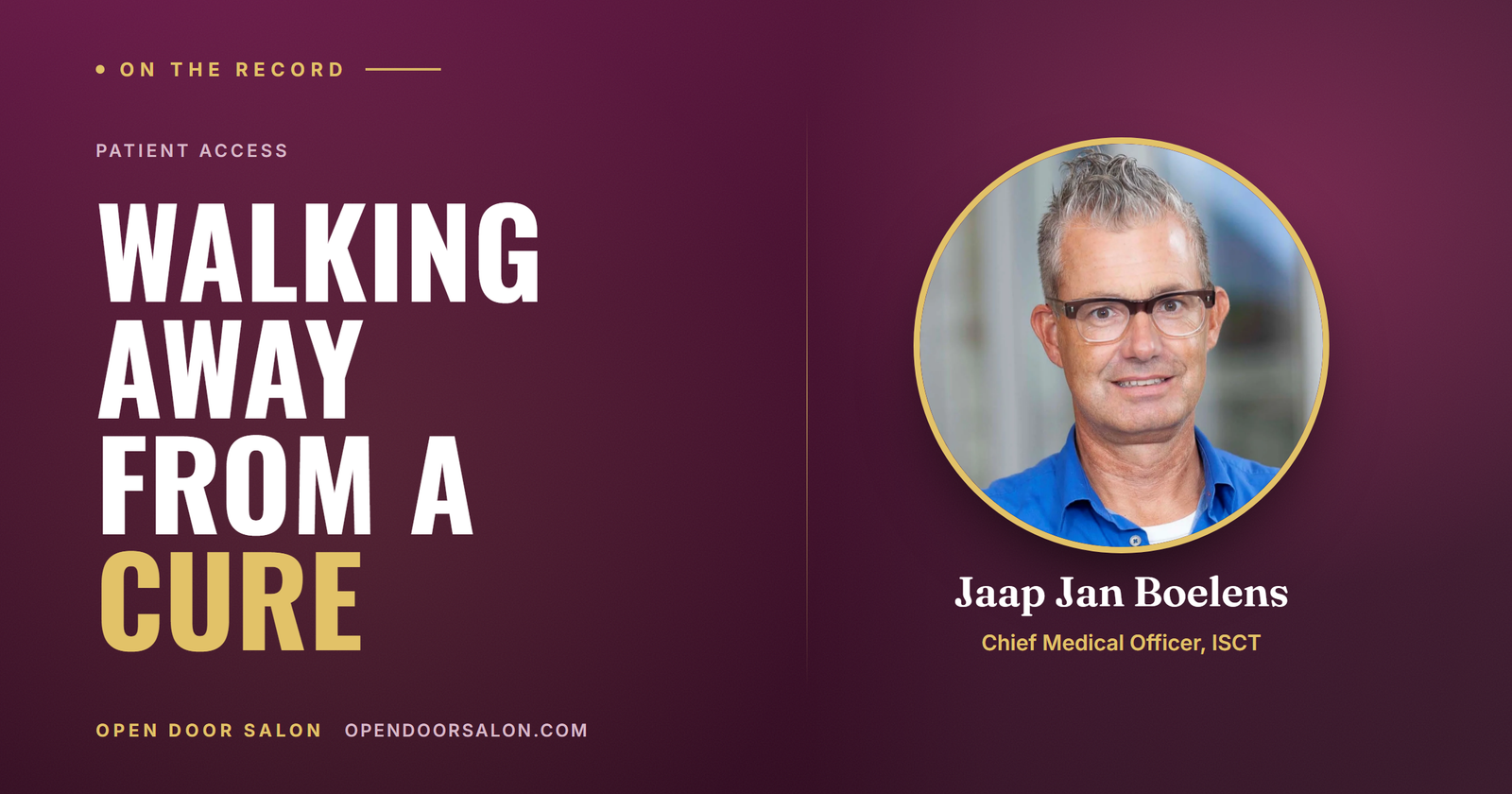
A single-case agreement is the one-off contract a health insurer signs to cover a specific patient's treatment at a center that isn't in its standard network, and in gene therapy it has become one of the quietest reasons patients never get cured. When there is no standing in-network deal for a million-dollar, one-time therapy, the hospital and the payer have to negotiate that patient's coverage from scratch. While they do, the clock runs. Jaap Jan Boelens, Chief Medical Officer of the International Society for Cell and Gene Therapy (ISCT), treats the sickle cell patients caught in that wait, and in his conversation with Open Door Salon he described what it does to them.
What is a single-case agreement, and why does gene therapy need one?
It is a patient-specific coverage contract, and gene therapy needs one because the treatment is often delivered at a specialist center the insurer has no existing rate with. Standard drugs run through established formularies and network contracts. A one-time cell or gene therapy for sickle cell disease frequently doesn't, so the payer negotiates a bespoke agreement for that single patient before anything can proceed. That negotiation is not a formality, and its length is wildly inconsistent from one payer to the next.
For some of the payers it takes two months or three months to get a single-case agreement in place, but in others it can take over a year.
How long does the whole process actually take?
Long enough that the agreement is only the first delay, not the last. Once a single-case agreement is finally signed, the clinical clock hasn't even started, because the patient's own cells still have to be collected and manufactured into the therapy. Boelens laid out the full runway.
And then you have to start with the cell collection, so it can take years before a patient is ultimately dosed.
That is the sequence a patient with sickle cell disease is asked to accept: months to more than a year to get the coverage agreement, then the cell collection and manufacturing on top of it. For someone living with the daily pain and organ damage of the disease, "years before you're dosed" is not an abstraction. It is a reason to give up on the cure.
Why do patients walk away from a cure they qualify for?
Because a proven alternative is available now, and waiting years for the newer therapy is a real cost of its own. A standard bone marrow transplant can also treat sickle cell disease, and it doesn't wait on a single-case agreement. Boelens has watched patients do the math and choose the older option specifically to stop waiting.
I've seen patients backing out on the gene therapy because the track to get a single-case agreement in place is going to take too long... I've seen patients backing out because they want to get rid of their sickle cell. So they elect to go to standard bone marrow transplant instead of gene therapy.
This is the human edge of the access problem. The patient qualifies for the cure, the cure exists, and the paperwork moves so slowly that a standard transplant becomes the rational choice. It is the same gap, from the clinic side, that shows up on the finance side in why gene therapy reimbursement takes so long, and in the payment-model problem laid out in how to pay for one-time cell therapy. A company that shuts down still owes the patients already on its therapy continued treatment.
What else stalls the contract besides the payer?
A second contract most people never hear about: the one between the therapy's manufacturer and the hospital itself. Before a payer's single-case agreement even matters, the institution has to have a contract in place with the company that makes the product, and Boelens said that step is just as uneven, especially at smaller centers new to these therapies.
That's the contract between the company and the institution... I've heard some of the institutions it can take years, while in others it's done in three to five months.
He pointed out that sickle cell therapy often reaches smaller sites that never ran the pivotal trials and have no experience evaluating these contracts, which adds yet another delay on top of the payer negotiation. Two separate agreements, each ranging from a few months to a few years, stacked in front of a patient who is sick today.
The through-line from ISCT's leaders is that none of this is a science problem. The cure works. What fails is the contracting and coverage machinery around it, and until that speeds up, some patients will keep choosing the older transplant over a newer cure they qualify for. Health systems and sponsors who want to help fix the access side can work with Open Door Salon or learn more at ISCT.
Drawn from the recorded, on-the-record Open Door Salon conversation with Jaap Jan Boelens and Bambi Grilley of ISCT. For background on single-case agreements as a coverage mechanism, see CMS guidance on out-of-network coverage arrangements.