
Unproven Stem Cell Therapy: The Risks Families Face
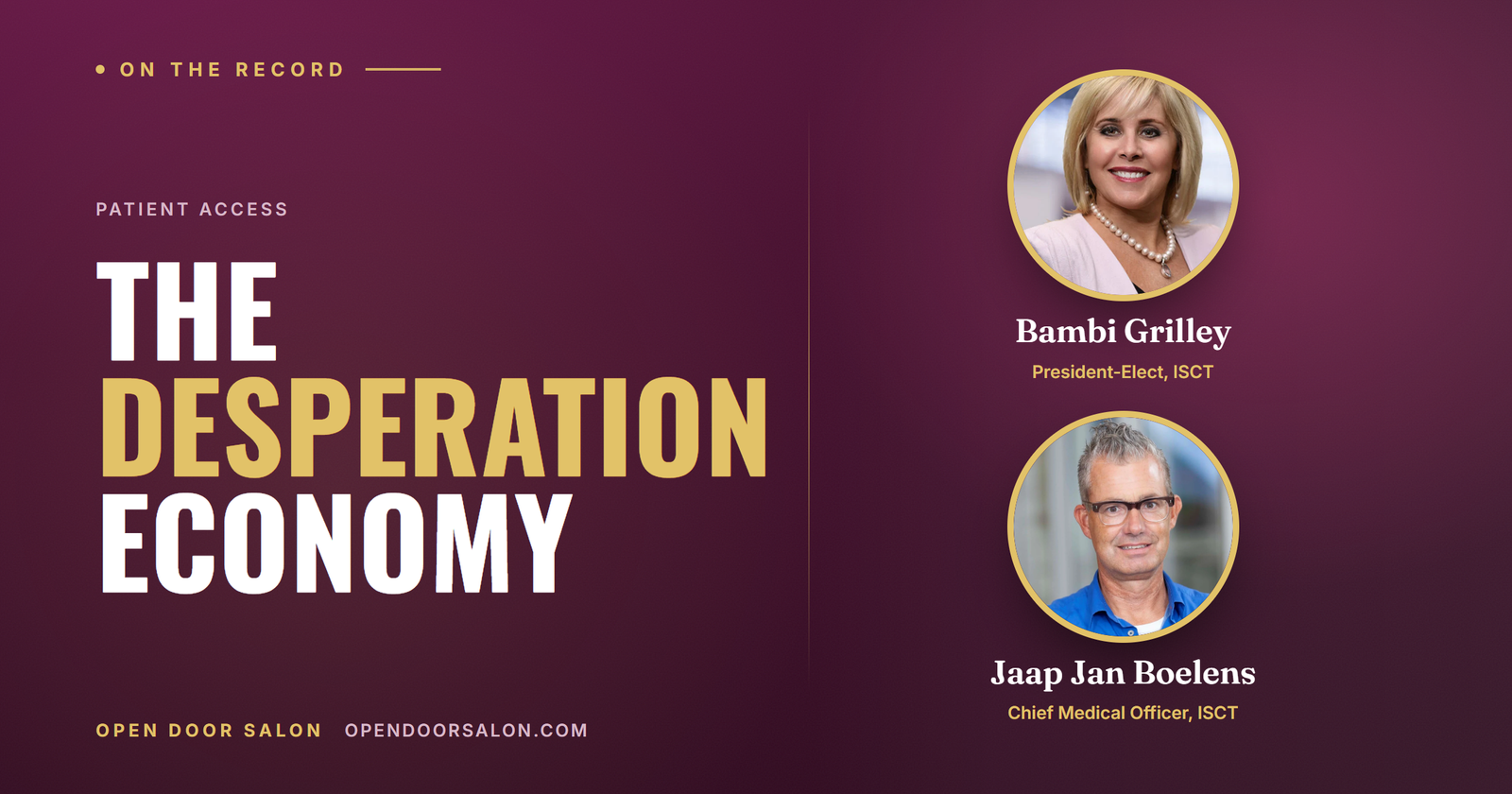
The risks of unproven stem cell therapy fall into three categories, and the one families rarely see coming is financial. When a child has a rare disease and no approved option, desperation makes an unproven treatment abroad look like the only door left. Bambi Grilley, President-Elect of the International Society for Cell and Gene Therapy (ISCT), works on the ethics of exactly this problem, and in her Open Door Salon conversation with ISCT Chief Medical Officer Jaap Jan Boelens, she laid out why the market for these therapies exists and what it costs the families who turn to it.
What is an unproven stem cell therapy?
It is a treatment marketed as a cure without the evidence or regulatory oversight that a legitimate therapy carries, and telling it apart from a real one is genuinely hard for a non-expert. A product under an Investigational New Drug (IND) application is being studied under regulatory rules with data collection and safety oversight. An unlicensed, unproven therapy is not. Grilley said that distinction, which is everything to a scientist, is nearly impossible to convey to a frightened parent.
Trying to explain the difference to a family about an unproven stem cell therapy and what that means as compared to a product that's under an IND, this is really hard to explain.
Why do families go abroad for them?
Because rare disease plus no approved option produces a level of desperation that erases nuance, and someone somewhere is always advertising a target. Grilley described how the reasoning collapses once a family runs out of legitimate choices.
When you start looking at patients who have really rare conditions and no treatment options... then you start seeing a lot more desperation in the patients or their families. Once you start getting to desperation, those shades of gray start disappearing.
She walked through the internal monologue of a parent who is, in her words, just a normal person with no medical knowledge: the major US centers can't target my child's condition, but someone in South America or Asia says they can, so I'll crowdsource the money and go. It is not stupidity. It is a rational response to being told, correctly, that no proven option exists, and it is the same access vacuum that leaves eligible patients without treatment in the first place.
What are the actual risks?
Three of them, and Grilley is explicit that the financial one is the least discussed and often the most devastating. There is the risk of getting no real treatment, the risk of side effects from an unmonitored product, and then the money.
That's the kind of third major risk. There's the risk of not getting treatment, there's the risk of side effects from getting treated, and there's the huge, in cell and gene therapy and extending into these unlicensed products, financial risks that go with these.
The financial exposure compounds fast: the therapy itself, then flights, then months in a hotel, then childcare for the other children left at home, then lost income from time off work. Boelens, who sees these families in clinic, confirmed the shape of it, noting that these therapies are usually entirely out of pocket, that families crowdfund or self-pay, and that they can end up with, in his words, horrendously high expenses for a condition that may have no cure. A family can lose everything and still not get the child treated.
How should a family weigh the evidence?
By asking what evidence actually exists, and by having the conversation with a clinician who can interpret it rather than a marketing page. Boelens said his approach is to stay candid and keep returning to the science.
I would always try to fall back on the evidence, the scientific evidence... and also ask the family what evidence they have seen from this institution or this center.
The hard part, both guests agreed, is that many families never reach a specialist like Boelens. They talk to a family doctor who may not understand the difference between an unlicensed product, an IND-stage therapy, and an approved one, and all the shades of gray in between. That knowledge gap is where the desperation economy operates. It is the darker mirror of the real progress the field has made, the kind captured in stories like Emily Whitehead's, and it is why ISCT treats unproven stem cell therapies as an ethics problem, not just a scientific one.
Sponsors, advocates, and clinicians who want to help close the information gap can work with Open Door Salon or learn more about the field's ethics work at ISCT.
Drawn from the recorded, on-the-record Open Door Salon conversation with Bambi Grilley and Jaap Jan Boelens of ISCT. For guidance on distinguishing legitimate from unproven stem cell treatments, see the FDA consumer guidance on stem cell therapies.