
What Is a Target Product Profile? Write the Label First
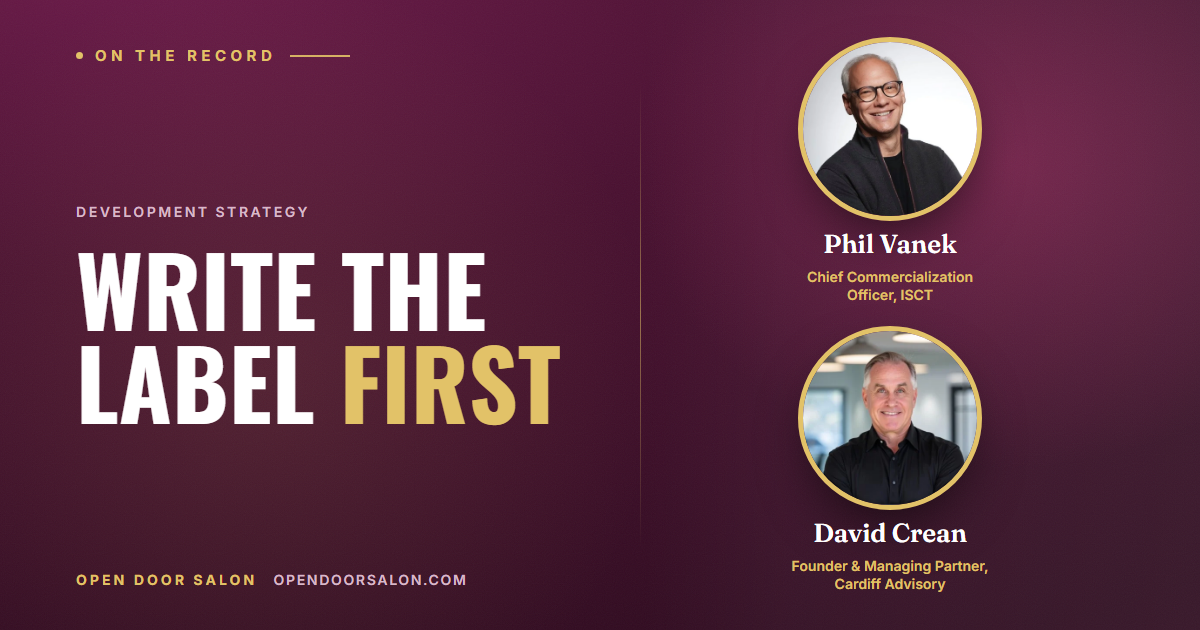
A target product profile is a short document that describes the medicine a company intends to end up with. It is written in the terms of the eventual label: the indication, the safety and efficacy it must show, and how payers and providers will judge it. David Crean, an investment banker and founder of Cardiff Advisory, compares it to writing the label first. Phil Vanek, chief commercialization officer of the International Society for Cell & Gene Therapy (ISCT), calls it the foundational document that defines what will make a product succeed. Both told Lori Ellis on Open Door Salon that founders should write one at the very start of development.
Their reason is practical. An early-stage cell and gene therapy company asks investors to underwrite a product that does not exist yet, and the profile is the clearest statement of what that product is meant to become.
What does a target product profile describe?
It describes the finished product before it exists. Crean frames it as a set of questions a founder should be able to answer today, as though the label were already being drafted:
Write the label today. What does that look like?
He listed what belongs in it: the target indication, contraindications, the safety and efficacy the company expects to achieve, and the view from reimbursement, payers and providers. The profile also gives an investor a reference point. In his words, it tells the investor:
Hey, I have a general idea of what I want to target and I'm going to have to tweak that target product profile.
The format has official roots. The FDA issued a draft guidance titled Target Product Profile: A Strategic Development Process Tool in 2007, described in this Federal Register notice on the draft. Crean said he understood the agency later pulled it, and that he still uses it with entrepreneurs.
When should a company write its target product profile?
At the beginning, before the clinical program is designed around it. Crean was specific about the timing:
You should be doing that right up front. You shouldn't be doing this at the end of Phase 2 or going into a Phase 3.
Vanek described the same discipline from the ISCT side, where the society works with companies from idea through commercialization and payment:
We encourage people to think with the end in mind and work backwards and really make sure that the contribution of the science and the scientific merit is there to justify what ultimately needs to be a medicine or a product or a therapeutic, not just a laboratory curiosity.
Is a target product profile a marketing document?
No. It guides development decisions, and Crean was direct about that distinction:
It's not a marketing exercise. It's guiding, frankly, your entire development strategy, development program. This is what I'm trying to achieve.
A profile written early gives a board and its investors a fixed reference for whether each study moves the company toward the product it described.
What questions should a target product profile force a founder to answer?
Whether the therapy matters enough to win. Vanek listed the questions he expects the profile to settle:
Ultimately does the therapy matter? Can we win in the market? Is it a novel asset? Is there enough therapeutic headroom?
He added a commercial question: Do we really need another one of these assets out in the market? They already exist. And that's a commercialization question.
For investors deciding what to back, that question sits beside the science, which is the subject of our earlier post on what investors look for in a biotech founder.
Why does a target product profile include best and worst cases?
Because it forces a founder to test assumptions against competitors. Vanek explained what he values in the format:
What I love about the TPP is also that it sort of sets this concept of base case, best case, worst case. So you really are forced into facing your assumptions.
Where do reimbursement and manufacturing fit in the profile?
Both belong in it from the start. Crean argued that payer planning should be part of the profile rather than something left to a future partner or acquirer:
Phil talked about the target product profile. It needs to be a part of that and the earlier you can do that the better.
Vanek tied it to manufacturing, which in cell and gene therapy can decide whether a product reaches patients at all. If a company cannot make the product or manage its supply chain, he said, it is dead in the water anyway. The manufacturing side is covered in what CMC means in cell and gene therapy. The payment side is explored further in why gene therapy reimbursement takes so long. Why Crean and Vanek put reimbursement at the start of development is set out in when a biotech should plan for reimbursement.
Companies that want to reach the leaders who follow this conversation can learn about sponsoring Open Door Salon.
This post is drawn from the recorded, on-the-record conversation between Lori Ellis, Phil Vanek and David Crean on Open Door Salon; quotes are lightly edited for clarity, and the full episode is the record.