
Why Is Cell and Gene Therapy So Expensive? Insiders Explain
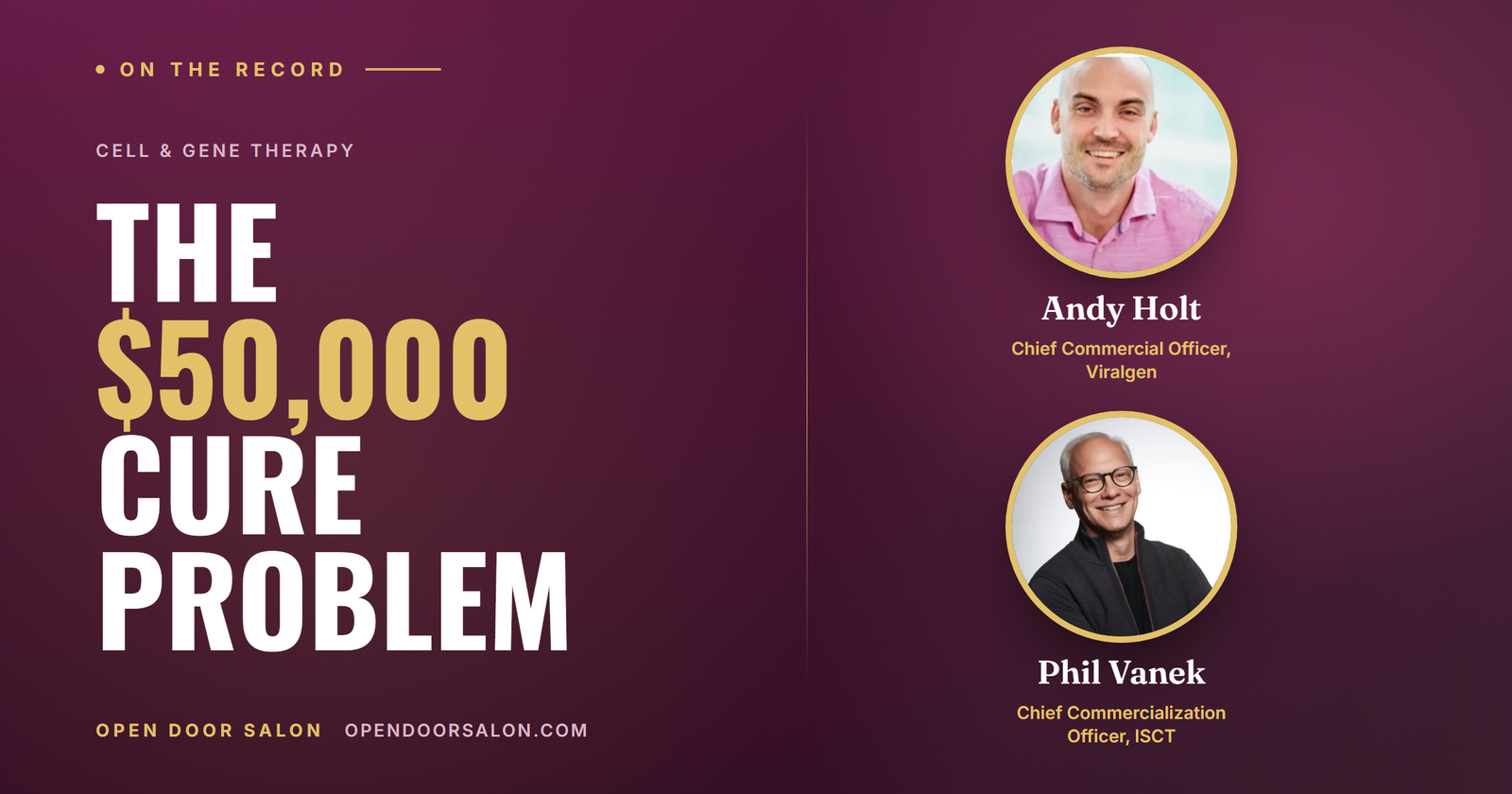
Cell and gene therapies can cure diseases that were recently untreatable. They are also among the most expensive medicines ever made, which is why "why is cell and gene therapy so expensive?" has become one of the most common questions in the field. We put it to two people who build and commercialize these therapies for a living: Andy Holt, Chief Commercial Officer of Viralgen, a contract manufacturer of AAV gene therapies, and Phil Vanek, Chief Commercialization Officer of the International Society for Cell and Gene Therapy. What they described is more complicated than the price tag suggests.
Why is cell and gene therapy so expensive? Even the manufacturer questions the easy answer
Holt has spent roughly eighteen years making and testing these therapies, and he is blunt about the usual explanation for their cost. Manufacturing expense, he said, "doesn't have to be a problem anymore. Certainly can be a convenient reason why barriers to access are high. But I don't think it's a true reason when we're at our best any longer."
His sharper version: "The cost of goods of manufacturing is one cog in that wheel, but it's no longer the biggest cog or the slowest-turning cog." That is a notable thing to hear from someone whose entire business is manufacturing.
The $50,000 number that complicates the story
The clearest sign that cost is not fixed by the science comes from outside the US. Holt pointed to India, where CAR-T therapies are "commercialized for under $50,000 a dose. They're using the same fundamental tools for manufacturing, and yet they're able to offer a radically lower price in that health care system." That is far below what US or European systems manage with the same technology.
Same tools, a fraction of the price. If manufacturing were the immovable cost, that gap would not exist.
If it isn't only manufacturing, what is it?
For Vanek, the cost conversation is incomplete if it stops at the lab. He argues the field has been "metered by our success," with real technical wins and clinical approvals but not the clinical adoption to match. And the price of the therapy is only part of what a health system actually pays.
"It's not just the price of the drug or the therapy or the medicine or the surgery," he said. "It's the entire wraparound that also has to be affordable." The admitting center, the critical care, the coordination of everyone involved. All of it accrues into a system he describes as already stressed.
The reimbursement problem hiding inside US insurance
Holt's most specific point was not about science at all. It was about how the US pays for cures. "In many ways our health care system isn't set up to reimburse for that, especially in the US," he said. "We do a lot more treating than we do curing in medicine right now." Even where a payer does say yes, the reimbursement itself can run months behind the treatment, leaving the hospital to carry the cost in the meantime.
He told a story from an insurance executive that points at a deeper obstacle. The payer wanted to cover these therapies. The math worked: fewer hospital visits, clear lifetime value, a strong quality-adjusted life year calculation. The obstacle was structural. "The problem is if the employee of the company leaves to go to a different company, I've paid the $4 million and I don't get the long-term value," Holt recounted. Because US insurance is tied to employment, the payer who funds a one-time cure is often not the one who collects decades of savings. The employment-linked system, in his words, "creates a disincentive" to pay for the very therapies that work. The fix the industry keeps proposing, outcomes-based or value-based contracts that pay out as a cure proves itself, runs straight into the same job-switching problem.
What the payers are actually weighing
Vanek pushed back on the easy framing. "Payers think like investors on behalf of the patients," he said. "They are absolutely looking for return on an investment." A new therapy does not simply get added to the system. It has to replace something already there, and it has to be substantially better to earn the slot. His guidance to developers follows directly: go into markets "that have substantial unmet need, that are sizable, that can provide the best possible benefit for the investment made."
A reframe that might change the math
One idea ran through the whole conversation. Holt thinks the industry mislabels what it does. "Everybody wants to say they're genetic medicines, which implies pills or creams," he said. "I think that's a misnomer. What we're really doing is surgically altering the body with genetic tools." Call them genetic surgeries, he argued, and the accounting changes: "the more we view it that way, the better and more holistically we could look at the whole value chain and understand barriers to access in a less convenient but more accurate way."
Where they land, and where we left it open
Holt and Vanek do not agree on a single fix, and they did not pretend to. One sees manufacturing that has quietly gotten cheaper and a US reimbursement structure still built for treatment instead of cures. The other sees a care pathway and a capital market that punish patience. What they share is a sense that the too-expensive story is incomplete, and that the real barriers are built by people, which means people can change them.
That is why we have these conversations on the record. If you work somewhere on this problem, in manufacturing, at a payer, on an investment team, in a clinic, or in policy, you understand a part of it that the people on the other sides do not. The fastest way to close the gap is to get those pieces in the same room.
A cell line can also fail at the GMP door nine months after the mistake that caused it, which is its own kind of manufacturing cost.
The harder question is who actually pays for a one-time cure when US insurance is built for monthly refills, which is its own reimbursement problem worth unpacking. Holt and Vanek take that question head-on in why US insurance so often will not cover a one-time gene therapy, from the same conversation. Cost is also only half of why an approved gene therapy still is not available to most patients. The next generation of these therapies skips the lab step entirely, and ISCT's leaders put a realistic timeline on in vivo gene therapy. The same logic now runs upstream: two brain-health investors make the case for starting the payer and prescriber conversation before the IND.
Open Door Salon convenes these conversations on the record. The access problem described here ran through six of last quarter's conversations, gathered in the free Q2 briefing. Watch the full conversation with Andy Holt and Phil Vanek. And if your company needs to reach the decision-makers in that room, that is what sponsorship is for.