
In Vivo vs Ex Vivo Gene Therapy: How Far Away Is It?
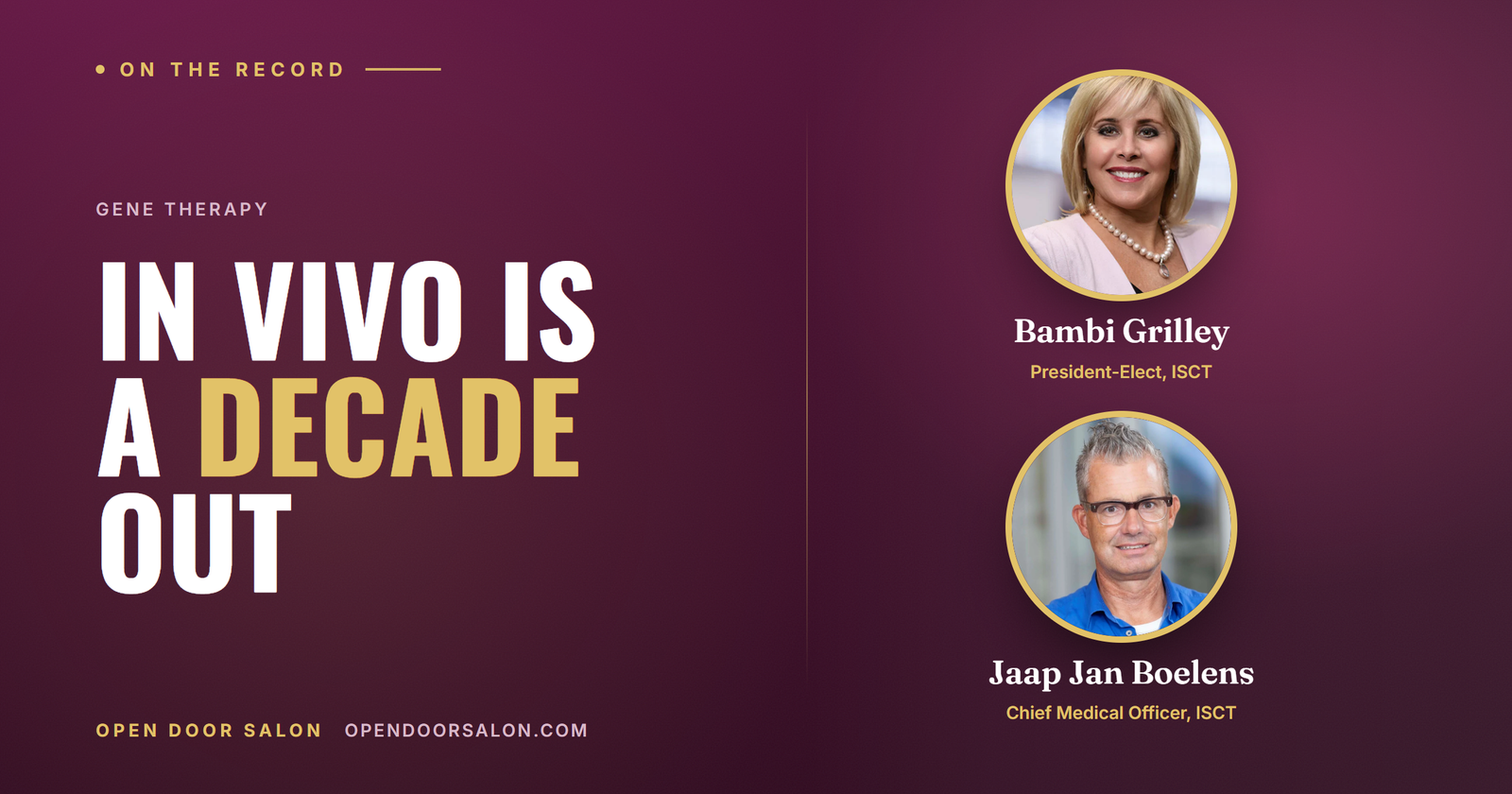
In vivo gene therapy for genetic disease is likely more than a decade away, and the delay is not regulatory, it is scientific. Today's approved gene therapies for conditions like sickle cell are mostly ex vivo: a patient's cells are removed, edited in a lab, and reinfused. In vivo means editing the cell directly inside the body, with no lab step, and that is a much harder problem to get right. Jaap Jan Boelens, Chief Medical Officer of the International Society for Cell and Gene Therapy (ISCT), drew the distinction carefully in his Open Door Salon conversation with ISCT President-Elect Bambi Grilley.
How far away is in vivo gene therapy?
It depends entirely on which kind you mean, and Boelens was quick to split the question rather than give one number. In vivo CAR, aimed at cancer, is closer. In vivo gene therapy to correct a genetic disease is the longer road.
For the CAR in vivo I think it's closer than one decade away, but I think the in vivo gene therapy is likely more than a decade away, and then it's an issue with the dosing: how much to give to get sufficient cells in vivo and not overload the system.
He noted there is genuinely encouraging early in vivo data, some of it presented at recent oncology meetings in multiple myeloma, though the patient numbers are small and the selection criteria aren't fully clear yet. The promise is real. The timeline is honest about how much is still unsolved.
What is the difference between in vivo and ex vivo gene therapy?
The difference is where the editing happens.
Ex vivo means it happens outside the body. A patient’s cells are collected, corrected in a laboratory where the dose can be measured and the result checked before anything goes back, and then reinfused. That laboratory step is slow and expensive, and it is also a control point. If the edit did not work, nobody has been dosed yet.
In vivo means the therapy is delivered into the patient and the editing happens inside them. There is no collection step and no laboratory. That removes the manufacturing step, which is the least scalable part of the process. It also removes the chance to check the edited cells themselves before a patient is dosed.
What is an example of ex vivo gene therapy?
The approved therapies for sickle cell disease are the clearest example. A patient’s own blood stem cells are collected, edited outside the body, and returned. Boelens describes cases where it takes years before a patient is finally dosed.
CAR T for cancer follows the same shape. Cells come out, are re-engineered to recognize the disease, and go back in.
Both require the laboratory infrastructure that in vivo delivery is trying to remove.
Why is dosing the hard part?
Because in vivo editing has no lab step to control the dose, so getting the amount right inside a living body is the central engineering problem. Give too much and you risk toxicity. Give too little and nothing happens. As Boelens put it, the challenge is delivering enough to work without overloading the system, and there is no reset button once the therapy is inside the patient. That narrow window, effective but not toxic, is what pushes the genetic-disease version past the decade mark.
How long does gene therapy last?
Because a cancer therapy can succeed in weeks, while a genetic-disease cure has to last a lifetime, and lasting that long inside the body is unproven. Boelens contrasted the two directly.
In the cancer therapy you may get away with a couple of weeks or a month effect, but in ex vivo gene therapy for sickle cell you need decades.
He added a second durability trap specific to the in vivo route: the body can mount an immune response against the therapy and simply reject it. So the in vivo approach has to clear two bars at once, sustain a genetic correction for decades and avoid being neutralized by the patient's own immune system. That is why he sees far more hurdles for in vivo gene therapy than for in vivo CAR, where a shorter effect can still be a win. The durability question is the same reason real-world monitoring is non-negotiable, a point that connects to why these therapies are so expensive to develop and follow.
Boelens’s concern is that the evidence base is young. Sickle cell approval rested on roughly fifty to sixty patients, some with less than a year of follow-up, for a condition those patients will live with for another five or six decades.
For the bone marrow transplant we have five decades of experience, so we know when it works in the first year it will work for the upcoming fifty years. But for the cell and gene therapies, we don’t know.
Regulators have built for that gap: the FDA and the EMA require fifteen years of follow-up, though Boelens expects patients who feel well to stop coming back. Whether a payer covers any of this turns on a different set of questions, covered in why insurance will not cover gene therapy.
What safety question comes with editing cells inside the body?
The same unknowns that govern whether it works also govern whether it is safe, and there may be no way to shut it off. Grilley added the concern that sits inside Boelens's black box.
You have to know that two years after you infuse, you don't cause them to develop diabetes or cancer or some bad thing.
Her point is that efficacy, durability, and safety are not separate boxes to check in sequence. They are the same unknown. Once an in vivo therapy is working inside a patient, the field needs a way to monitor it for years and, ideally, a way to turn it off if something goes wrong, and that control doesn't fully exist yet. It is a sober counterweight to the field's real progress, seen in patient stories like Emily Whitehead's CAR-T recovery.
The honest read from ISCT's leaders is that in vivo gene therapy is coming, but the genetic-disease version is a decade-plus problem of dosing, durability, and control, not a paperwork delay. Sponsors and researchers tracking that road can work with Open Door Salon or follow the science at ISCT. The wait has a cost the field does not discuss enough, which is what desperate families do while a real therapy is still a decade away.
Drawn from the recorded, on-the-record Open Door Salon conversation with Jaap Jan Boelens and Bambi Grilley of ISCT. For a primer on the difference between in vivo and ex vivo gene editing, see the NIH National Human Genome Research Institute.