
Why Is Neuroscience So Hard to Fund? Two Investors Explain
Neuroscience has been one of the hardest places in life sciences to raise early-stage money, and the reason is not that investors failed to understand the science. It is that they understood the track record.
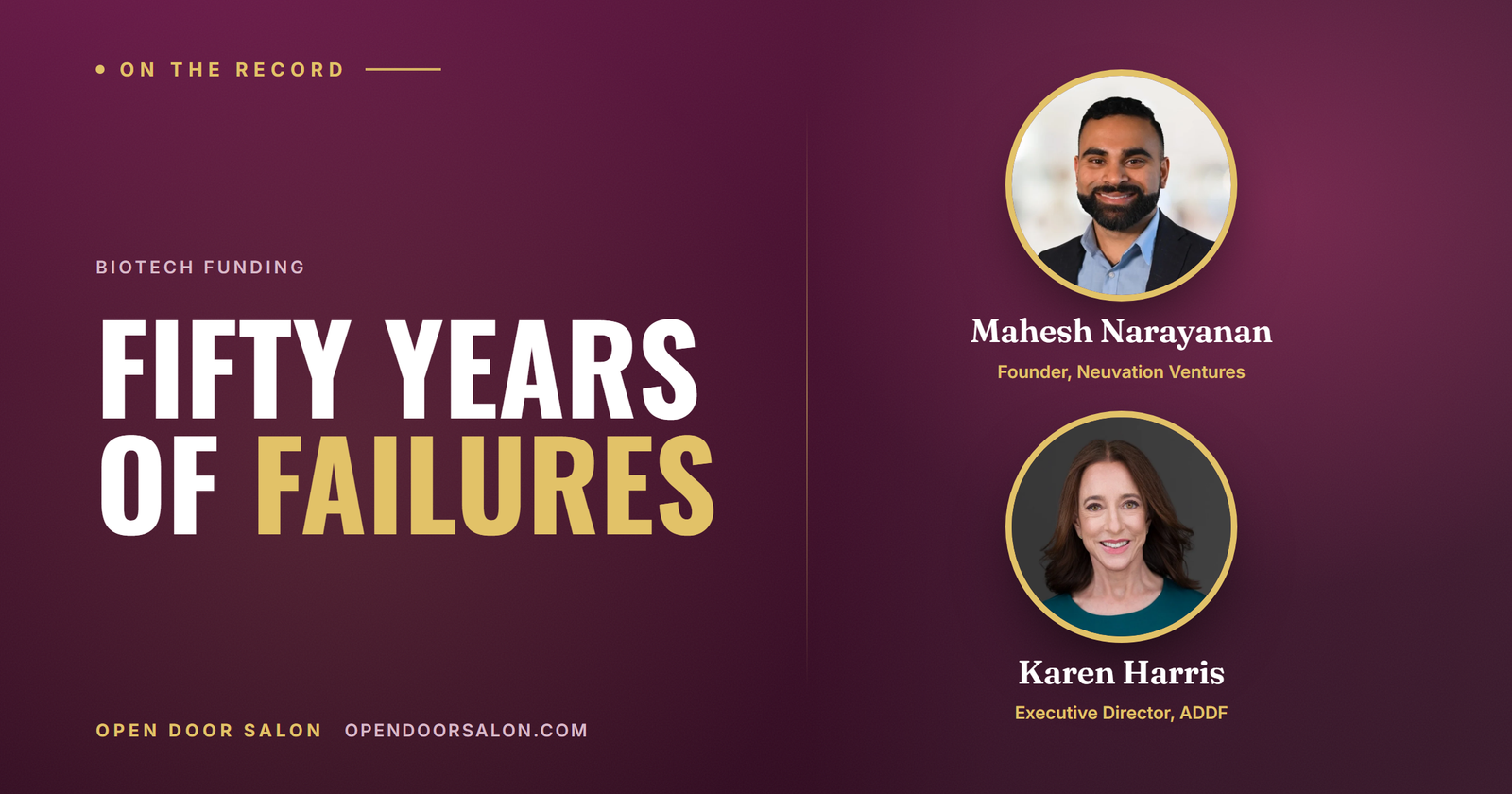
On Open Door Salon, Mahesh Narayanan of Neuvation Ventures and Karen Harris of the Alzheimer's Drug Discovery Foundation took the question from opposite ends of the capital stack, and they do not entirely agree about how much has changed.
What made investors cautious about neuroscience?
Narayanan does not soften it.
There's just been too many failures, to be honest. And whether that's done by big pharma, whether it's done by smaller companies, it just hasn't been enough to show a lot of major capitalists that there's returns in the neuro space.
He puts the duration of that pattern at roughly fifty years. On that reading, investor caution was a rational response to evidence. Capital went into central nervous system programs for decades and did not come back often enough. An investor who declined a neuro deal in 2015 was reading the same data everyone else was.
What has actually changed?
Narayanan's argument is that the last five years broke the pattern.
He points to more FDA approvals and, importantly, more acceptance of these drugs as standard of care. Approval alone does not create a market. A drug becomes commercially real when physicians prescribe it by default and payers reimburse it without a fight, and that second transition is the one now underway.
Harris describes the same period from inside the disease area.
We had two now disease modifying drugs approved by the FDA, two blood tests that are approved by the FDA.
Her read is that the blood tests are the leverage point, because they enable earlier detection, better monitoring of treatment, and leaner clinical trials. A trial that can screen and stratify patients with a blood draw rather than PET imaging is a cheaper trial, and cheaper trials change what is fundable. The commercial half of that shift arrived in 2026, when the second-largest insurer in the country began covering a blood-based Alzheimer’s test.
Where the mechanism research went
The scientific picture also moved, and not in the direction the field's reputation suggests. Amyloid-targeting programs have fallen from roughly a third of the Alzheimer's pipeline a decade ago to about 20 percent today, while tau-targeting and inflammation or immune-directed programs have each roughly tripled from around 6 percent to about 20 percent, according to the 2026 Alzheimer's drug development pipeline analysis. All three mechanisms now hold roughly the same share of the pipeline.
The pipeline has diversified. Harris raised Biogen's tau data presented at AAIC as an example of a genuinely new mechanism reaching late-stage testing, and characterised the results honestly.
Biogen just announced data at AAIC for a drug for elimination of tau, which is a completely new mechanism ... although the results were somewhat confusing, I think that there were positive cognitive changes and I'm glad they're running a phase three trial to sort it out.
Her caution is warranted. That program, diranersen, missed its primary endpoint on cognitive change while showing substantial reductions in cerebrospinal fluid tau and in brain tau on imaging. Biogen is advancing to Phase 3. It is a real result and an ambiguous one, which is what most inflection points look like from inside.
The third barrier, which is not scientific at all
Approvals and diagnostics address whether a drug can exist. Narayanan raises a separate gate that sits after both.
We can make the drugs, we can get them in the market, but if physicians aren't willing to prescribe it or payers aren't willing to pay for it, those drugs end up being a failure either way.
For an investor, that is a real risk line. A program can clear every scientific hurdle and still fail commercially because prescribers hesitate or coverage never arrives. Pricing that risk correctly requires knowing how payers in the indication behave, which is a different expertise than evaluating a mechanism, and it is part of why neuro deals have been harder to underwrite than the science alone would suggest.
Where the two investors diverge
Harris is the more optimistic of the two on capital flows, noting pharma deal activity in Alzheimer's and expecting venture to follow pharma. Narayanan is more cautious about the pace while being more emphatic that the underlying turn has happened.
The disagreement is useful because it locates the actual open question. Nobody on the episode argues the science is standing still. The argument is about how long the lag runs between a scientific turn and the capital that should follow it, and neither investor claims to know.
What it means for a founder now
If you are building in this space, the caution you encounter is priced off a fifty-year record, not off your data. That record sets the burden of proof. It is also why a funder built specifically to carry assets across that gap, the venture philanthropy model Harris runs, matters more here than in most fields. It is also why both investors spend so much of the conversation on commercial evidence rather than scientific evidence, and why what they need to see from a founder looks the way it does. When that evidence does not arrive before the cash does, the founder is into the pivot-or-close decision on a fixed runway.
Open Door Salon convenes these conversations on the record. If your company wants to reach the operators and investors in this room, that is what sponsorship is for.
Drawn from the recorded, on-the-record conversation with Karen Harris and Mahesh Narayanan on Open Door Salon. Pipeline figures are from the 2026 Alzheimer's drug development pipeline analysis in Alzheimer's & Dementia: TRCI.