
Why Won’t Insurance Cover Gene Therapy?
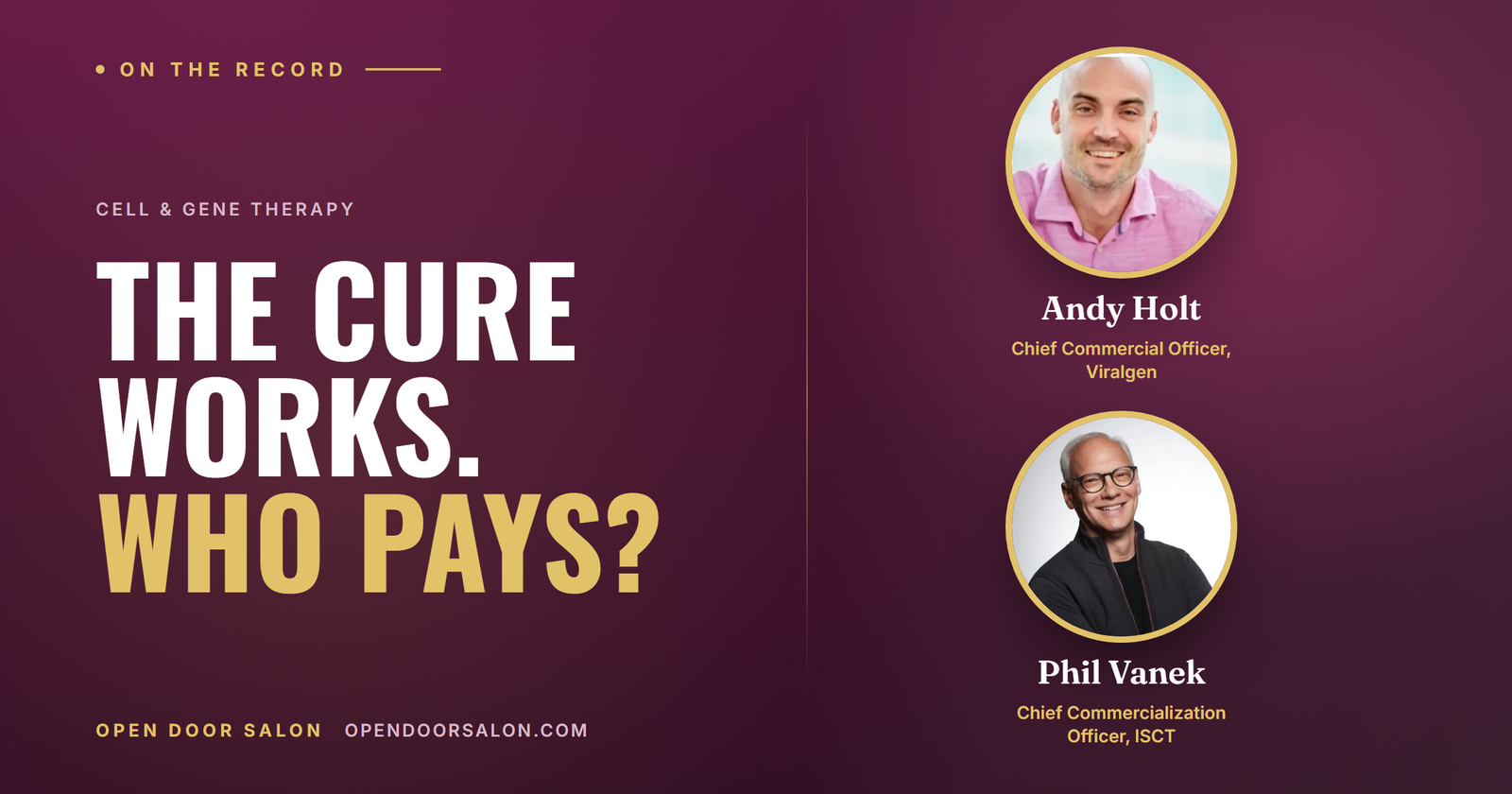
A gene therapy can be a one-time cure that pays for itself many times over in avoided hospital visits and decades of better health. So why does US insurance so often balk at paying for it? We put the question to two people who build and commercialize these therapies for a living: Andy Holt, Chief Commercial Officer of Viralgen, a contract manufacturer of AAV gene therapies, and Phil Vanek, Chief Commercialization Officer of the International Society for Cell and Gene Therapy. Their answer has almost nothing to do with whether the therapy works, and almost everything to do with how the US pays for care.
Why won't insurance cover gene therapy?
Not because payers doubt the value. Because the US system is built to treat, not to cure, and the structure of employment-linked insurance means the payer who funds a one-time cure often is not the one who collects the long-term savings. Holt put the structural problem first:
"In many ways our health care system isn't set up to reimburse for that, especially in the US. We do a lot more treating than we do curing in medicine right now."
A system organized around ongoing treatment has a clear way to pay for a drug taken every month. A single curative event that pays off over twenty years does not fit that machinery as cleanly, and in the US a second feature makes it harder still.
The payer who pays isn't the payer who benefits
Holt's sharpest example came from a conversation with an insurance executive who wanted to cover these therapies and still could not make the math work in his favor:
"I would love to pay for [a gene therapy for SMA] more easily because the lifetime value is clear, the quality-adjusted life year calculations are clear. I'd love to pay for [another] more easily because I can document those patients don't come to the hospital as often. That's great, right? Lower infections, lower everything, all of the math maths for me. The problem is if the employee of the company leaves to go to a different company, I've paid the $4 million and I don't get the long-term value."
Because US health coverage is tied to employment, the insurer that funds the cure frequently loses the patient, and the savings, the moment that person changes jobs. Holt named the incentive that creates:
"The employment-linked health care creates a disincentive to do so that they don't enjoy, because they are not going to see the long-term benefit. They're going to eat all the short-term cost."
He was careful to say this is not payer reluctance about the science. It is a structural trap. In his words, "the insurers have a reverse incentive to innovate here, because they are almost guaranteed to not see past an initial cost no matter what they do."
Why single-payer systems don't hit the same wall
The same therapy lands differently in a system where the patient does not change insurers every time they change jobs. Holt drew the contrast plainly:
"In a single-payer system, whether it's the US with Medicare and Medicaid or in Europe with more traditional, broader single-payer systems […] they're okay paying, because the patient stays in the system."
When the payer keeps the patient, the lifetime-value case that looks unwinnable to a US commercial insurer starts to make sense. The barrier, in other words, is not the price of the cure. It is who holds the patient long enough to collect on it.
Payers think like investors
Vanek reframed the payer not as an obstacle but as an investor with a fixed pool of capital and a duty to spend it well. Payers, he said, "think like investors on behalf of the patients" and are "absolutely looking for return on an investment." That framing carries a hard consequence for any new therapy, because a fixed budget means a new treatment does not simply get added on top of what already exists:
"It has to be substantially better than something else that's out there that it's going to replace. Remember, it's not just being added into the system. It's going to replace something out of the system."
So coverage is a competition for a slot, not an open door. A therapy earns reimbursement by being clearly better than the thing it displaces, for a population large enough and underserved enough to justify the spend. Winning that slot is not the end of the wait either, because the money can take months to reach the hospital after a payer has already agreed to cover the therapy.
The cost isn't just the therapy
Vanek added the part that the sticker price hides. What a health system actually pays for a gene therapy is not only the dose: it is, in his words, "not just the price of the drug or the therapy or the medicine or the surgery," but "the entire wraparound that also has to be affordable." The admitting center, the critical-care capacity, the ancillary and follow-up care, the coordination of everyone involved: all of it accrues into a system he described as already stressed. A cure that is affordable as a vial can still be unaffordable as a course of care.
Where it leaves us
Holt and Vanek did not land on a single fix, and they did not pretend to. One sees a US reimbursement structure still built for treatment instead of cures, with employment-linked insurance quietly punishing the payer who does the right thing. The other sees a fixed pool of capital that forces hard trade-offs and a care pathway that adds cost well beyond the drug. What they share is the sense that the barrier here is structural rather than scientific, which means it was built by people and can be changed by them.
That is why we have these conversations on the record. If you work somewhere on this problem, at a payer, in policy, in manufacturing, or in a clinic, you understand a part of it the others do not. For the cost side of the same conversation, see why cell and gene therapy is so expensive in the first place. For the supply side, see why a therapy can be approved and still be out of reach.
Join the conversation
Open Door Salon convenes these conversations on the record. Watch the full conversation with Andy Holt and Phil Vanek. And if your company needs to reach the decision-makers in that room, that is what sponsorship is for.