
Why Is Biology Hard for AI? Two Drug Developers Explain
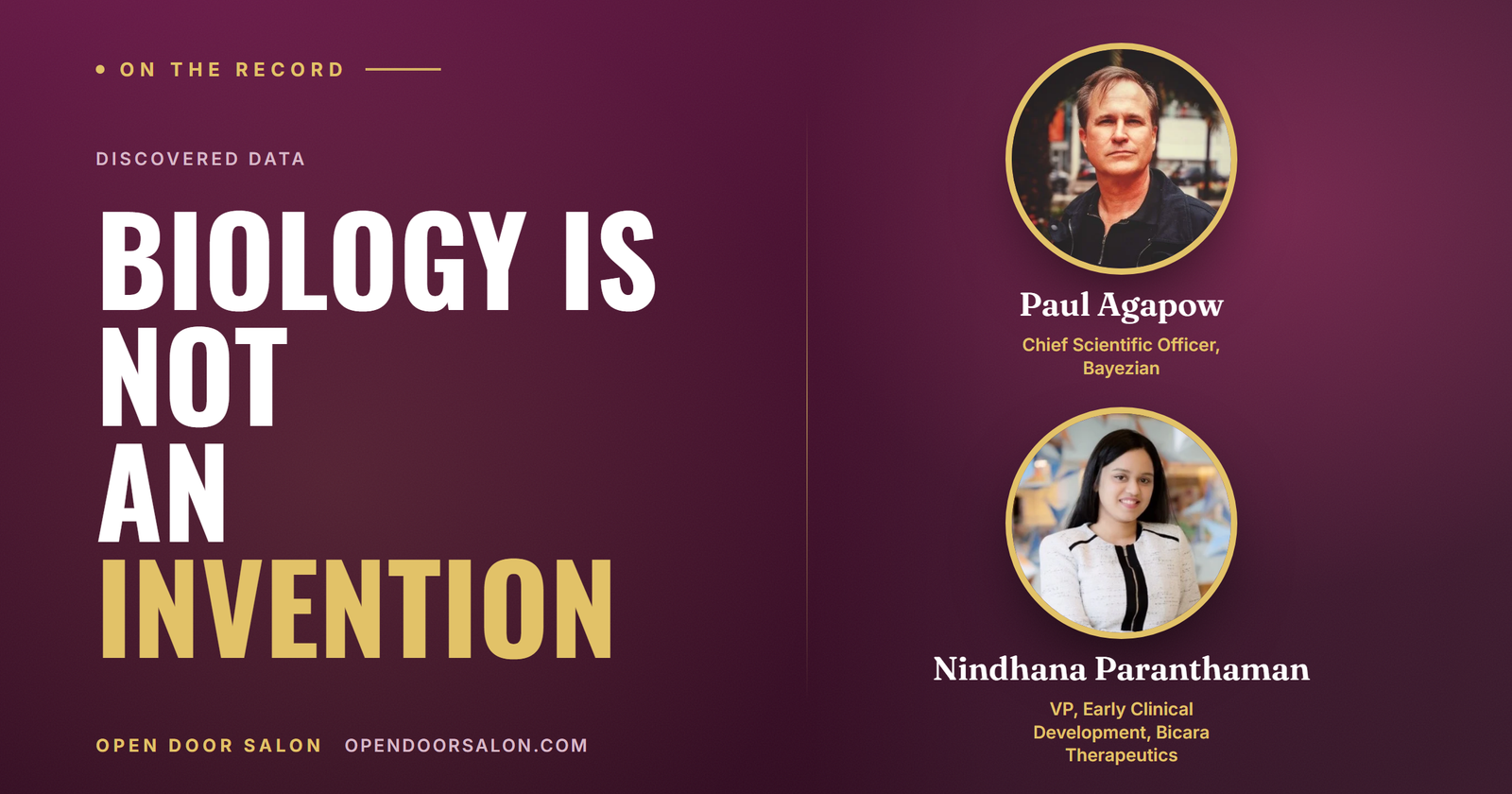
Because biological data is being discovered rather than invented, and machine learning carries an unspoken assumption that the world it models has already been observed. Sales figures and flight delays can be cataloged completely. Biology cannot: what we have is contingent on which cells, which patients and which conditions produced each measurement, and the coverage is thin. Models trained on domains we can see fully break when they meet one we are still mapping.
That is the argument Paul Agapow, chief scientific officer at Bayezian, made on Open Door Salon alongside Nindhana Paranthaman, VP of early clinical development at Bicara Therapeutics. He works on machine learning inside regulated drug development, and his case describes why the problem is structurally different from the ones AI has already solved.
What does discovered versus invented data actually mean?
It is the distinction the whole argument rests on.
The data we have for biology is, it is something that we are discovering, not something that we are inventing.
An invented system is one people built and therefore can observe in full. Every transaction on a platform is recorded because the platform records it. Biology is the opposite: the system existed first, we are still finding out how it works, and every dataset is a partial view captured under particular conditions.
Why does that break a model?
Because the data does not travel well. Agapow's second point is about context dependence.
That data is itself, it's highly contingent. It's highly context dependent.
What was happening when a measurement was taken, which cell types it came from, which patient it came from: all of it conditions what the number means. A model learns the circumstances alongside the signal, and cannot tell you which is which. He is blunt about the consequence.
Biology is just damn messy, and it doesn't behave like other things.
Is this a data volume problem?
Not primarily, and this is the part most often misread. More of the same kind of data does not resolve contingency; it produces more observations that each carry their own conditions. Agapow raises the question of how well we know biology at all and reports that some have put it on the order of a tenth of a percent, a figure he offers loosely, to convey scale. It is not a measurement to lean on.
The practical reading for an operator is that a model performing well on a benchmark has demonstrated something narrower than it appears. The benchmark shares the conditions of its training data. The clinic does not.
What does this look like when it goes wrong?
Agapow tells it as an anecdote about a drug discovery startup approaching a contract research organization to synthesize its first compound.
One of the first questions the CRO asked was, they said, do you have a medicinal chemist on your staff?
The organization asked because people were repeatedly arriving with requests to synthesize compounds that are impossible, that do not exist. The model had produced a structure. Nobody with the training to recognize that it could not be made had looked at it before it became a purchase order.
Why do teams keep trying to route around biology?
Because the incentive is real and human, and he says so without condescension.
We're all looking for one weird trick to shortcircuit biology.
Wet lab work is slow and expensive. Computation is fast and cheap. The temptation is to let the fast thing substitute for the slow thing. He also gives a cultural reason: a great many initiatives clustered on generative chemistry because the data was available and success was easy to measure, while the clinical counterpart is much harder to quantify and so drew fewer people.
Does the same pattern show up on the clinical side?
Paranthaman recognizes the shape from trials, where early-phase promise routinely fails to survive contact with a broader population.
The moment you kind of unleash it ... into more, I would say, variability across multiple different factors and criteria ... it does get a little messy.
Her conclusion is about the start of a project. If the right factors and outcomes were not identified up front, it becomes very difficult later to work out what the findings actually were, which is the same failure the AI case describes in different vocabulary.
So what should a team do with this?
Neither guest argues for less AI, and that is worth stating plainly because the argument is easy to mistake for skepticism. What they describe is a constraint on where it can be trusted without a person in the loop. Engaging with biology early, in Agapow's framing, is non-negotiable; a model is a way of deciding what to test, not a substitute for testing it.
Where the boundary sits is not settled here. Agapow expects roughly a third of what is being built today to survive five years, and that estimate assumes the surviving third is the part that stayed close to real experiments. Whether that proportion holds is the thing the next few years will actually answer.
This piece is drawn from the recorded, on-the-record conversation with Paul Agapow and Nindhana Paranthaman on what AI actually delivered in clinical development. Related reading: why AI errors in biotech take months to find, whether a digital twin can replace a patient in a clinical trial, and how to reduce protocol amendments. If your organization wants to reach the people building and buying these systems, that conversation starts here.