
How to Reduce Protocol Amendments in Clinical Trials
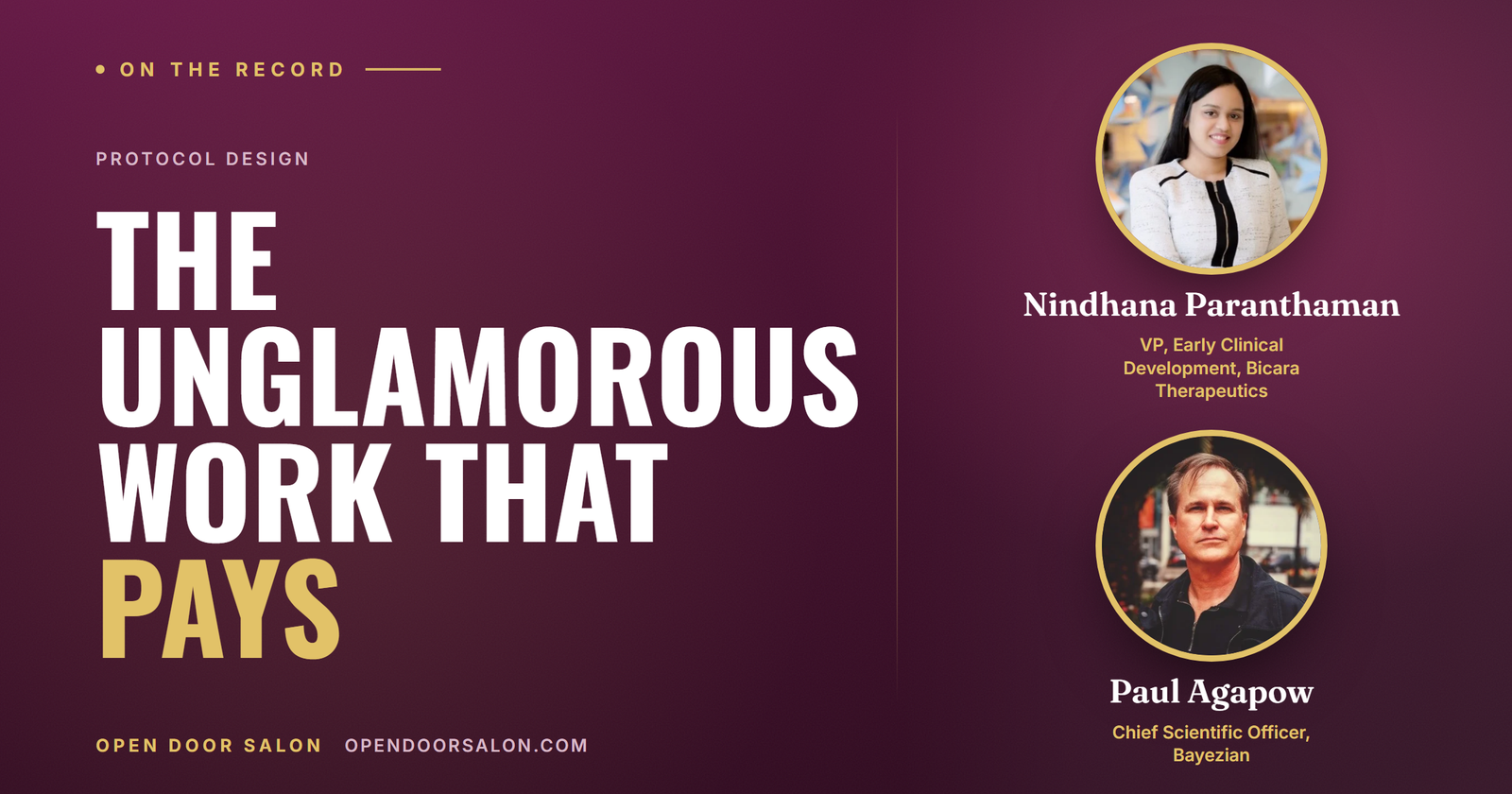
Start earlier. Most protocol amendments trace back to decisions made before a study opened, when eligibility criteria were carried over from historical trials and tuned by hand to a population that had since changed. Reducing them means putting better information into protocol design at the front end rather than correcting the protocol once sites are already recruiting. That is where two drug development leaders independently pointed when asked where AI is actually worth the money.
Nindhana Paranthaman is VP of early clinical development at Bicara Therapeutics, where she runs oncology trials. Paul Agapow is chief scientific officer at Bayezian. Neither picked a headline application. Both picked the documentation work nobody talks about.
Why do protocol amendments matter so much?
Because the cost is operational and it compounds. An amendment consumes the time of the team writing it, then moves through every participating site, often across several countries, each with its own review and activation timeline. Paranthaman describes the knock-on directly.
Slows down again ... patient recruitment at sites in different countries.
A study that pauses recruitment while an amendment clears is a study whose timeline moved, whose costs moved with it, and whose data arrives later. That is why the front end of a trial is disproportionately valuable: a decision made there propagates across every site for the life of the study.
The scale of this is documented. Research from the Tufts Center for the Study of Drug Development, published in Therapeutic Innovation and Regulatory Science, reported that most protocols carry at least one substantial amendment, that a large share of those amendments were judged avoidable, and that the median direct cost of implementing one runs into six figures, rising with phase. Among the avoidable causes the researchers named were protocol design flaws and infeasible eligibility criteria, which is precisely the front-end work Paranthaman is pointing at.
Where do amendments actually come from?
Paranthaman describes protocol development as a process that still runs largely on manual assembly. Eligibility criteria are pulled out of historical studies, then adjusted to fit the setting and the population in front of the team today. The work is careful, but it depends on individual judgment about which historical precedent still applies, and that is where the assumptions that later need correcting get set.
Her interest is in whether systems can inform that judgment before it hardens into a protocol.
If there's a way for ... systems or models to inform that and ... actually enhance how we ... set up protocols and minimize protocol amendments, because that also has an operational impact on trials.
Is this work actually a priority anywhere?
Not obviously, and she is candid about why.
I know it's not a glamorous sort of part of the work.
Protocol drafting does not demonstrate well. It does not produce a launch announcement or a platform story. The work is undervalued relative to its effect, so an organization willing to invest in it competes against fewer people for a real operational gain.
Why is this the strongest case for AI in trials?
Agapow reaches the same conclusion from the commercial side, and his framing is the sharpest line in the exchange.
I think that's just complete gold on the balance sheet.
His reasoning is about the shape of the task. A tedious job that must be done correctly every time, done faster and with fewer people, produces a return that shows up directly and does not depend on a scientific breakthrough landing first.
It's low risk. It's doesn't cost a lot.
Why is a low-risk application more attractive than a breakthrough one?
Because the failure mode is survivable. A model that drafts a protocol section badly produces a draft a human corrects. A model asked to select an asset badly produces a pipeline nobody validated, which is the more expensive category of mistake and the one Agapow describes elsewhere in the conversation as costing eighteen months. Why models go wrong on biology in the first place is the subject of why biology is hard for AI.
The asymmetry matters for anyone deciding where to spend a limited AI budget. Documentation and protocol work sits close to the people who can check it, and errors surface in days rather than after a program has been built on them.
What can a team actually do about amendments now?
Neither guest offers a product recommendation, and this is where the conversation deliberately stops short. What the exchange supports is a shift in where attention goes. Instrument protocol design at the front end, and track amendments as an outcome the organization owns.
Paranthaman also connects this to the broader failure the industry has with its own data. She points to the value of partnering with organizations that can work through trial data to surface findings that inform future strategy, particularly for smaller biotechs where internal resources are thin. Whether models reliably reduce amendment rates is not yet demonstrated at scale, and neither guest claims it is.
Where does that leave the question?
Open on the mechanism, clear on the priority. Both a clinical development leader and an AI scientist, asked independently where the return is, named the same unglamorous work. That agreement is the useful signal, because the two of them disagree about plenty else in the conversation, including how far modeling can be trusted inside a trial at all.
This piece is drawn from the recorded, on-the-record conversation with Nindhana Paranthaman and Paul Agapow on what AI actually delivered in clinical development. Related reading on where trial timelines bind: whether the FDA is the clinical trial bottleneck, and on how capital concentrates around proven work, why biotechs chase the same drug target. If your organization wants to reach the teams running these trials, that conversation starts here.