
How Can US Biotech Startups Compete With China?
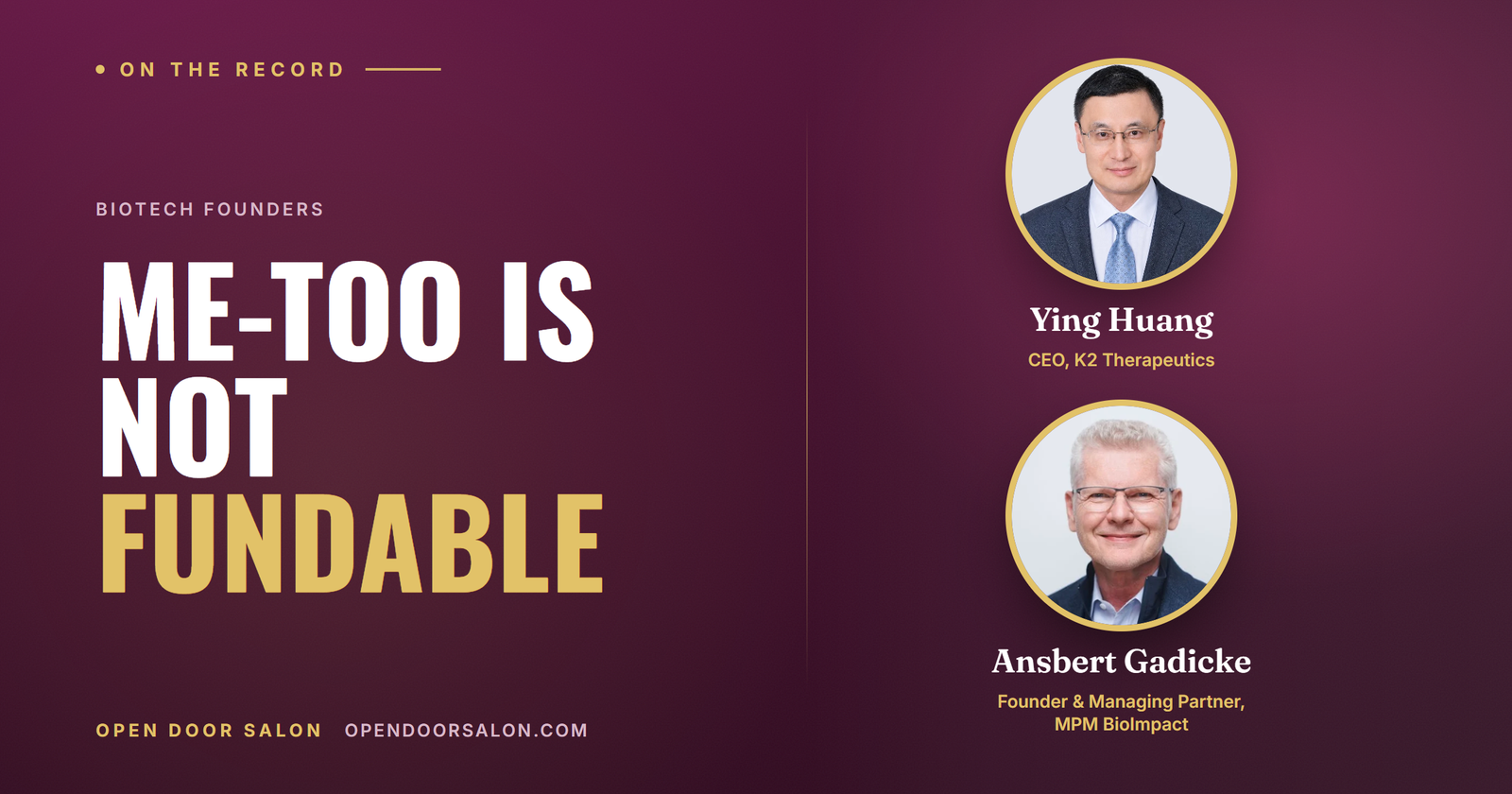
US biotech startups can compete with China by working on what China is not yet doing: new technologies, novel targets and science that has not been validated in the clinic. Ansbert Gadicke, founder and managing partner of MPM BioImpact, said a me-too product no longer gets funded in the US because investors can find similar candidates in China. Ying Huang, chief executive officer of K2 Therapeutics, said founders should pick novel targets, and that cross-border collaboration with China is another route. Both spoke on Open Door Salon.
Why are US founders competing with Chinese assets?
Because they compete for the same funds. Lori Ellis asked what Gadicke would tell a founder in California or Boston who feels squeezed, and he started by agreeing with the premise:
I think first of all, it’s correct that they are competing for the same dollars.
The funds that back Western biotech are often the same ones that license assets from Chinese companies, he said.
What no longer gets funded in the US?
Incremental drugs. Gadicke said an improved version of an existing product used to be a fundable plan for a US company, and is not anymore:
A few years ago, a US biotech company could get funded if it was doing an interesting me too product. That is not fundable anymore because everybody knows if you’re looking for something that comes slightly better, you’ll probably find 20 in China.
A US version would probably also be slower and more expensive to develop, he said. His conclusion was short:
So you have to look at true innovation.
Why is it hard to compete on cost and speed?
Because the gap is large. Discussing policy proposals in Washington, Gadicke said that "everything costs 25% and is two times as fast in China," which makes it hard for a US company to compete on the same kind of program. He did not favor banning Chinese products to close that gap, though he said some leveling of the playing field might make sense.
Where does the US still have an advantage?
In basic research and new targets. Huang said the US remains the hub for the best basic science and technology, and that the advantage shrinks once a target has been validated in the clinic, because competitors follow:
So I think if our founders here in the US focus on those novel targets, that’s probably the way to go because once a target has already been validated in the clinic somewhat, then of course you will see more competition coming from not just China, but other places as well.
Does the original innovator still win?
Often, yes. Gadicke’s example was Orna Therapeutics, a circular RNA company MPM helped build, which Eli Lilly agreed to acquire. When Orna started, he said, no one in China was working on the idea. By the time of the sale there were 30 to 50 Chinese companies following it, and Lilly still chose Orna:
In those cases, I think Western Pharma still prefers to work with the innovator, right?
The edge has limits. Once a program has phase two results that buyers believe, Gadicke said, there is no strong reason to prefer the Western company.
Can a US startup work with China instead?
Huang said cross-border collaboration is the other option:
The other lesson we learned is that instead of thinking about completely being competitive with companies in China, we can think from the other perspective, which is cross-border collaboration.
At K2, a research institution in Boston contributed a novel target and its biology, and a company in China built drug candidates against it. Huang said the aim is to combine the efficiency and lower cost of development in China with access to the US and European markets. If the asset works, the plan is to bring it back to the US for further development. Our earlier post on why big pharma is licensing drugs from China explains the market behind deals like that. The checks a partner runs before signing a license are covered in due diligence for licensing drugs from China.
How realistic should founders be about money?
Very. Gadicke said experienced founders are usually reasonable about terms, and the gaps come mostly from scientifically brilliant founders who are new to the business. Some of them expect to own 80% of the company after a seed round, run it entirely and fill the board with friends. Huang said the market eventually teaches everyone. For a few years IPOs gain ground and companies exit at high valuations, he said, and then for two or three years, as the US market just saw, there are almost no IPOs or exits. Founders then have to make sure they have enough capital to keep operating:
I think as a founder of a biotech company, you have to have a realistic view, right?
Our earlier post on the data on whether biotech startups should raise less money early covers the same question from another investor’s seat.
Companies that want to reach the leaders who follow this conversation can learn about sponsoring Open Door Salon.
This post is drawn from the recorded, on-the-record conversation between Lori Ellis, Ying Huang and Ansbert Gadicke on Open Door Salon; quotes are lightly edited for clarity, and the full episode is the record.