
Can You Patent an Invention Made With AI?
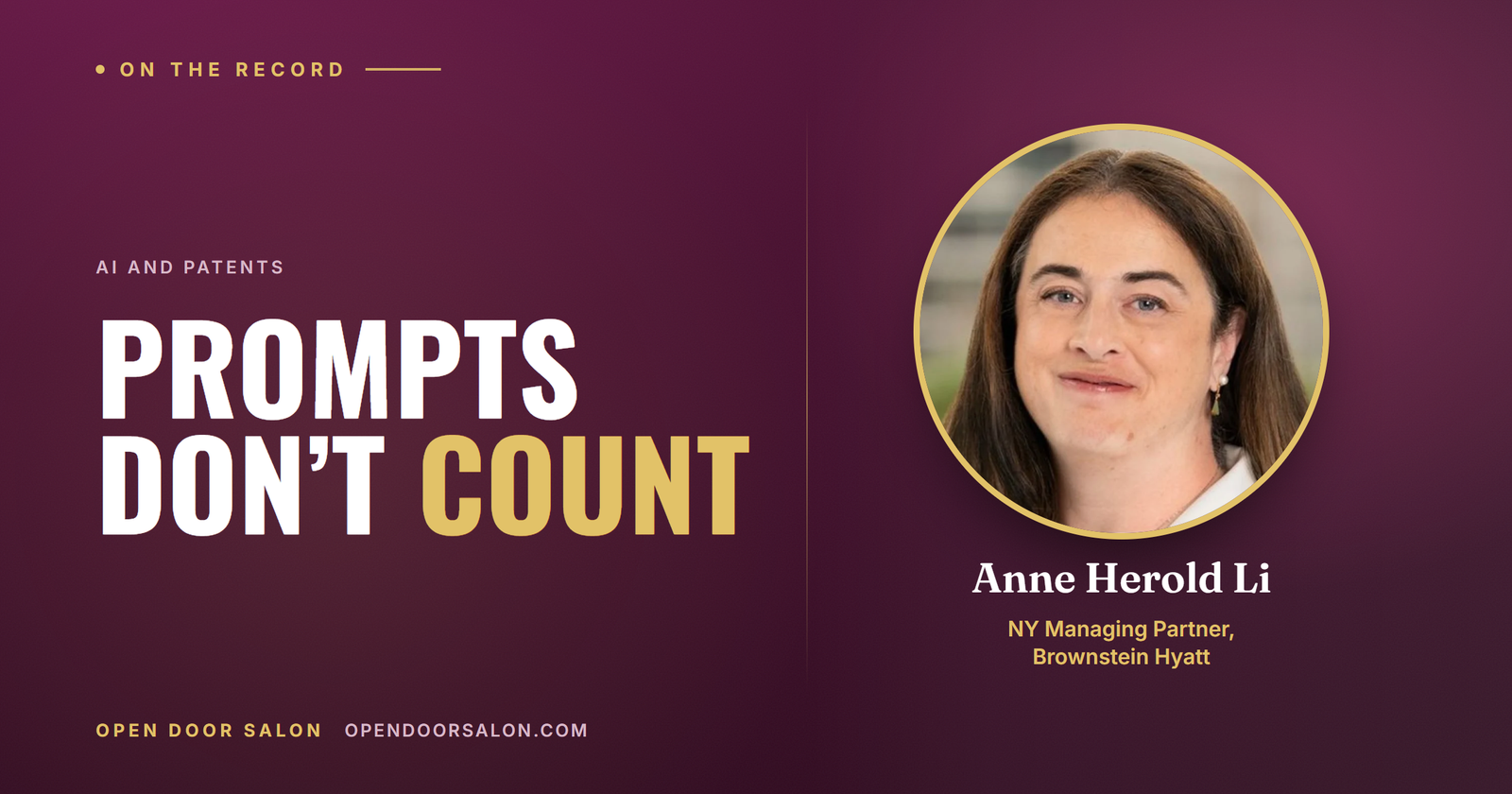
Yes, if a human made the invention. In the United States, patents and copyrights require human work, and prompts alone do not count. An invention made with AI as a tool can still be protected, depending on how much the person contributed. Anne Herold Li, shareholder at Brownstein Hyatt Farber Schreck and a patent trial lawyer, described where that line falls on Open Door Salon.
The US Patent and Trademark Office’s revised inventorship guidance, published in November 2025, treats AI systems as tools and keeps human conception as the test for inventorship.
Does US law require a human inventor?
Yes. Herold Li put it plainly:
In the United States, the United States has made it very clear that in order to patent something or to copyright something, it has to have been done by a human.
Asked whether a prompt counts as that human contribution, she said it does not. Her example was a prompt for a children’s book about a curious wolf who rescues a lost child, a story arc she said covers a large share of the books she read to her own children. Typing that request does not make the result proprietary.
Where does an AI-assisted invention fall?
On a spectrum, and the question is where. At one end is the generic prompt. At the other, Herold Li said, is a researcher who feeds a tool his own data and works with it to solve a computational biology problem. That is closer to using an instrument in a lab, and she compared it to the move from hand pipetting to robots:
The question kind of becomes where on the spectrum are you?
The Copenhagen researcher at the center of September’s enzyme dispute was her example of the far end. He was putting in large amounts of his own data and directing a tool at specific computational biology problems:
Those prompts are probably his. Those prompts are probably copyrightable.
In a private AI environment, she said, his output might even have been patentable, because he really worked with the tool to make it work. The difference is how much the human did with the tool.
Can an AI be named as an inventor?
No. The USPTO’s November 2025 guidance rescinded the office’s February 2024 guidance on AI-assisted inventions and applies one standard to every invention, whether or not AI was used. Conception is the touchstone, AI systems are tools, and a patent claim must name at least one natural person as an inventor. What the guidance leaves open, and what Herold Li’s spectrum describes, is how much a person must contribute when the tool shapes the idea.
Who decides where the line falls?
Courts, regulators and patent offices, each in its own way. Herold Li stressed that inventorship is a spectrum, and that each of those bodies is now working out where an applicant sits on it. She said different bodies are coming down at different points, which turns the process into what she called a self-regulating cat-and-mouse game between the rule-makers and the companies and inventors they regulate. Her concern is that any fixed checklist invites applicants to describe their work in exactly the terms the checklist asks for, so that every inventor reports following all 17 required steps.
Does using a public AI tool change the answer?
It can. The same researcher’s work, done inside a proprietary AI environment, might be protectable. Done in a public tool, Herold Li said, it risks becoming public disclosure, and outside the United States public disclosure before filing ends patentability. Our post on whether sharing research with AI can destroy a patent covers that risk and the one-year US grace period.
What about the data used to train the AI?
That is a separate question, and Herold Li thinks boards are missing it. A company that builds its own AI agents has to know where the training data came from:
Whose data are you training it on?
She pointed to the Westlaw case against Ross Intelligence, in which the US Court of Appeals for the Third Circuit rejected Ross’s fair use defense for training a legal research tool on Westlaw’s headnotes. In the life sciences, she said, much of a company’s historical data was produced with collaborators, clients or patients under agreements that never mention AI training. Our earlier post on who owns the data in a collaboration agreement covers how those contracts are written.
What should an inventor do now?
Keep the work in a controlled environment. Herold Li’s practical advice to scientists was to master the tools, because the job market now expects it, and to use a proprietary AI environment, or a local copy that never touches the internet, for anything unpublished. The company-wide version of that rule is in our post on whether biotech employees should use public AI tools. For who carries the risk when an AI model gets something wrong, see our post on who is liable for AI mistakes in drug development.
Companies that want to reach the leaders who follow this conversation can learn about sponsoring Open Door Salon.
This post is drawn from the recorded, on-the-record conversation between Lori Ellis and Anne Herold Li on Open Door Salon; quotes are lightly edited for clarity, and the full episode is the record.