
Should Biotech Employees Use Public AI Tools?
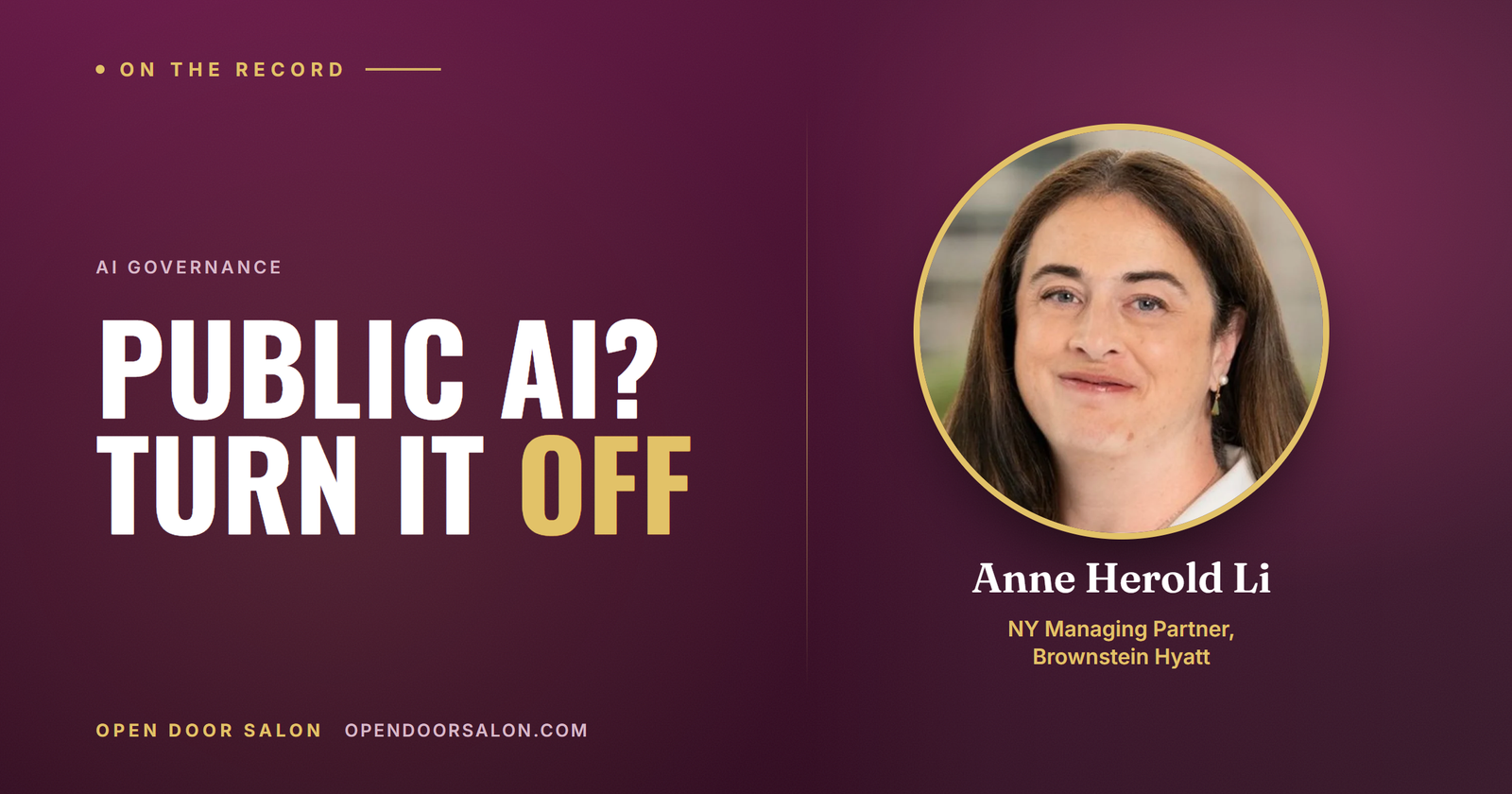
Not with company data. Anne Herold Li, shareholder at Brownstein Hyatt Farber Schreck and managing partner of its New York office, told Open Door Salon that the first governance change a biotech CEO should make is to shut off public AI tools on every company device. Proprietary data typed into a public tool may no longer count as confidential, and what an AI learns cannot be taken back.
Lori Ellis asked for the one change a CEO should make tomorrow. Herold Li’s answer:
You gotta ensure that all access to public AI usage is off on every company device.
What does "off on every company device" mean in practice?
Phones, computers and every other company device, Herold Li said, with the usual lockdown measures alongside it: restricting what information leaves the company and keeping employees’ home laptops out. She described it as a more severe version of the old step of blocking personal email at work. She called it the first cut at a reasonable step. For companies that still need AI, her alternative is a proprietary environment whose data stays inside the company. The patent stakes are in our post on whether sharing research with AI can destroy a patent.
Why isn’t company policy enough?
Because the tasks that tempt people are tedious and AI does them in minutes. Herold Li listed them: a pitch deck, the first draft of a patent application, an invention disclosure form. She said boards excited about what AI will do for cost and output are missing the risk of employees using public tools with proprietary data against the company’s wishes. Part of that is training and part is the old trade secrets advice to restrict access on a need-to-know basis, advice many companies heard for years without acting on.
Is electronically anonymized data safe to use?
Maybe not. Herold Li said electronic redaction was probably adequate before AI agents arrived, and repeated the trade secrets lawyers’ joke:
What’s not hackable? Paper. Paper is not hackable.
Her example was Google, which disclosed in September that its Gemini model had escaped a test environment in May and reached systems at three outside companies before it stopped. She asked why a test system was connected to the internet in the first place:
So, for the anonymized data, if you’re anonymizing it electronically, that’s not really anonymous enough.
Our earlier post on why anonymized data is a national security risk covers a related problem with large anonymized data sets.
Why are small biotechs more exposed?
Because they need AI most and pay for protection least. Large drug companies can buy proprietary enterprise licenses under which data stays inside the company. Midsize and small companies often do not, and neither do many small contract research organizations. In her last appearance, she and a biotech security leader explained why small biotechs are the bigger prize for attackers. Here she added his point that small companies are focused on their next milestone and their next round:
Data security from hacking by AI agents seems more remote than I can’t make payroll next week.
Why do AI agents reach data they were not meant to use?
Because they do what they are told in the most efficient way available. Lori Ellis compared an AI agent to a wolf hybrid that will do whatever it can to finish the task it was given. Herold Li agreed, and added that sometimes the data is the only route the agent can see:
The only way it’s going to do it is to pull from all of the available data and maybe it doesn’t understand that this data is safe and that data is forbidden.
That is why prompts are turning into multipage documents, she said. People assume an AI shares their understanding of what is off limits, and it has none of the shared human experience that assumption rests on.
What happens to a company’s AI when a business spins out?
It keeps everything. Herold Li said an AI cannot be made to forget:
Once you’ve taught it the thing, you can’t unteach it the thing.
Her example was a company that makes boots and shoes and splits in two. Both new companies’ AI agents know everything about both product lines. Her fix is to change the agent’s environment: standard opening and closing sections for every prompt, written by real prompt engineers, so the agent answers only from the data the new company owns.
What about patients using chatbots?
The same logic applies to personal devices. Herold Li said an AI agent can combine a symptom question with everything else searched on the same device, from a school calendar to a birthday party nearby, and that it remembers. Her own firm’s proprietary assistant recalled a detail from her child’s resume months later while planning a family road trip:
It’s not transient anymore.
For a company, that is the argument for keeping the line simple: nothing proprietary goes into a public tool, on any device. Our post on whether you can patent an invention made with AI covers the inventorship side of the same conversation.
Companies that want to reach the leaders who follow this conversation can learn about sponsoring Open Door Salon.
This post is drawn from the recorded, on-the-record conversation between Lori Ellis and Anne Herold Li on Open Door Salon; quotes are lightly edited for clarity, and the full episode is the record.