
Has China Passed the US in Research Spending? What It Means
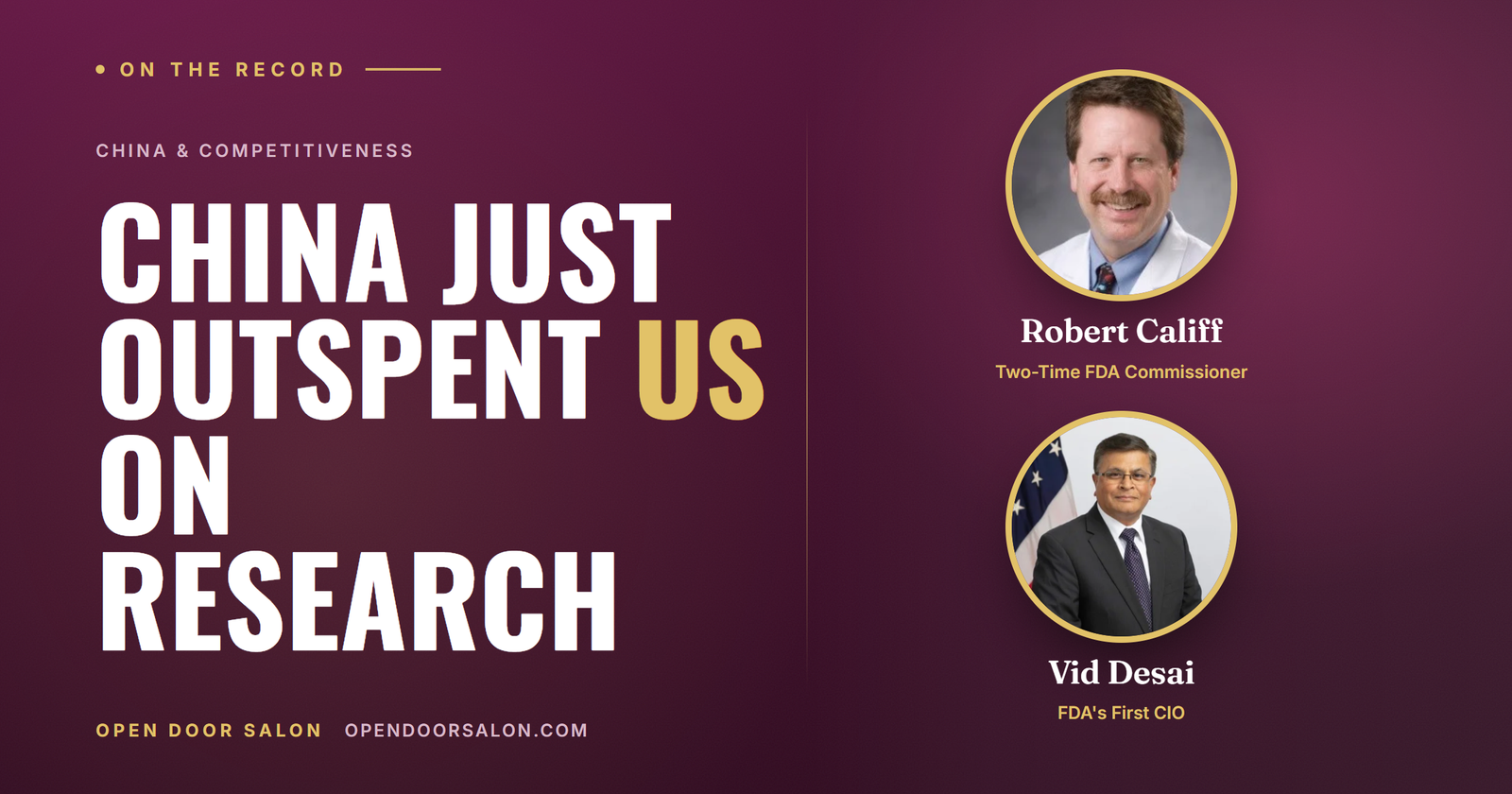
Yes. According to Vid Desai, the FDA's first Chief Information Officer, China's research funding passed that of the United States for the first time last year, at roughly $1.3 trillion against about $1.2 trillion. The crossover happened while US federal research funding was being cut, which is what makes it more than a scoreboard change. Desai and Robert Califf, the only person to have served twice as FDA Commissioner, described the gap on Open Door Salon as a competitiveness problem the US has not yet answered with a strategy. The domestic side of that gap includes the agency’s own tooling, where government AI projects stall on operating funding rather than technology.
Has China actually passed the US in research spending?
Desai put a number on it directly, and framed it as a first.
Last year, for the first time... China's research funding exceeded that of the US... they invested something like $1.3 trillion versus our investment is about 1.2 trillion.
The margin is thin, and the direction is corroborated beyond the conversation: by the OECD’s purchasing-power measure, China’s R&D spending passed the US for the first time in 2024. What matters is the direction of travel on each side. Desai's concern is that the crossover is happening at the same moment US federal research funding is being reduced and agency leadership is turning over, so the two curves are moving apart rather than converging. His summary of the position was blunt.
we're entering a fight with literally our hands tied behind our back
Why does China move faster on biotechnology?
Califf's read is built on direct experience rather than analysis at a distance. He helped start a joint American-Chinese university outside Shanghai and has run clinical trials in the country. What strikes him is structural: a single national mission, without the conflict-of-interest friction that shapes American research institutions.
there's not much of a conflict of interest issue within China that is there's a unitary mission to make kind of the global leader in biotechnology
He is careful not to romanticize it. Internally, he notes, Chinese competition is intense and startups fail constantly. The difference is what happens at the boundary: the internal competition is fierce, and then the country presents a single face outward. American research, by contrast, is fragmented across institutions that are individually excellent and collectively slow.
How much cheaper is a clinical trial in China?
This is the number sponsors already know, and Califf stated it plainly.
You can do a phase one trial in China for a third the cost and 6 months quicker than you can in the US and Europe.
A third of the cost and half a year faster is not a marginal advantage. It is the kind of gap that moves programs on its own, without any policy encouraging it. Califf's framing is worth holding onto: he is not describing a threat so much as a price sheet that every sponsor has already read. Companies are not relocating early-stage work out of ideology. They are responding to arithmetic. Any US policy that ignores the arithmetic will not change the behavior.
Can the US decouple from Chinese biotechnology?
Califf's answer was the sharpest moment in the conversation, and it cuts against a good deal of current policy thinking.
trying to wall ourselves off from China is a doomed strategy. It won't work... we got to figure out how to coexist with China. We can't, we don't have the power to hold China back.
He raised the practical version of the question too: if a drug is highly effective, would the FDA deny it to American patients because it was developed in China? He does not think so. That question sits underneath every containment proposal and rarely gets asked out loud. His own position, stated simply, was that he wants to be friends and not enemies. Coming from someone who ran the agency twice and has worked in both countries, it is a harder position to dismiss than the same sentence from a commentator.
What would an American strategy actually require?
Both men landed on the same place: the US does not have one. Desai pointed to legislation as the missing instrument, noting that the last major piece of health policy of that kind was 21st Century Cures and that it is difficult to imagine an equivalent passing in the current environment. Califf pointed at the research infrastructure, arguing that the delay is not regulatory but structural, sitting with sites that are slow, expensive, and organized to protect revenue and guard against litigation.
What neither offered was reassurance. The gap they describe is one of coordination and funding, and both are cuttable in a way that scientific talent is not. That is the part worth sitting with. The US is not losing on the quality of its science. It is losing on the speed and cost of everything wrapped around the science, which is the same pattern showing up in the search for alternatives to Chinese suppliers and in the regulatory wave reshaping China biotech deals.
What this means for operators
If you run development programs, the cost and speed differential is already in your planning assumptions whether or not you have written it down. If you are watching policy, the useful question is not whether restrictions will tighten but whether anything is being built to close a two-to-three-times cost gap and a six-month timeline gap. Restrictions do not close those. Capacity does.
The funding picture is a useful companion here: our conversation on who actually funds global health covers the donor side of the same question, and the three routes by which intellectual property leaves covers the security side.
You can watch the full conversation with Robert Califf and Vid Desai on the episode page. If your organization wants to reach the decision-makers in that room, that is where to start.
Drawn from the recorded, on-the-record conversation with Robert Califf and Vid Desai on Open Door Salon. Figures and program details verified against primary sources where cited.