
How Do Biotech Companies Prioritize Their Pipeline? The Hardest Call
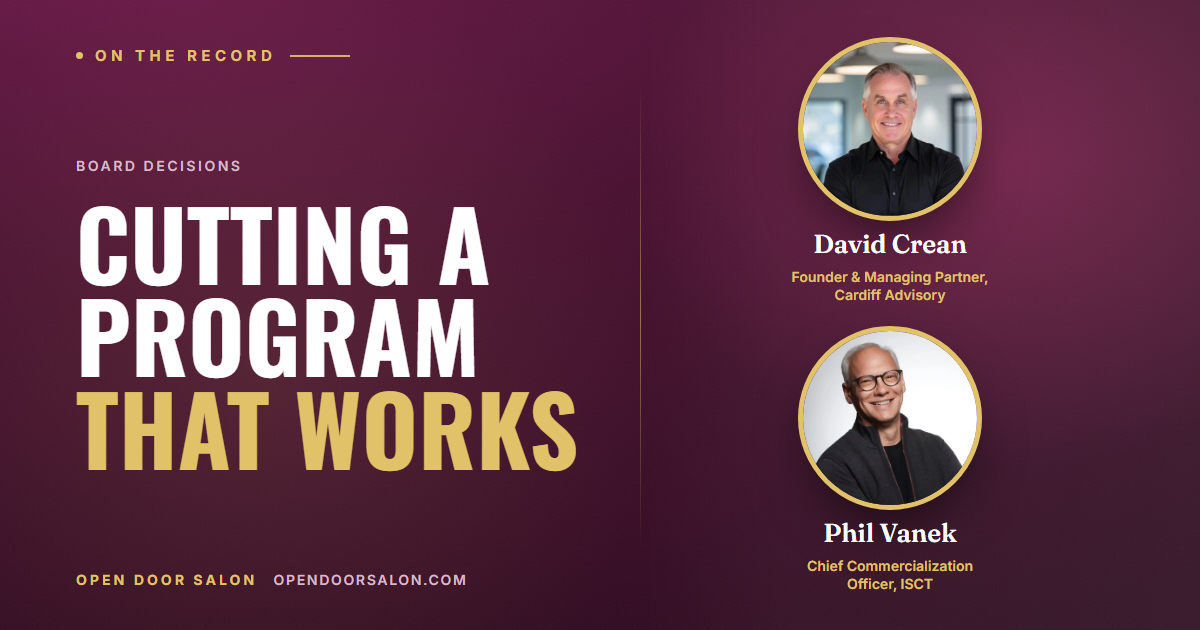
Biotech companies prioritize their pipeline by asking which asset gives the highest probability of creating meaningful value with the capital they have or can raise. The board makes that call with management, investors and the company's bankers. David Crean, an investment banker, founder of Cardiff Advisory and a former board chair and lead independent director, described the process on Open Door Salon. He also named the decision he finds hardest: cutting a program that works.
Who decides between two assets?
The board, with management, investors and bankers around it. Lori Ellis asked how collaborative those decisions are, and Crean answered from experience:
In my experience it's extremely collaborative. You can't make decisions in a vacuum.
A CEO cannot simply return from a board meeting with a decision already made, he said, because the investors who sit on boards have a financial stake and expertise the decision needs.
What do investors on the board add?
Expertise, in Crean's view, as well as money. He described why the investors are in the room:
That's why they're on the board and that's why you're a good investor.
A good investor, he said, lends expertise and does more than write checks. He was equally direct about the CEO's side of it:
You really need to incorporate a lot of people's opinions and expertise.
On the most common version of the decision, choosing which of two assets to take forward, he came back to the same point:
There's a lot of things that you can unpack that go into that decision, but it must be collaborative.
What should drive the choice?
The data, with the banker answering whether the plan can be financed. The board makes the decision, and Crean described what should drive it:
I think that the data should determine what that decision is.
His role as a banker, he said, is to tell everyone at the table whether he can finance the plan, find investors, or find a strategic company to acquire it. Phil Vanek, chief commercialization officer of the International Society for Cell & Gene Therapy (ISCT), added that bankers are part of the equation. That holds, he said, whether the goal is a transaction, new capital or an introduction to a buyer.
What question should a board ask about each asset?
Which one creates the most value with the capital available. Crean put it as the core test:
Which one is going to give us the highest probability of creating meaningful value with the capital that we have currently or potentially could go and get?
He framed the obligation directly:
Companies are stewards of capital and so they have to ask those questions, very difficult questions, before they focus on one or the other.
What an asset needs to show an investor in the first place is covered in what a target product profile is and when to plan for reimbursement.
Who else belongs at the table for advanced therapies?
The clinical voice. Vanek said ISCT had recently added a chief clinical or chief medical officer role because adoption of advanced therapies depends on a care pathway that hospitals have to deliver:
So I would add board members, investors, bankers, and that chief medical officer become absolutely critical to these conversations.
Why is cutting a working program the hardest decision?
Because the science is not the reason. Crean, speaking as a board member, said the easy case is a program whose biology does not work, where the whole board agrees to stop. The hard case:
The difficult situation is when you know that a program works, the biology is there, the rationale is there and you have some encouraging evidence but the company doesn't have enough capital to fund everything.
At that point, he said, it comes down to portfolio optimization and portfolio management:
Which one do you keep going and which one do you have to kill or maybe you slow down, maybe you deprioritize. That's a super difficult question.
What does a board owe shareholders in that decision?
A defensible reason. Crean described the scrutiny that follows:
You're going to be constantly asked, are you doing your fiduciary duty as a board member? You're going to be asked by shareholders like how did you come up with that decision?
For founders, the practical lesson is that capital allocation is a strategic decision as much as a scientific one. The deals that follow are covered in how long biotech M&A deals take. The earlier steps, including manufacturing, are in what CMC means in cell and gene therapy.
Companies that want to reach the leaders who follow this conversation can learn about sponsoring Open Door Salon.
This post is drawn from the recorded, on-the-record conversation between Lori Ellis, Phil Vanek and David Crean on Open Door Salon; quotes are lightly edited for clarity, and the full episode is the record.