
Is the FDA Still the Global Gold Standard?
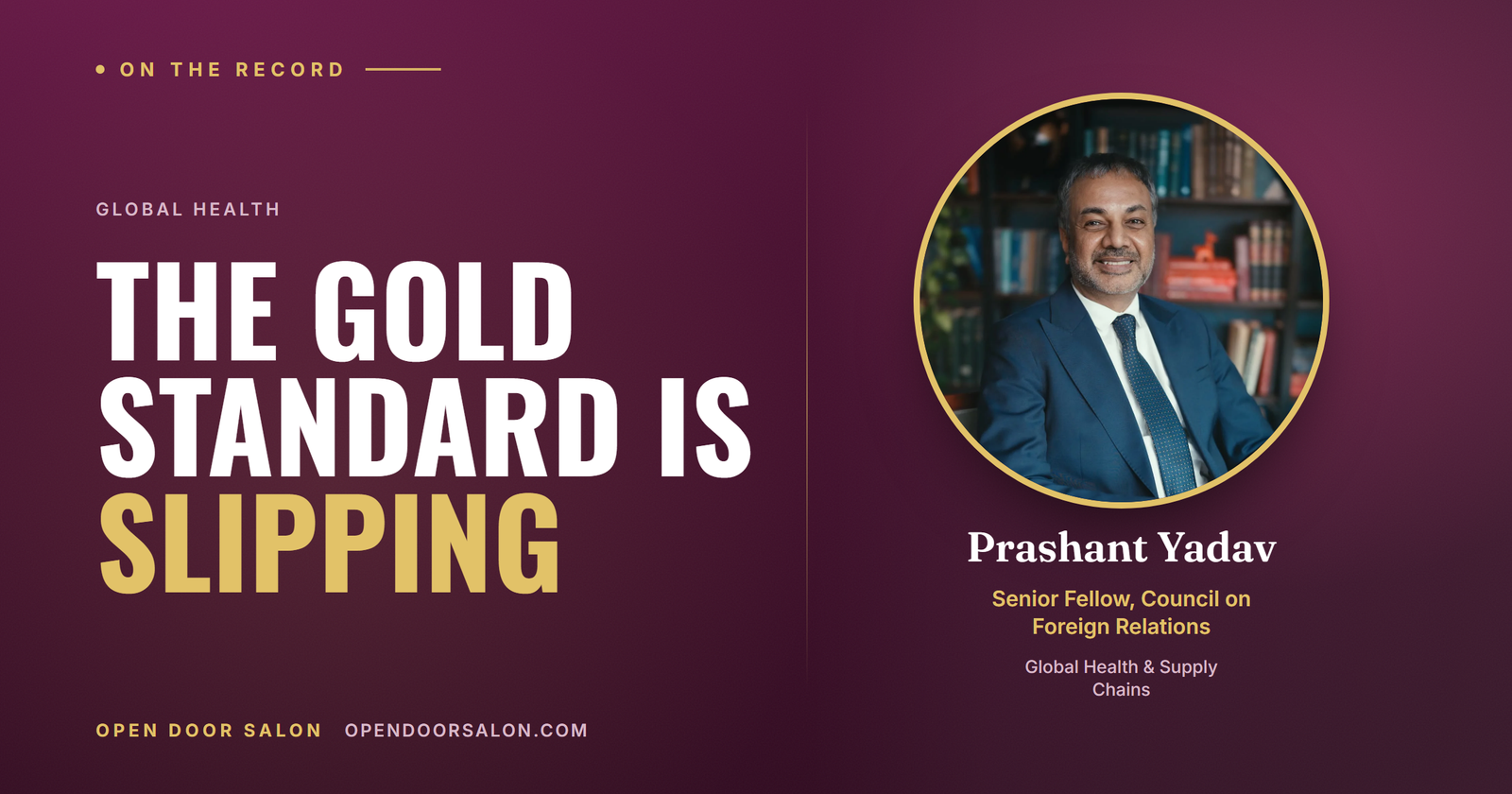
For decades, the answer was obvious. The US Food and Drug Administration was the regulator the rest of the world measured itself against. On Open Door Salon, Prashant Yadav, Senior Fellow at the Council on Foreign Relations, argued that the answer is no longer automatic, and that the erosion of that standing is a global health problem, not just an American one. The institutional strain reaches the agency’s technology too, where its own AI projects stall on funding rather than the technology itself.
What made the FDA the gold standard in the first place
The reputation was earned, slowly. Yadav was clear that the FDA's authority came from a long track record, not a slogan.
"The US Food and Drug Administration has truly been the agency that is considered by agencies and regulators around the world as a gold standard."
That standing took generations to build.
"This has been built over more than 75 years."
Other countries' regulators and patients leaned on it. When the FDA cleared a drug as safe and effective, that judgment carried weight far beyond US borders.
Why the question is suddenly live
What changed is not a single decision but a pattern of instability. Yadav pointed to turnover that goes well beyond the top of the organization.
"There is constant changes not just at the top leadership level but at multiple mid-tier levels. There is staff exodus."
When the people who carry the institutional knowledge leave, and when the leadership keeps turning over, the predictability that made the agency trusted starts to thin. Regulators are trusted because they are consistent, and consistency is exactly what churn erodes.
This is not a partisan story
It would be easy to file this under one side of US politics. Yadav was careful to refuse that framing.
"Now that confidence is constantly getting eroded, and this is not a political issue."
The erosion, he argued, crosses the political spectrum inside the United States, and it reaches well beyond it. Treating regulatory credibility as a partisan trophy misses the point: the asset being spent down belongs to everyone who relies on the agency, regardless of party.
Why it matters outside the United States
The most important consequence is the one furthest from Washington. Patients and regulators in other countries built their own assumptions on top of the FDA's credibility. They assumed a strong regulator somewhere in the system would catch what their own capacity could not. As that assumption weakens, countries that relied on it are left more exposed, with fewer places to turn for a trusted signal on whether a medicine is safe, effective, and well made.
Confidence is an asset that compounds, in both directions
The deeper point is that regulatory trust behaves like capital. It accrues slowly through consistent, science-driven decisions, and it can be drawn down quickly. Rebuilding it is far harder than spending it. A regulator that loses the confidence of its peers does not get it back with a single good year; it has to re-earn the track record. That asymmetry is why the erosion Yadav describes is worth taking seriously now, before more of it is gone.
So, is the FDA still the gold standard?
For the moment, the FDA remains a deeply capable agency, and Yadav did not suggest otherwise. The honest answer is that its gold-standard status is no longer something the world takes for granted, and that the trajectory matters more than any single snapshot. The work of holding onto that standing is not glamorous. It is consistency, retained expertise, and decisions that are visibly about the science. Whether the agency protects those things will decide whether the question in this headline stays open or closes for good. (Organizations thinking about how regulatory shifts reshape their strategy are exactly who Open Door Salon partners with.)
The same on-the-record conversation also looked at what regulatory instability means on the ground, in what happens to clinical trials when a war disrupts them, who actually funds global health, and how China is reshaping global health.
A later conversation with Robert Califf, twice the FDA’s Commissioner, took up a different question about the same agency: whether the FDA is really the clinical-trial bottleneck, or whether the delay sits with the research sites.
Prashant Yadav and Anna Titkova joined host Lori Ellis for the full conversation on Open Door Salon. More on Prashant Yadav and Anna Titkova.