
What Investors Look for in a Biotech Founder: The Caddie Test
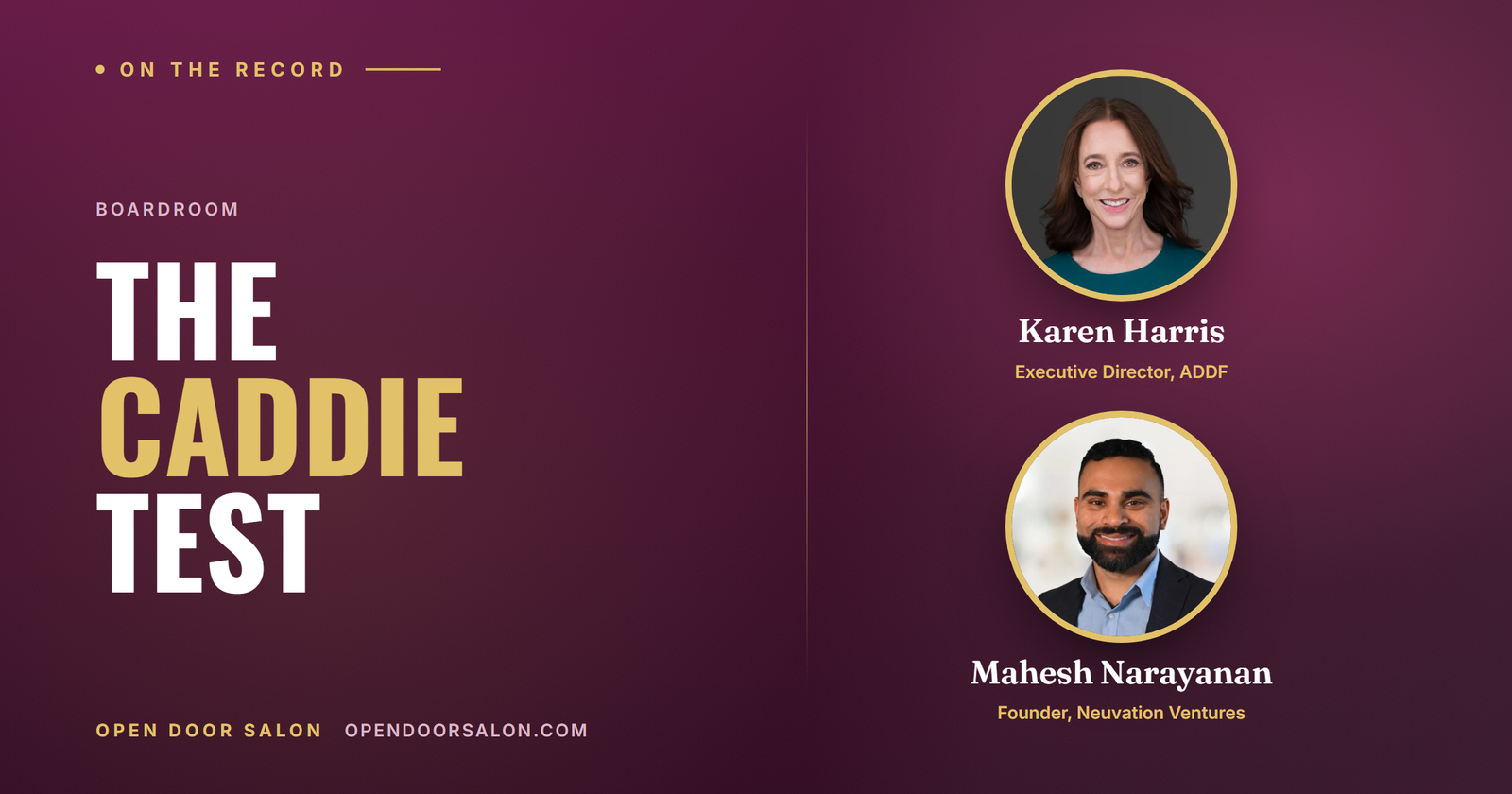
Founders prepare for the science questions. Both investors on this episode described judging something else entirely, and neither method involves the pitch deck.
Karen Harris of the Alzheimer's Drug Discovery Foundation and Mahesh Narayanan of Neuvation Ventures were unusually specific on Open Door Salon about how they read people.
What does an investor watch instead of the pitch?
Harris structures and negotiates the ADDF's deals herself, which puts her across the table from a founder for hours, negotiating terms. That is where she forms her judgment.
I always tell the science people, I can tell who's going to be a good CEO just by the way that they handle those negotiations.
It is a sharper signal than a presentation because it cannot be rehearsed. A negotiation reveals how someone handles pressure, incomplete information, and a counterparty whose interests differ from theirs, which is a fair description of the CEO job.
What is the caddie test?
Narayanan's firm built the same instinct into a repeatable process.
The goal of a caddie is not necessarily to go play the game for the golfer. The golfer is the one that's hitting the ball. So it's just telling them where to go.
During diligence, his team gives founders small tasks and watches how they execute them independently. The point is not the task. It is whether the founder can take direction and then carry it themselves, because the fund's capacity is finite.
He is explicit about the arithmetic: a seed fund managing 25 to 30 companies cannot be present every day. A founder who needs the investor in the room to make progress is a founder that model cannot serve, however good the science.
What does a seed investor need to see in the data?
Before any of the people-reading happens, there is an evidence bar, and Narayanan sets it plainly.
It has to be what we call an MVP. There has to be some kind of minimum viable product for us to see. It has to be much further than just an ideation.
He expects validation of the target and the product, whether that is animal data or multiple models supporting a pathway or device. His stage sits later than venture philanthropy's, which is why the bar is higher; he says directly that funders like the ADDF are willing to take more risk earlier than his fund can, which is the whole point of the venture philanthropy model. How few companies clear an investor's bar is easy to underestimate: AbbVie Ventures reviewed more than 660 opportunities in a year and made five investments.
Harris's requirement is about commercial orientation.
What I like to see most is a scientist who also understands that this has to be a commercial venture as well.
She adds the reason it goes wrong so often in this particular field: with Alzheimer's, commercialization is far enough away that founders forget it is coming at all. Writing a target product profile at the start of development is one way founders keep that commercial end in view.
The two red flags that end a deal
Narayanan names them without hedging. The first is a founder who will not go full time.
One of the big red flags for us is if the team is not even full-time ... They're not looking to take conviction in their own product and take a jump at it. They can't expect us to either.
The second is coachability, and he is careful about what he means. He is not asking founders to accept every piece of advice, and he says plainly that not every investor's advice is good advice. What he wants is a founder who will listen and incorporate what makes sense, on the grounds that his firm has watched many companies fall into the same ditches.
He also dispatches a common assumption. A two-person team of two scientific founders is not, in his words, something VCs are looking for or investing in these days. He does not expect a full-time CFO or chief medical officer at seed, but he does expect advisors, and a scientific or business advisory board that covers the gaps.
What the philanthropy side weighs differently
Harris's checklist overlaps Narayanan's but is not identical. Alongside the commercial instinct, she looks for strong management teams, and specifically for teams capable of fundraising and going the distance.
That second phrase carries weight in a disease area where development timelines run long enough to outlast most people's patience and most funds' horizons. A team that can raise once is not the same as a team that can raise repeatedly through years of ambiguous data, and part of that skill is knowing which of the money is not equity at all. For a funder whose stated purpose is getting an asset to the point where somebody else will finance it, the ability to keep financing the company is the thing being underwritten.
The pattern underneath both
Neither investor is primarily assessing intelligence or scientific credibility. They are assessing whether this specific person can run a company through years of ambiguity, a stretch that runs longer here because capital has been cautious about neuroscience for about fifty years, and they are using proxies that a founder cannot easily perform: how you negotiate, how you execute an unglamorous task, whether you took the job seriously enough to quit your other one.
That emphasis follows from the broader diagnosis both share, which is that the science is rarely why an early-stage neuro company fails. The same pattern shows up wherever commercial design arrives long after the science works. In cell and gene therapy, an ISCT commercialization chief and a life sciences investment banker make the same case about what investors need to see first: the target product profile, the manufacturing plan and the reimbursement plan, early.
Founders reading their own company face the same problem from the inside. The signals that a biotech is running out of money arrive as ordinary operating problems: a manufacturing delay, a term sheet that moves. The same judgment shows up in how a founder handles cutting a program and placing the team.
Getting into the room comes first, and two biotech investors explain whether warm introductions still matter in venture capital.
Open Door Salon convenes these conversations on the record. If your company wants to reach the operators and investors in this room, that is what sponsorship is for.
Drawn from the recorded, on-the-record conversation with Karen Harris and Mahesh Narayanan on Open Door Salon.