
Why Don’t Eligible Patients Get Cell Therapy? The 20% Gap
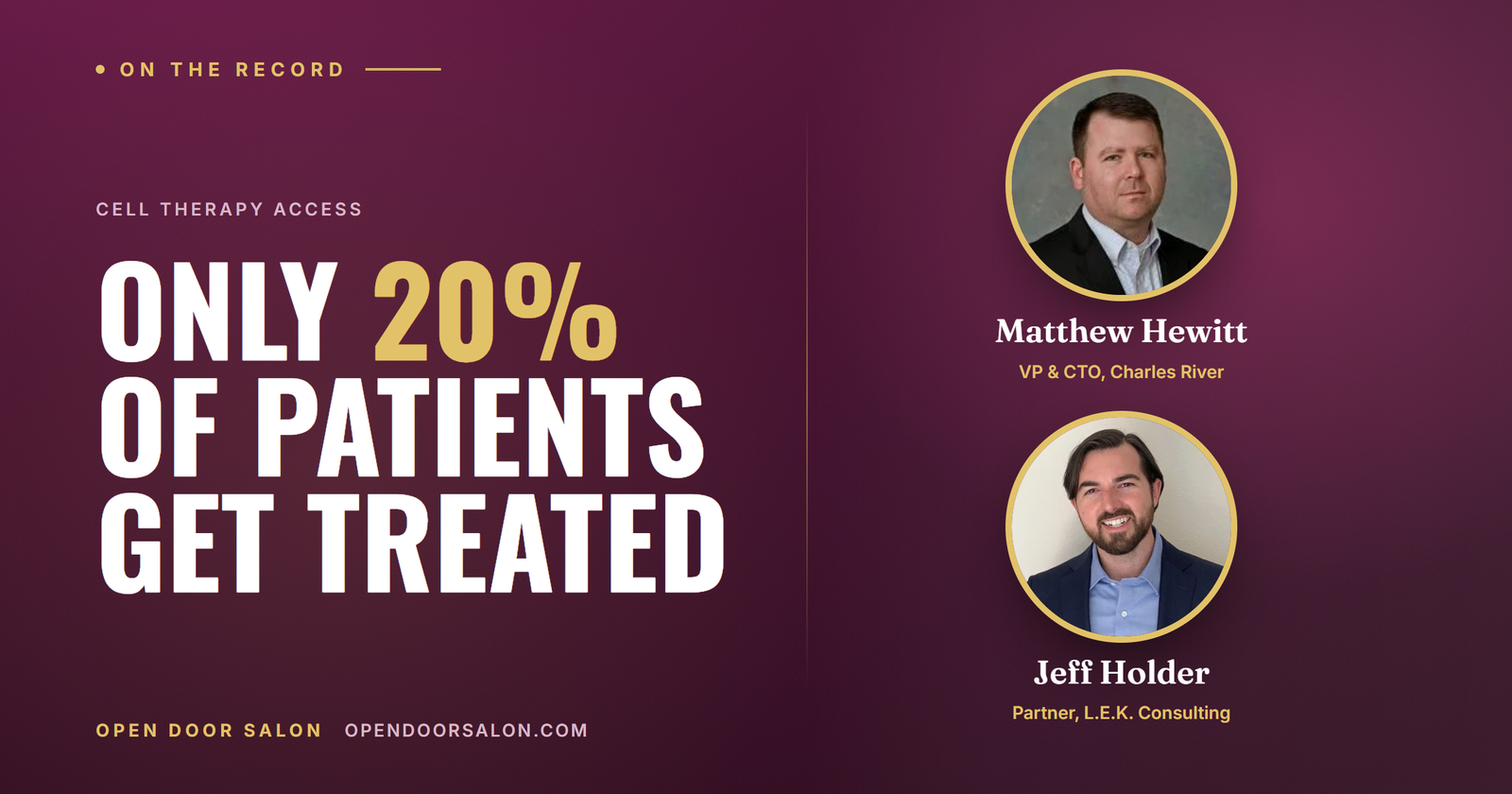
Cell and gene therapies have rewritten what is medically possible for some cancers and rare diseases. Most patients who qualify still never receive one. Matthew Hewitt of Charles River Laboratories and Jeff Holder of L.E.K. Consulting put hard numbers on that gap in the full conversation and traced it through the referral chain, the clinician network, and the economics of running a treatment center.
Only about 20% of eligible US patients actually get treated
Roughly two in ten eligible patients in the US receive these therapies, and worldwide the figure is far lower. Matthew Hewitt, Vice President and CTO of the Manufacturing Business Division at Charles River Laboratories, sharpened the often-quoted statistic:
I think one of you said like two out of every 10 patients that's eligible for these therapies get it, which is true, but I think we should qualify that two out of every 10 is in the US. Globally it's about 5% or less.
The gap is not a manufacturing ceiling or a demand shortage. It sits in the path between a diagnosed, eligible patient and an actual infusion, and that path runs through providers, referral decisions, and clinician familiarity with what these therapies can do.
Most cancer patients are managed outside the centers that deliver it
A structural reason for the gap is that the majority of cancer patients are treated in community settings, while cell therapy lives at accredited centers of excellence. Jeff Holder, Managing Director and Partner at L.E.K. Consulting, laid out the split:
at least in cancer in the oncology space, 80% of patients are managed in the community setting and not in academic medical centers or centers of excellence.
Standing up a cell therapy program is not a small lift, and the economics gate it:
there's a fixed cost threshold to being able to be fact accredited and to have all the infrastructure and training around the ability to do a carti like a cell therapy.
Only a limited number of sites clear that threshold, which keeps treatment far from where many patients live.
Referral is a business decision, and patients are revenue
Even when a center cannot deliver cell therapy, referring the patient onward is not automatic, because patients carry revenue. Holder named the incentive directly:
from a provider angle, patients are revenue and would you refer on a patient to another center when you have options to treat them?
The result shows up in the exam room. Holder recounted a case he believes is more common than the field admits:
I had a friend who was also dealing with a cancer diagnosis and had prompted the idea of, hey what about a cell therapy, and the doctor's response was, honey you're not that sick yet, we haven't tried enough things for you to consider that. And I think that's a more common response than we'd like to admit.
The journey starts at the brain, not the vein
Hewitt argued the field measures the patient journey from the wrong starting point. The industry tracks what it calls vein to vein, the time from cell collection to reinfusion. He relayed a clinician's reframe that the real start is upstream, in the prescriber's decision, a shift she described as moving from vein to vein toward brain to vein:
we traditionally talk about vein to vein.
The point of the reframe is where the clock actually begins:
it's when the clinician tells the patient look we're going to prescribe you this that's when the journey starts.
If the referring clinician never raises cell therapy as an option, the vein-to-vein clock never starts and the eligible patient never enters the funnel at all.
Clinician capacity is trainable, and it scales
The encouraging counterpoint is that the clinician bottleneck is not fixed. Trained technique spreads fast once it starts. Hewitt used the delivery method for a spinal muscular atrophy gene therapy as evidence:
At that time there was probably maybe half a dozen people in the world that could do that consistently. Now 10 years later there are thousands because we've trained clinicians on this technique and they've done it thousands of times.
He noted the same maturation curve in checkpoint inhibitors, bispecifics, and antibody drug conjugates. Each began as a specialist technique and became routine. The access problem, in his telling, is partly a question of how early the field invests in training the next ring of treatment centers rather than a permanent limit on who can deliver.
Some clinicians still call a 10-year-old therapy experimental
Part of the gap is perception. A decade after approval, some clinicians still treat cell therapy as unproven. Hewitt cited a patient advocate's account from a recent panel:
he still talks to some clinicians that say, oh I don't want to do cell therapy, that's experimental. And these are therapies that have been approved for almost 10 years now. And so I think there is still a great deal of work to do on the clinician side.
That perception lag has a commercial consequence. Every clinician who files cell therapy under experimental is a referral that never happens, which is why both guests put clinician education alongside manufacturing capacity as a lever the field still has to pull.
The fix is data, not just talk
The change the commercial side controls is evidence. Bringing durable-outcome data to clinicians and payers beats asserting the value. Holder put the responsibility on sponsors:
part of that education is on the sponsor side bringing the data and showing not telling the value of the drug.
A decade of real-world remission records now exists where early approvals had only months of follow-up, which makes the case easier to carry to skeptical providers. The 20% figure, in this framing, is not a fixed ceiling. It is the current state of a system still learning to refer, to train, and to fund therapies it has had for less than ten years.
What the commercial team has to change
The conversation did not reduce the access gap to one cause, and neither guest offered a single fix. Referral economics, treatment-center capacity, clinician familiarity, and durability data each hold part of the 20% back, and each belongs to a different owner. So does the contracting step, where ISCT’s Jaap Jan Boelens has watched patients abandon a cure while a single-case agreement is negotiated. What the discussion makes concrete is that closing the gap is as much a commercial and educational job as a manufacturing one. ISCT’s Bambi Grilley makes the same point from the supply side, on why approval and availability are not the same thing. The payment side of that commercial job, why insurance so often will not cover a one-time cure, is its own conversation with Andy Holt and Phil Vanek. The teams doing that work, the sponsors, manufacturers, payers, and centers that treat patients, are the decision-makers we built this audience to reach. When the legitimate options run out entirely, families start looking at unlicensed clinics abroad, which is the same access gap with the guardrails removed.