
Why Is Big Pharma Licensing Drugs From China?
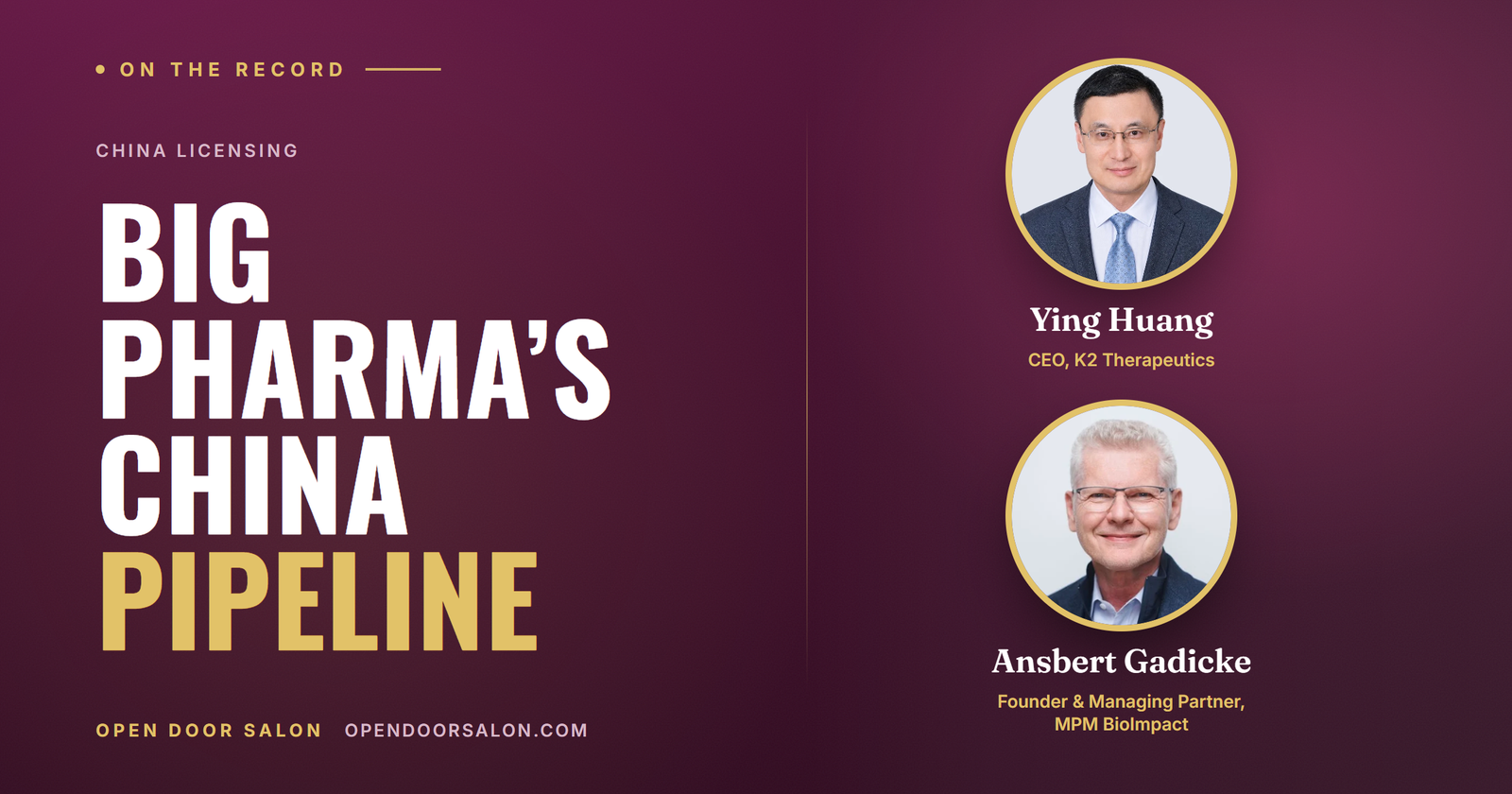
Big pharma is licensing drugs from China because it needs to replace products that are losing patent protection, and China now has thousands of biotech companies with candidates to license. Ying Huang, chief executive officer of K2 Therapeutics and former chief executive officer of Legend Biotech, laid out both sides of that market on Open Door Salon. Ansbert Gadicke, founder and managing partner of MPM BioImpact, estimated how large the shift has become.
The change has been fast. Around the time Legend licensed its cell therapy to Johnson & Johnson in 2017, Gadicke said, several large drug companies told him they did not believe data from China. Legend’s therapy, Carvykti, was later approved in the US and Europe.
How does China compare with US biotech on licensing deals?
A little above 50%, Gadicke estimated, counting business development deals and comparing China with US biotech. Before Legend, he said, essentially no first-in-class or best-in-class drugs were coming from China:
Right now, if we look at the number of business development deals and compare China with US biotech, it’s already probably a little bit above 50%.
He expects that level to hold, and said the open question is where it stops growing:
I think it’s definitely a lasting development. The question is how far does it go, right?
Why do drug companies need these assets now?
Because a large share of their revenue is about to lose patent protection. Huang put the total at roughly $300 billion to $350 billion of commercial products losing exclusivity over the next five to six years, through the early 2030s:
So we know that there are many, many major pharmaceutical companies out there who actually need to replenish their pipeline.
On the supply side, Huang counted more than 4,000 biotech companies operating in China, most with four or five programs each. China’s domestic market cannot fund all of them, he said, so licensing to Western companies has become one of the main ways they raise capital. Both sides of the market point the same way, which is why he expects the trend to last.
Why hasn’t another country matched China?
Gadicke said he has not seen the same development in India, which still focuses mostly on generics. He pointed to the support Chinese biotech companies receive from regional governments that compete for biotech as a source of growth. Huang pointed to infrastructure. Around Shanghai’s Pudong district, contract research organizations, manufacturers, equipment suppliers and clinical trial providers sit within an area of 20 or 30 square kilometers, much as Apple’s suppliers cluster around iPhone production:
So this kind of ecosystem, it does take a long time to build.
Why do licensed Chinese assets lower development risk?
Because many have already been tested in people. Huang’s company, K2 Therapeutics, licenses assets from partners in China and develops them for global markets. An asset that has finished an early clinical study arrives with human data:
For example, if our partner has already gone through a phase one study in China, then we know that the safety, the PKPD, and also maybe even a preliminary efficacy signal has been demonstrated already in a study in human patients.
He described the arrangement as good for both sides. Chinese companies get capital without diluting their founders and can reinvest it in new medicines, and patients in the US get treatments sooner:
So what the end result is, we’re providing potentially life-saving medications to US patients cheaper and faster.
Why license instead of acquiring Chinese companies?
Acquisitions are harder. Huang said buying a Chinese company means government and antitrust reviews and complicated ownership structures. He could name one full acquisition of a Chinese biotech by a Western drugmaker, AstraZeneca’s purchase of the cell therapy company Gracell, and said nearly every other transaction has been a license or partnership.
Gadicke said investors prefer the same structure. Equity in China carries more geopolitical risk, governance is hard to enforce, and Chinese biotech companies are hard to exit:
We actually, as a principle for now at least, don’t invest in equity in China and only do licensing deals.
Is the bargain era for Chinese assets over?
Prices are rising, but most assets still change hands at reasonable terms. Huang said upfront payments have inflated because competition for the best assets has grown:
If you have more bidders than assets, that’s what happens, right?
Outside crowded target areas, he said, K2 still finds many assets at a reasonable price. Gadicke said Chinese companies often start out expecting the large upfront deals that only a few projects get each year, then adjust once they meet venture investors and biotech buyers. Before any of those deals close, buyers run the checks covered in due diligence for licensing drugs from China.
What could slow the shift down?
Policy in both countries. Lawmakers in Washington have proposed reviewing Chinese assets and limiting how China trial data is used. In October, China published a draft rule that would restrict exports of cell and gene therapy and siRNA technology platforms while leaving licensing largely exempt. Gadicke argued that keeping the best products away from patients is not workable. Huang said K2 is incorporated in Singapore to buffer this kind of cross-border work. Our earlier post covers how biotech leaders now view clinical data from China.
Companies that want to reach the leaders who follow this conversation can learn about sponsoring Open Door Salon.
This post is drawn from the recorded, on-the-record conversation between Lori Ellis, Ying Huang and Ansbert Gadicke on Open Door Salon; quotes are lightly edited for clarity, and the full episode is the record.