
Why Approved Gene Therapies Still Aren’t Available
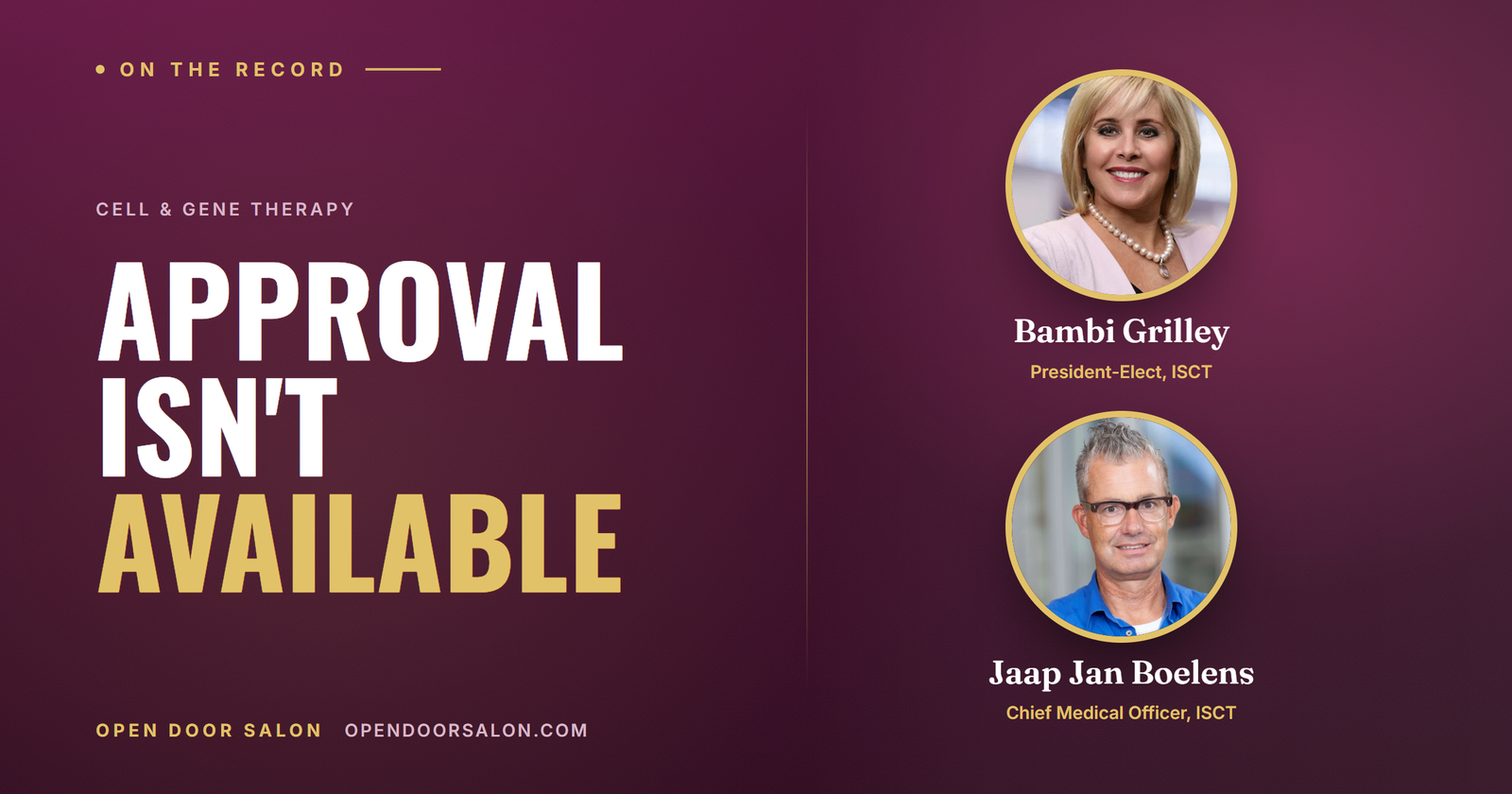
Regulatory approval is supposed to be the finish line. In cell and gene therapy it is closer to a starting gun, and the reason approved gene therapies still aren't available to patients has almost nothing to do with the science. It comes down to two things that happen after the FDA says yes: manufacturing these products at scale, and getting anyone reimbursed for them. Bambi Grilley, President-Elect of the International Society for Cell and Gene Therapy (ISCT), has watched approved products stall on exactly that gap. In her conversation with Open Door Salon alongside ISCT Chief Medical Officer Jaap Jan Boelens, she was blunt about it.
We have multiple examples in the cell and gene therapy space of products that received regulatory approvals but never became available to patients.
Why doesn't regulatory approval mean a gene therapy is available?
Because approval and availability are two separate fights, and most of the field is still braced for the first one when the second arrives. Grilley said companies coming out of the ISCT meeting in Dublin kept describing the same sequence: win the approval, then discover the harder problem is everything downstream of it.
A lot of the companies are actually saying the first part of the battle is regulatory, the second part of the battle is reimbursement and related patient access.
That reframing matters because the two battles need different tools. Clearing a trial and satisfying a regulator is a scientific and evidentiary problem. Getting a bespoke, refrigerated, million-dollar product into an ordinary hospital and paid for is a logistics and finance problem. A company can win the first decisively and still never treat a patient at volume.
How does manufacturing at scale delay access?
Cell and gene therapies don't ship like ordinary drugs, so the supply chain that works for a pill collapses when you try to stretch it nationwide. Trials win approval on small patient numbers routed to a handful of expert sites; going from that to a product available everywhere is a manufacturing problem, not a paperwork one. Grilley walked through why that scale-up is so slow.
These are not just pills that you put in a bottle and you ship over to another country. These are usually bespoke products for specific patients. Even if they're not bespoke, they still have to be stored at a certain temperature to be viable. There's a lot going on there that makes the whole manufacturing process and making it to scale very difficult.
Referral systems can funnel early patients to a few centers that know how to handle the product. But turning a therapy approved for a small cohort into one a hospital in any state can order, store, and administer is its own multi-year build, and it runs in parallel with the reimbursement problem rather than before it.
Why do so few sickle cell patients get an approved therapy?
Because approval on paper hasn't translated into treated patients on the ground, and sickle cell is the clearest example. There are approved cell and gene therapies for sickle cell disease and a large eligible population in the US, yet the number actually treated remains small. Grilley used it as the case that makes the access gap impossible to wave away.
We have several products approved for sickle cell anemia... and yet we have a fairly low trickle of patients who have received cell and gene therapy products.
She traced the trickle to the same stack of issues: manufacturing capacity, hospitals that have to be set up and ready to take those patients, and reimbursement decisions sitting on top of all of it. It echoes what Charles River's Matthew Hewitt and L.E.K.'s Jeff Holder documented in the "20% gap" conversation: eligibility is not the same as access, and the drop-off between the two is where the promise leaks out.
What happens if the field can't solve access?
The therapies stop being viable products, no matter how well they work. This is the part Grilley keeps returning to, and she frames it not as a commercial inconvenience but as a survival question for the whole field.
This is really an existential threat to cell and gene therapy, because if we can't solve this, these products are not viable.
Her logic is uncomfortably simple. If a field can cure sickle cell and still can't get the cure to patients more than a year after approval, investors notice, funding tightens, and the science stops mattering because the market isn't there to support it. The cost of a therapy, covered separately in why cell and gene therapy is so expensive, is only half the story; the reimbursement timing that strands a hospital for a year is the other half, taken up in why gene therapy reimbursement takes so long.
None of this is an argument against the science. It is an argument that the science is no longer the binding constraint. On the record, from someone who has worked the lab-to-clinic side of this field for nearly three decades, the message is that approval is where the real work starts. Boelens takes the same argument down to the individual patient, on what a single-case agreement is and why it decides who gets treated. The version of this field that removes the manufacturing step is not close either: Boelens puts in vivo gene therapy for genetic disease more than a decade out. Sponsors and health systems that want to be part of solving it can work with Open Door Salon or learn more about the field's own effort at ISCT. There is also a harder edge to unavailability: Grilley and Boelens on what families risk when they go abroad for an unproven therapy instead.
This piece is drawn from the recorded, on-the-record Open Door Salon conversation with Bambi Grilley and Jaap Jan Boelens of ISCT. For background on approved sickle cell gene therapies and their real-world uptake, see the FDA's 2023 approval of the first sickle cell gene therapies.