
Can a Digital Twin Replace a Patient in a Clinical Trial?
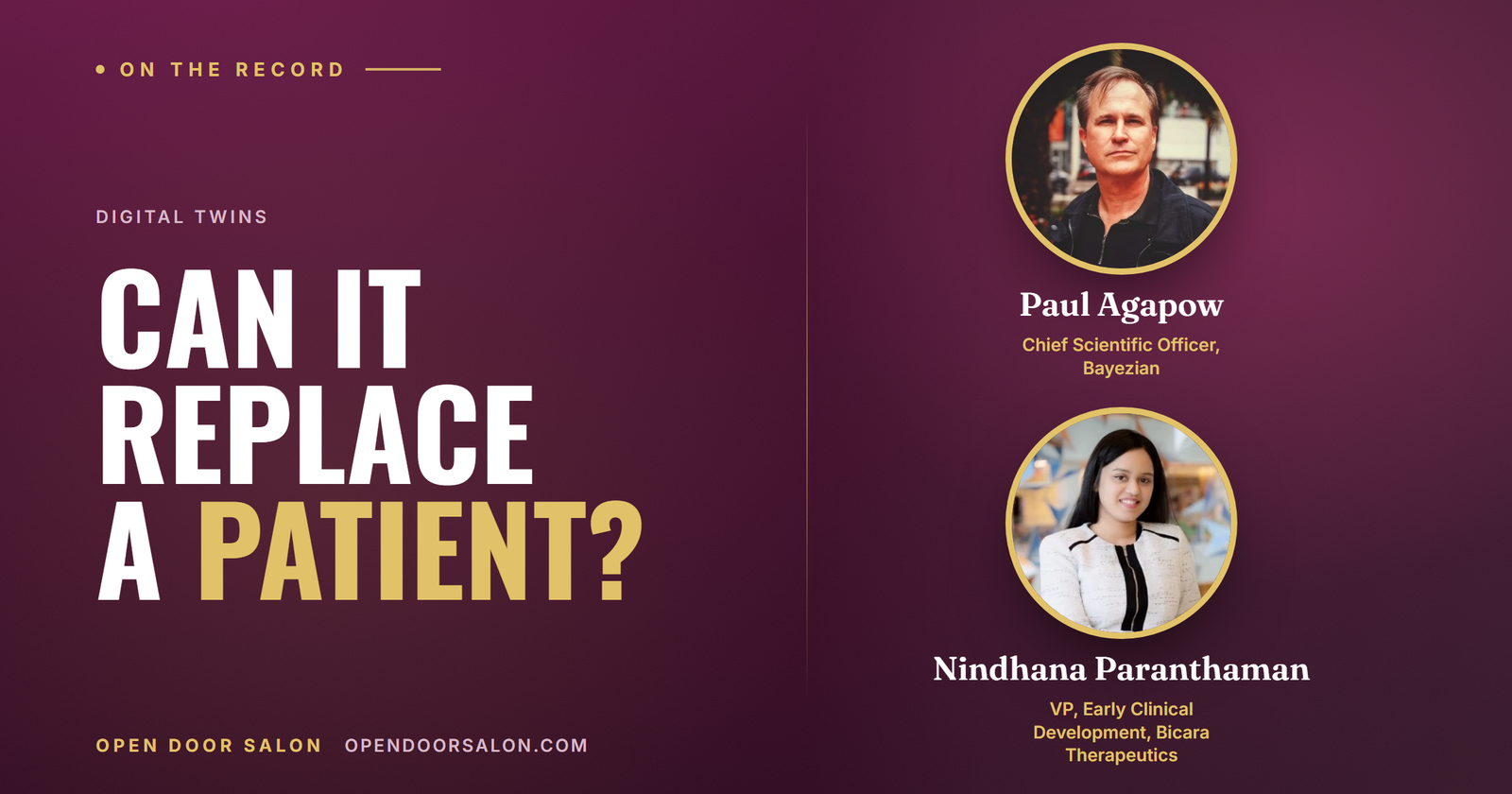
No. A digital twin cannot replace a patient in a clinical trial, and the reason is logical. A twin is a working replica of a process you already understand. A randomized trial exists because there is something you do not understand and want to prove. Better models do not close that gap, because the gap is not about model quality.
That was the answer Paul Agapow, chief scientific officer at Bayezian, gave when the question came up on Open Door Salon, in conversation with Nindhana Paranthaman, VP of early clinical development at Bicara Therapeutics. Both work on AI inside drug development, and neither is hostile to the technology. They still landed on a clear no, with a narrower yes underneath it that is worth understanding, because the narrow version is where the real opportunity sits.
What is a digital twin, and where did the idea come from?
The term arrived in biology from industrial process engineering. There, a digital twin is a mechanistic replica of something like a production line: you build a model of the real process, then interrogate it. Change this input, and what happens three steps downstream? Because the underlying process is fully understood, the replica can answer.
In biology the word has been stretched to cover much weaker things. Simulation. Predictive models trained on historical data. Counterfactuals. Agapow's objection is that the borrowed word carries authority the underlying method has not earned. The deeper reason biology resists that kind of modeling is set out in why biology is hard for AI.
They're using a strong claim to bolster up a weak claim.
That matters commercially, because the strength of the word is doing work in the sales conversation that the model itself cannot do.
Why can't a digital twin replace a trial patient?
The objection is structural. Agapow puts the definition and the problem in the same sentence.
A digital twin is a copy of a process that we do know and we understand perfectly.
A randomized clinical trial is the opposite instrument. It exists precisely because the effect of an intervention is unknown, and the trial is the mechanism for finding out. Substituting a replica of a known process for an experiment about an unknown one does not shorten the work; it removes the part that was generating the evidence.
Agapow is blunt about the version of the claim that circulates most.
We won't need patients, or we won't need as many patients ... And this idea is almost entirely wrongheaded.
Are the digital twins in press releases actually twins?
Often not. Agapow notes that a good deal of what is announced as a twin is a predictive model doing a narrower job, including work in the Alzheimer's space aimed at steering decisions on a particular asset.
AI models ... which have been called twins in their press releases.
This is a practical filter for anyone evaluating a vendor. Ask what the system actually models, what data it was trained on, and whether the claim is mechanistic or statistical. A model that predicts an outcome from historical data can be genuinely useful and still not be a twin in the sense the word implies.
Where could digital twins genuinely help?
Paranthaman does not dismiss the category, and her version is narrower and more plausible. She sees the opening in early-phase safety work, where modeled signals could supplement generated data and reduce how many patients are exposed to a therapy that may carry risk without benefit.
Maybe there is some value in ... introducing this ... especially with regards to trying to identify ... safety signals ... with new drugs, and supplementing data that we're generating in early phase ... studies.
The distinction she is drawing is between supplementing evidence and replacing it. A model that helps you decide which signals deserve attention is doing a different job from a model asked to stand in for a person. Paranthaman's other candidate for that kind of job is protocol design, covered in how to reduce protocol amendments in clinical trials.
What about synthetic control arms in rare disease?
This is the strongest case either guest makes, and it comes from the practical reality of small populations.
Especially in the context of rare diseases or rare ... cancer types ... where perhaps patients don't want to go on a control arm.
When eligible patients are scarce and few want to be randomized to a control, a synthetic comparator built from existing data can make a study feasible that otherwise is not. Regulators have engaged with the underlying approach: the FDA's draft guidance on the design and conduct of externally controlled trials sets out when an external control group can support a submission and the conditions that make one credible.
Agapow agrees there is an opportunity here, with a boundary attached.
We cannot ... really in any sense put a twin into the trial phase, into the clinical phase.
So where does that leave the question?
Both guests end up in roughly the same place by different routes. The opportunity comes before a trial: sharpening which questions get asked, which signals get chased, and which studies are worth running at all. What neither of them sees is a model standing in for a person in the study that produces the evidence. The same two guests also traced where capital goes once one approach shows a result, in why biotechs chase the same drug target.
They did not resolve where exactly the boundary falls, and that is honest. Synthetic control arms in rare disease are being used and studied; a twin substituting for a trial patient is not a near-term proposition. The useful question for an operator is not whether twins are real, but which of the two things a given vendor is actually selling.
This piece is drawn from the recorded, on-the-record conversation with Paul Agapow and Nindhana Paranthaman on what AI actually delivered in clinical development. Related reading on how AI failures surface late in biotech work: why AI errors in biotech take months to find, and on where trial timelines actually bind, whether the FDA is the clinical trial bottleneck. If your organization wants to reach the people making these calls inside drug development, that conversation starts here.